
The Invisible Archive in the Fibers
You find it hanging on a crowded rack, a bolt of emerald silk whispering of a different era. The cut is perfect, the beading intricate. Then you lift it, bring it close, and the smell hits you. That dense, sweetly sour, unmistakable odor.
It’s not just a smell; it’s a biography written in microbial ink. The musty scent on vintage clothes is not the fabric decaying, but the ghost of its past life, a chemical echo left by tiny organisms. Specifically, they are microbial volatile organic compounds, or mVOCs.
These are the metabolic byproducts of bacteria and mildew that thrived on the residual sweat, skin cells, and body oils deposited on the garment, often during storage in damp conditions above 65% relative humidity. Their signatures include compounds like butanoic acid and dimethyl sulphides, creating that complex, stubborn perfume of the thrift-store rack.
For the sturdy cotton shirt, this is a simple hurdle. For the unwashable artifact-the beaded 1920s flapper dress, the structured 1960s power blazer with its fragile interlining, the silk chiffon gown-this scent is the final guardian. You cannot simply toss it in a machine. More step-by-step care walkthroughs live in our Vintage Guides.
Modernizing vintage clothes often means confronting this invisible archive head-on, with a plan that prioritizes preservation over haste. The goal is to respect the object’s history while clearing the air for its next chapter.
The First Rule: Do No Harm
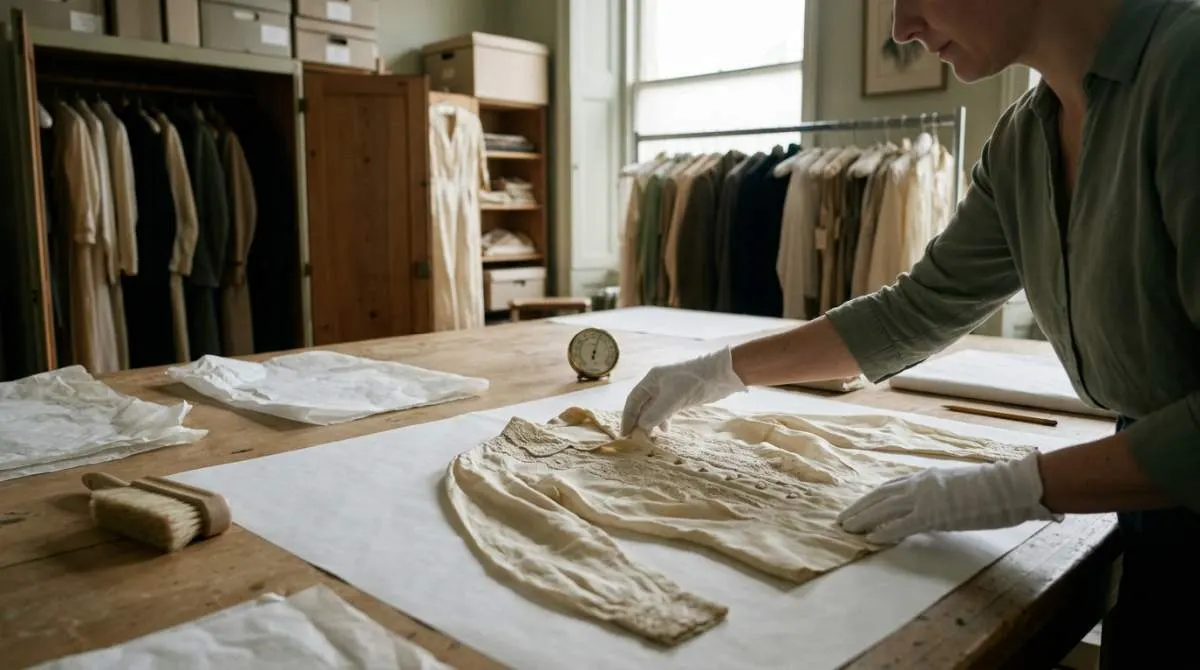
Before you even think about sprays or potions, the safest and most overlooked step is pure air. For any vintage piece older than 1970, or anything with beading, sequins, fragile silk, or leather trim, start by simply letting it breathe. Find a well-ventilated spot in indirect shade-never direct sunlight, which will fade delicate dyes and weaken protein fibers like silk and wool over time. Hang the garment on a padded hanger and let the air circulate around it for at least 24 hours.

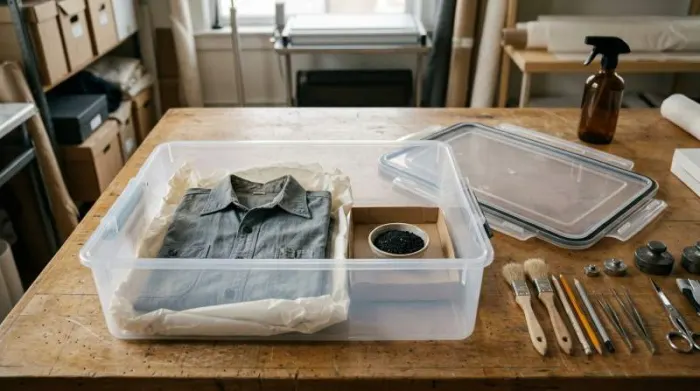
This passive method can surprisingly lessen superficial odors. If the smell persists, the next safest intervention is a dry absorbent. For truly delicate vintage, experts recommend placing the garment in a sealed container or bag with a cotton sack of activated charcoal or even plain baking soda for about 72 hours.
The absorbent pulls moisture and odor molecules from the fibers without introducing any liquid risk. This is the crucial pre-cleanse, especially for pieces where the next steps carry their own dangers.
Because here is where the common online advice fails. Lists will tout white vinegar or vodka sprays as cure-alls. And they can work, but with catastrophic caveats for vintage. The alcohol in high-proof vodka, even diluted, kills odor-causing microbes by dissolving their cell membranes and then evaporates odorlessly.
Behind the Scene · Fictional Simulation
The Dress That Wouldn't Forget
Ruthie Alvarez is a nineteen-year-old steam presser and stock assistant at a secondhand dress shop in the summer of 1973.
The back room smelled of hot metal and old wool, and the bulb over the pressing table buzzed like a trapped fly. I worked the nozzle down the bodice of a beaded silk crepe dress, watching the steam rise and vanish into the dark. Sequins clicked under my thumb. The gown had come in that morning from a house clearance, and the owner wanted it on the rack by opening. Every pass of steam lifted the creases, and every time the fabric cooled, the musty smell crept back like something breathing out.
I turned the dress inside out and found a small paper tag stitched into the side seam, the ink faded to a grey whisper. Under the arm, the lining had been mended by hand, tiny uneven stitches in a thread that no longer matched. I pressed my palm flat against the silk and held it there until the warmth left my skin, and the smell came up through my fingers, faint and sweet, like a drawer opened after years. The bulb flickered once and steadied.
A fictional scene written for this article — not a real account.
It’s a trick from the costume industry. Yet that same alcohol can act as a solvent on certain semi-synthetics.
- Vodka on Acetate: The alcohol can actually dissolve acetate fibers, causing permanent dull spots or a rough, melted texture on common vintage jacket linings.
- Vinegar on Semi-Synthetics: Its acidity can cause discoloration and gradual fiber breakdown in acetate and rayon, again targeting those hidden linings.
- Agitation on Wool: Vintage wool from the 1960s and 1970s can felt irreversibly with machine agitation; the structure is lost forever.
- Steam on Embellishments: Steam should never be used on beaded silk, fragile lace, or velvet with a disintegrating pile, as it can loosen adhesives and distort the fabric.
A Hierarchy of Safety, From Air to Absorbents
So what do you actually do? The process is a ladder, and you stop as soon as the odor is gone. Always test any method on a hidden seam first, like inside a cuff or facing. Step one is always airing out in indirect shade.
Step two is the dry absorbent in a sealed environment. If the mustiness remains, you might cautiously move to a very light, misted application of a diluted vodka solution (one part water to one part 80+ proof vodka) on natural fibers like sturdy cotton or linen, avoiding any acetate linings or trim.
Spray lightly from a distance, let it dry completely, and repeat only if necessary. For a fragile silk blouse or a dress with intricate vintage fashion styling, you may never get past step two, and that’s okay. The aim is to reduce the odor to a tolerable level, not to sterilize it into smelling like a new garment.
The scent of its age, when separated from the funk of mildew, can be part of its charm. It’s the difference between the smell of an old book and the smell of a flooded basement.
This cautious approach honors the object’s integrity. That 1970s silk kimono with its hand-rolled hems wasn’t made for our modern arsenal of chemical cleaners. Its beauty is tied to its vulnerability.
Using harsh methods risks what we love most-the delicate hand of the fabric, the subtlety of a aged dye. It’s a lesson in patience, in accepting that some histories are woven in too deeply to be fully erased without collateral damage.
Why the Smell Still Matters
In the end, that musty odor is more than a problem to solve; it’s a testament. It’s proof of the garment’s survival through attics, basements, and decades of changing climates. Each attempt to remove it responsibly is an act of conservation, a dialogue between the past’s craftsmanship and the present’s care. When you successfully integrate a vintage piece into your wardrobe-pairing a 1950s prom dress styling with minimalist trainers, or balancing the dramatic shoulder balance of an 80s blazer with sleek trousers-you’re not just wearing old clothes.
You’re continuing a story. You’re clearing the air, literally, for its next act. The faint, clean scent it retains (or the gentle absence of the former funk) becomes part of your own story with it. The careful removal of that thrift-store smell isn’t just housekeeping. For help weaving finds like this into a modern wardrobe, see our vintage styling guide.
It’s the first, essential step in a sustainable fashion history, granting a beautiful object another lifetime of use without rewriting the fragile text of its origins. The smell is the ghost; you are simply learning how to live with it, respectfully.
Why do vintage clothes smell musty
The musty scent is often linked to a compound called geosmin, released by bacteria breaking down organic matter in damp storage. It's the same earthy smell you get after rain, but concentrated in fibers. In the 1940s, department stores even used cedar-lined rooms to naturally absorb odors from stored garments.