
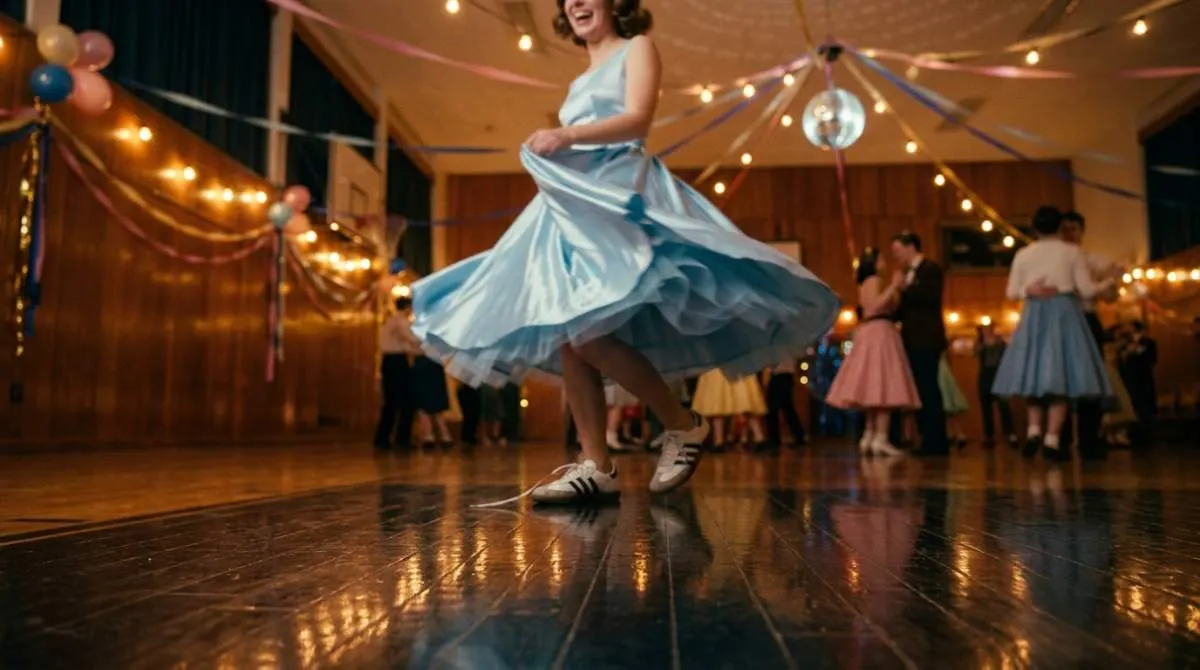
The 1950s Prom Dress: A Cage of Satin and Tulle
Picture a high school gymnasium in 1955, transformed for one night into a shimmering stage. This was the prom, a ritual far more about performance than party. For the girls, the uniform was armor: layers of pastel tulle, stiff satin, and crinoline that rustled with every step. A corsage was pinned just so, white gloves signaled decorum, and heels pinched toes all night long. It was a world of rigid perfection, where every detail was a silent testament to middle-class aspiration and social codes that felt as unyielding as the dress's boned bodice.
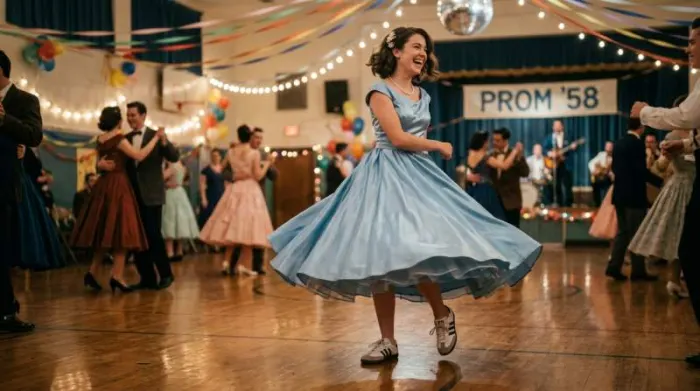
Yet, in the very same decade that demanded this level of formality, a different kind of icon was being born on the other side of the Atlantic. In 1950, Adidas introduced the Samba, a soccer training shoe built for stability on icy German fields. It was a brute of utility, designed for quick pivots and muddy pitches. The idea that these two worlds, the pristine ballroom and the gritty soccer terrace, would one day collide seems almost unthinkable. But that's exactly where the magic happens [1].
The Samba's Silent Design Trick
The genius of pairing a 1950s prom dress with an Adidas Samba lies in a detail most people overlook: the sole. The Samba's original gum rubber sole is famously flat and low-profile. Unlike a chunky sneaker that would visually overwhelm a delicate skirt, or a heel that would fight against its natural drape, the Samba sits almost invisibly close to the ground. It doesn't break the dress's elegant vertical line; it simply lets the fabric drop and flare as it was meant to [2].
This allows the full drama of the crinoline to arrive without the accompanying agony of pumps. The sneaker, in this context, plays a supporting role so perfectly it almost disappears. Vintage sneaker collectors and retro fashion enthusiasts prize this specific 1950s design for its authentic, understated profile. It's a design trick of quiet intelligence, letting the dress be the star while providing a foundation of pure comfort [3].
Breaking Barriers: Class, Comfort, and Confusion
When these two items finally met, the clash wasn't just aesthetic, it was social. The prom dress was a symbol of a very specific, aspirational world. The Adidas Samba, however, had a grittier pedigree. By the 1970s and 80s, it was the shoe of choice for British football casuals and street kids, a working-class badge of identity far removed from cotillion halls. Putting them together was a deliberate snub to the old social codes.
The wearer wasn't dressing up to impress the establishment; they were dressing up to confuse it. The dress's stiff bodice became a kind of ironic costume, while the Samba's iconic three stripes served as a knowing wink. The combination worked precisely because both pieces were designed to be noticed, but for entirely different reasons. One aimed for perfect, untouchable elegance; the other was built for anything but.
The Underground Legacy: From Runway to Brunch
This style clash didn't fade with the last dance. It went underground, becoming a secret handshake for the creatively inclined. In the early 2000s, you could spot it on indie sleaze bloggers who paired thrift-store formals with scuffed Sambas. Japanese street style magazines like FRUiTS regularly featured the exact juxtaposition, celebrating its non-conformist energy.
Mood Match
Four Moments from a Fifties Prom
Here are four moments from that night, each paired with the song that belongs to it.
Getting ready for prom in a borrowed dress
Ain't That a Shame by Fats Domino
You are nervous and the dress does not quite fit, and Fats Domino understands that kind of ache better than anyone.
Dancing in sneakers instead of heels
Rock Around the Clock by Bill Haley and His Comets
Nobody can stand still when that guitar starts, and your feet know it before your head does.
Sneaking out of the gym for fresh air
Maybellene by Chuck Berry
That song is all about running, and slipping out the side door feels like the same kind of escape.
Slow dancing under crepe paper streamers
Only you by The Platters
The Platters turn a crowded gym into something private, and you will remember the boy's name for years.
Play these in order and you have the whole evening, start to finish.
Songs checked against en.wikipedia.org.
The first major mainstream echo came from the runway. Designers like Miuccia Prada famously sent models down the catwalk in pristine, feminine dresses paired with clunky athletic shoes, causing the fashion world to gasp and then take notes. This high-fashion endorsement gave the look a new vocabulary, but its heart remained on the street.
Then, the trend got wonderfully practical. Vintage store owners began reporting a curious pattern: young women were buying the stiffest, most elaborate 1950s gowns, not for costume parties, but for everyday wear. The Samba solved the impossible physics of a party dress. Who can walk city blocks or dance freely in vintage heels? The sneaker allowed the wearer to own the dress, rather than letting the dress own them. It grounded the fantasy in reality, making a grand silhouette feel modern, active, and a little bit punk.
Why the Samba? The Emotional Logic of the Clash
One might wonder, why this specific shoe? Why not a sleek ballet flat or a tough combat boot? The answer lies in the Samba's unique aura. It carries a specific, low-key intelligence and a long history of sport and utility. It brings a dose of street-corner swagger to a fabric that whispers of ballrooms. The effect is a full cultural wink.
The wearer dons a gown that once signaled total formality and restraint. But the feet say they're ready to run for a subway, kick a can down the street, or change direction at a moment's notice. It creates a harmony of thrilling opposites. The visual drama of the dress is completely real, but the vibe is relaxed and self-assured. That tension is the secret sauce of the modern revival.
This revival has been powered in waves. The Samba's own resurgence in the 2020s owes a huge debt to the rediscovery of 1980s British terrace fashion, where it was a football fan essential. That subculture was later tapped by streetwear brands, putting the shoe back on the global radar. Each time a pop star steps onto a red carpet in a ball gown and sneakers, a new generation rediscovers the simple, revolutionary truth at the heart of this look: comfort and elegance aren't enemies. When paired with a dash of rebellion, they become the very best of friends.
The Era: Both 1950s prom dresses and Adidas Sambas first appeared in the 1950s. The Illusion: The Samba's flat sole keeps the dress's vertical line intact, no heels needed. The Reality: Pairing the two defied class barriers and social expectations. Modern Echo: The trend is back thanks to runway shows, street style, and pop stars in ball gowns with sneakers.
Why Adidas Sambas Are Popular Again
The Samba's 2020s revival owes a huge debt to the terrace fashion scene of 1980s Britain, where football fans wore them as a badge of identity. That subculture was later rediscovered by streetwear brands like Palace and Gosha Rubchinskiy, who put the shoe back on the runway. A working-class utility shoe became a global style icon.
Sources
- [1] The Accidental It-Shoe: How the adidas Samba, a 1950s Football Boot Became Fashion's Favorite Canvas - Droppedkick.com
- [2] Samba Sneakers: How a Football Classic Conquered the Fashion World
- [3] Adidas' Lacy Samba: Where Street Meets Ballet - DRIFT
Bracketed numbers in the text (e.g. [1]) refer to the sources listed here.