
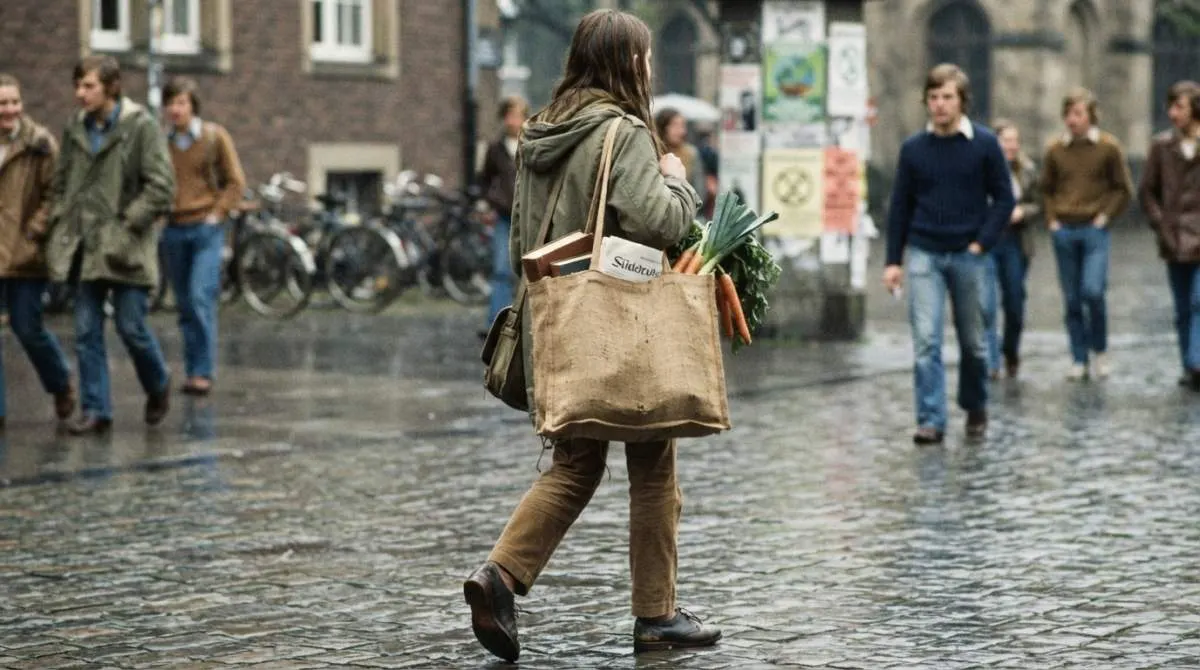
Picture the definitive accessory of late-1970s West German rebellion. It wasn’t a safety pin or a band t-shirt. It was a square of scratchy, slightly smelly brown fabric. The ‘Jute statt Plastik’ bag was a shopping tote, yes, but it was also a walking political billboard [1].
Its arrival in 1978 marked a moment when environmental worry and global solidarity crystallized into an object you could sling over your shoulder. This was the era of the German Autumn, with heightened political tensions, yet also the dawn of a new ecological consciousness that moved from fringe theory to mainstream concern [2].
It was intentionally, almost aggressively, non-glamorous. The jute was coarse against your skin. It had a distinct, earthy scent. This wasn’t an accident of production; it was part of the point [3].
In a society defined by the slick, synthetic comforts of the postwar economic miracle, this bag felt deliberately raw. It was a tactile rejection of the plastic it sought to replace, echoing a broader critique of consumerism that found voice in the writings of thinkers like Ivan Illich and Ernst Friedrich Schumacher, whose 1973 book ‘Small Is Beautiful’ argued for economics "as if people mattered."
1978: The Manifesto in a Bag
The campaign began that year, initiated by the fair trade organization GEPA (Gesellschaft zur Förderung der Partnerschaft mit der Dritten Welt) in Wuppertal. Founded just four years earlier in 1974 by church groups, GEPA was part of a nascent movement seeking to establish equitable trade relationships. They imported the bags, sewn in Bangladesh, and sold them for 1.50 Deutsche Mark each.
Mood Match
Four Moments, Four Songs
Here is how it works: find your moment, play the song, and let the room change around you.
Sitting alone in a cold student room.
Is This Love by Bob Marley & The Wailers.
That easy, rolling warmth is the nearest thing to a radiator when the meter has run out and the walls are thin.
Arguing politics with your parents at dinner.
What Do I Get? by Buzzcocks
It says everything you are too polite to say across the table, and it says it in under three minutes.
Cycling to a demo with friends.
Promised Land by Bruce Springsteen.
All that forward motion suits a pack of you on bikes, certain the world is about to be rearranged by lunchtime.
Dancing in a crowded basement club.
Le Freak by Chic
The bassline does the work for you, and nobody in that sweaty little room is standing still by the chorus.
Play them in order and you have a whole decade in four songs.
Songs checked against en.wikipedia.org.
The idea fused two growing anxieties of the era. The first was the environmental blight of plastic waste, then becoming visible in parks and streets, spurred by early reports on the persistence of polymers in the environment. The second was a new consciousness about economic exploitation in the so-called Third World, fueled by the 1973 oil crisis and subsequent debates about global resource distribution.
Specifically, the bag aimed to provide income for women in Bangladesh affected by the collapse of the jute industry. The "golden fiber" had been a major export until synthetic substitutes devastated the market. So you weren’t just avoiding a plastic bag.
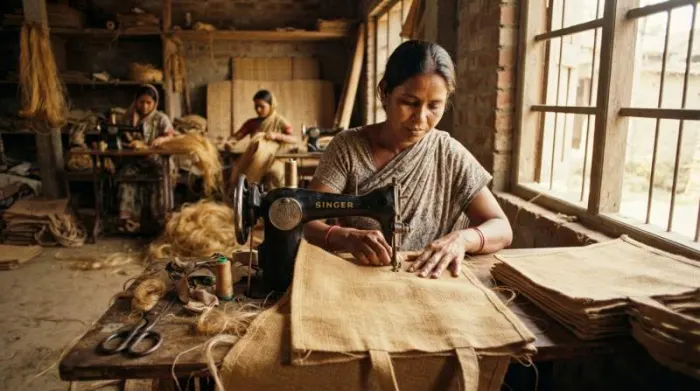
You were participating in a direct act of solidarity, a concept gaining traction through movements supporting liberation theology and anti-apartheid struggles. GEPA sold them through Third World shops (Dritte-Welt-Läden) and church groups, accompanied by educational leaflets explaining the interconnectedness of global trade and local environmental impact. The bag itself was the simplest possible vessel for a complex idea: your consumer choice could be ethical, a tangible application of the slogan "think globally, act locally."
The Peak: Five Million Statements
What followed was a cultural avalanche. Over the next decade, GEPA sold five million of these jute bags. They became ubiquitous at protests-such as the massive anti-nuclear demonstrations at Brokdorf and Wyhl-on university campuses, and in alternative living projects (Wohngemeinschaften).
The bag was the uniform for a generation that criticized the throwaway society (Wegwerfgesellschaft) and Western exploitation. It was, in essence, the accessory of the emerging Green Party (Die Grünen), founded in 1980, whose members often carried them to parliament.
Owners didn’t just carry it; they made it their own. The plain brown canvas became a backdrop for political customization. People stenciled or painted it with slogans like ‘Atomkraft Nein Danke’ (Nuclear Power? No Thanks) or ‘Frieden schaffen ohne Waffen’ (Create Peace Without Weapons), referencing the powerful peace movements opposing NATO's dual-track decision.
This practice turned a mass-produced item into a personal manifesto, a piece of vintage fashion that was less about aesthetics and more about declared allegiance, akin to the protest badges and patchwork jackets of the same scene.
Carrying this bag sent an immediate signal. It connected you to the peace movement, the anti-nuclear protests, and a whole alternative ecosystem of thought that included squats, organic food co-ops (Bio-Läden), and feminist collectives.
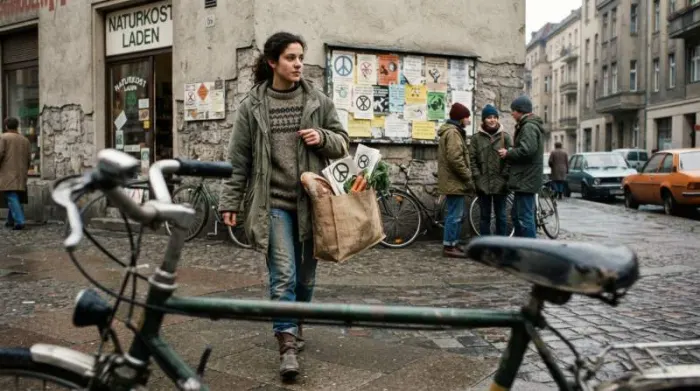
In that way, it functioned much like other iconic retro accessories of their times-a clear, non-verbal badge of identity. It was the opposite of discreet consumption; it was a banner worn in the supermarket aisles, a challenge to the prevailing culture of convenience.
- Material Truth: Its coarse texture and musty smell were celebrated as authentic, a rejection of synthetic falseness and a connection to a perceived pre-industrial simplicity.
- Political Canvas: The blank jute surface invited personalization with political slogans, making each bag unique and transforming shopping into a subtle act of street protest.
- Global Link: It physically connected a German shopper to a female worker in Bangladesh, making abstract solidarity tangible and prefiguring modern supply-chain transparency movements.
- Movement Symbol: It was adopted by the Greens and the entire alternative scene, becoming a visual shorthand for a set of values encompassing environmentalism, pacifism, and anti-capitalist critique.
The Fall: Relic of a Bygone Era
By the 1990s, the cultural tide had turned. The bag was now widely mocked as a clunky, unfashionable relic, a staple of comedy sketches parodying "öko" (eco-) types. The very qualities that once signaled authenticity-the scratchiness, the crude square cut-were now seen as dowdy and impractical.
The unified counterculture of the 80s had fragmented after German reunification, with attention shifting to eastern reconstruction and new social questions. Newer, softer cotton totes from mainstream retailers like Esprit or Benetton began to offer a more palatable, less politicized form of eco-consciousness, often stripped of the radical solidarity message.
The jute bag became a symbol of a past, perhaps overly earnest, era. It was the subject of gentle satire, a shorthand for a kind of granola-crunching idealism that no longer felt urgent in a post-Cold War, newly reunified Germany focused on globalization and digitalization.
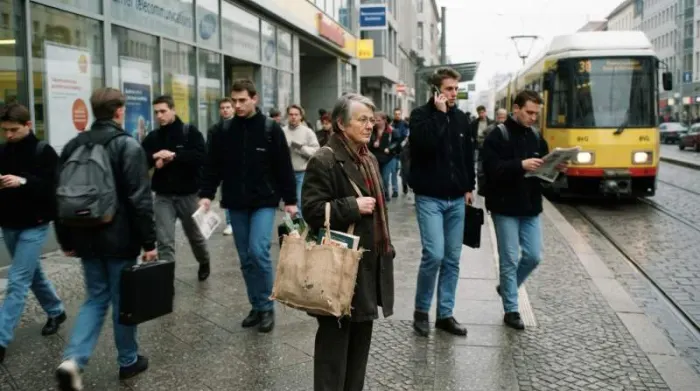
It was packed away in attics, a fashion faux pas that had outlived its moment. Its story mirrors how even the most potent symbols can be neutralized by time and shifting trends, their radical edges smoothed by commercial co-option and cultural fatigue.
A Quiet Legacy and Modern Echoes
Today, the original ‘Jute statt Plastik’ bag has settled into history. An example resides in the collection of the Deutsches Historisches Museum in Berlin, cataloged as an artifact of Alltagskultur (everyday culture) and political dissent. Authentic vintage pieces are now sought-after collectibles on auction sites, artifacts of a specific political moment.
The fair trade movement GEPA, of course, continues, and jute bags never truly disappeared from eco-shops, though they are now often lined or blended for comfort.
The bag’s legacy is twofold. First, it pioneered the model of the ethical shopping accessory as a mass-market statement, a path later followed by countless cotton totes and, arguably, the reusable bottle trend. It established a template where the object itself serves as an educational tool and a funding mechanism.
Second, it proved that an object could be a successful, widespread tool for political education and identity, creating a community of carriers recognizable to each other. Its journey-from urgent symbol, to mocked cliché, to museum piece-traces the arc of how a generation wore its politics on its sleeve, or rather, over its shoulder. In our current age of renewed eco-anxiety, climate strikes, and critical examination of fast fashion, its rough, musty ethos feels less like a quaint memory and more like a direct, coarse-threaded ancestor to today's conscious consumerism, reminding us that ethical choices were once worn with deliberate, uncomfortable pride.
Sources
- [1]40 Jahre Kampagne "Jute statt Plastik", Bewusstsein für ökologische Fragestellungen gestärkt
- [2]Problematising Plastic: A Visual Analysis of the ‘Jute not Plastic’ Campaign, 1976-1979 (Switzerland, Germany, Austria)
- [3]Gutes Gewissen II ǀ Quadratisch, praktisch, ökologisch, der Freitag
Bracketed numbers in the text (e.g. [1]) refer to the sources listed here.
What does jute statt plastik mean
It's German for 'jute instead of plastic'-a direct, punchy slogan that captured the 1970s shift from synthetic convenience to natural materials. The phrase was so catchy it became shorthand for an entire eco-conscious lifestyle, even inspiring a hit song by the German punk band Die Toten Hosen in the 1980s.