
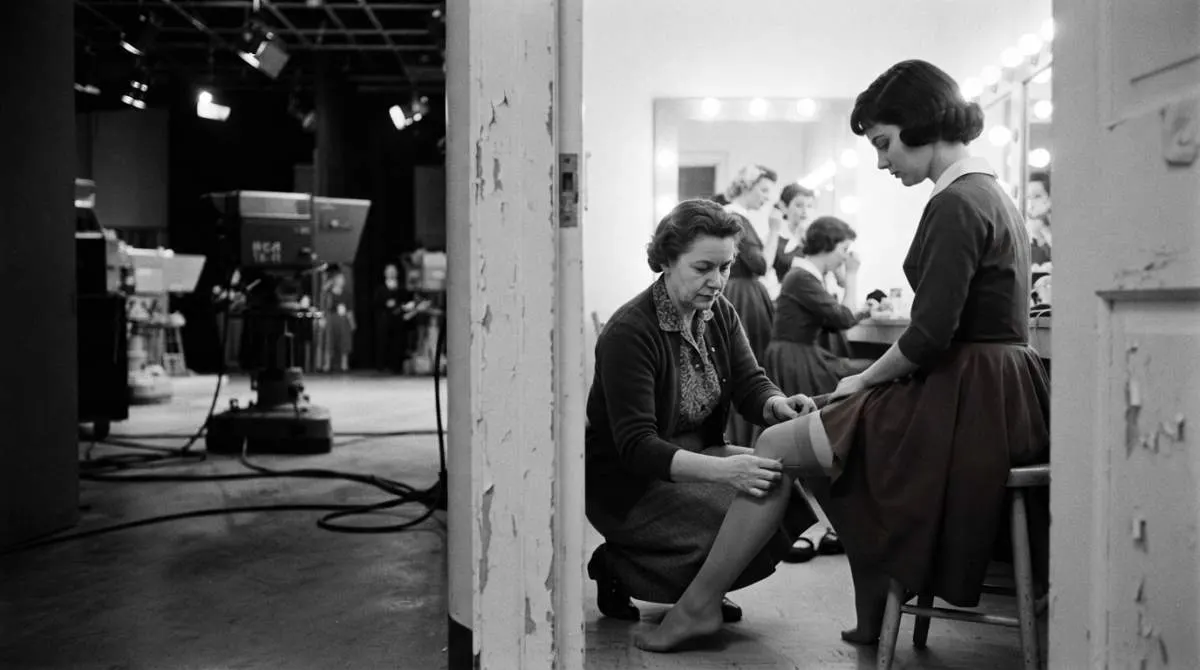
The letter arrived at the Ibici factory in Busto Arsizio sometime in 1969. It was handwritten, a direct request from a television performer preparing for the biggest show of her career. Raffaella Carrà was about to become the star of 'Canzonissima,' Rai's wildly popular Saturday night variety program.
She had a problem, and she needed a solution only a hosiery pioneer could provide.
Standard stockings, with their reinforced panties and heel seams, would wrinkle and sag under the spotlights. They would reveal themselves under her costumes, breaking the sleek line of a leg mid-kick.
For what she had planned, a performance of pure, televised energy, she needed something that would stay up invisibly. The Ibici company created a piece of precision engineering that would become a silent accomplice in one of Italian television's most famous scandals.
A Handwritten Request and a Custom Weave
Saverio Mayer, Ibici's co-founder and managing director, kept that letter as a prized memento. The request was specific: a low-waisted, micro-mesh stocking without a reinforced panty section and without a heel. The goal was complete invisibility and unwavering hold.
This was a direct challenge to the standard hosiery of the day, which often prioritized durability over aesthetics.
Ibici, founded a decade earlier, had built its reputation on transforming supportive stockings from a therapeutic product into an everyday, aesthetic accessory. Mayer's team got to work. They engineered the 'Modello Carrà' using a 70 denier elastic fiber and a custom weave.
The micro-mesh was key-a fine fishnet designed to maximize the visual appeal of legs under the harsh, defining gaze of television cameras.
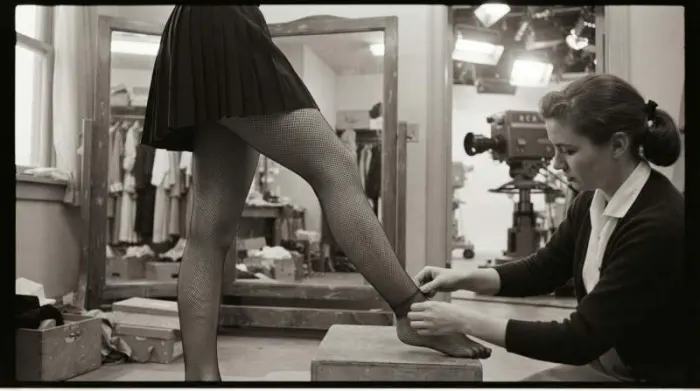
Fishnet stockings have a long, loaded history, often described as a 'revelation of flesh masked by coverage.' Here, that concept was refined for broadcast. The design eliminated any element that could create a visible line or cause a slip [1].
When Carrà and her dancers pulled them on, the stockings became a second skin, a sheer layer that highlighted movement without ever announcing its own presence.
- The request was for a low-waisted, micro-mesh stocking without a reinforced panty or heel.
- Ibici engineered the 'Modello Carrà' using a 70 denier elastic fiber and a custom weave.
- The design aimed for complete invisibility and unwavering hold under television lights.
- The stockings became a second skin for Carrà and her entire dance troupe.
On-Air and Under Scrutiny
Armed with her new secret weapon, Raffaella Carrà took to the 'Canzonissima' stage. Her 1969 and 1970 appearances were already pushing boundaries, featuring outfits that daringly exposed her navel. This alone was a provocation in a country where broadcasting standards were heavily influenced by conservative voices.
Her dance routines were energetic, precise, and demanded costumes that could keep up.
The 'Modello Carrà' performed flawlessly. It stayed in place through high kicks and complex choreography, ensuring the focus remained solely on Carrà's performance and not on any wardrobe malfunction. The success was so immediate that Ibici extended the design to her entire dance troupe.
The stockings became a backstage staple, an unspoken prerequisite for the visual spectacle Carrà was crafting.
Mood Match
Three Songs for the Evening Ahead
Here is how to line the right tune up with the moment you are in.
Getting ready for a Saturday night out
I Am a Woman by Peggy Lee
That smoky, self-possessed voice is the sound of a woman taking her time at the mirror, and it will do more for your posture than any girdle ever did.
Sewing a hem before a big night
Buon Natale Stock by Raffaella Carrà
Something bright and a little silly keeps the needle moving when your fingers are tired and the taxi is already on its way.
Hosting a retro-themed dinner party
Intensa estate Stock by Raffaella Carrà
It hums along underneath the chatter without ever demanding attention, which is exactly what a good host wants from a record.
Put the needle down, pour yourself something, and let the evening find its own pace.
Songs checked against .
Then, in 1971, she dialed the provocation up to its peak. She performed a new dance on 'Canzonissima' called 'Tuca Tuca.' Choreographed by Don Lurio and performed with dancer Enzo Paolo Turchi, it was a sequence of playful, intimate touches-knees, hips, shoulders, foreheads.
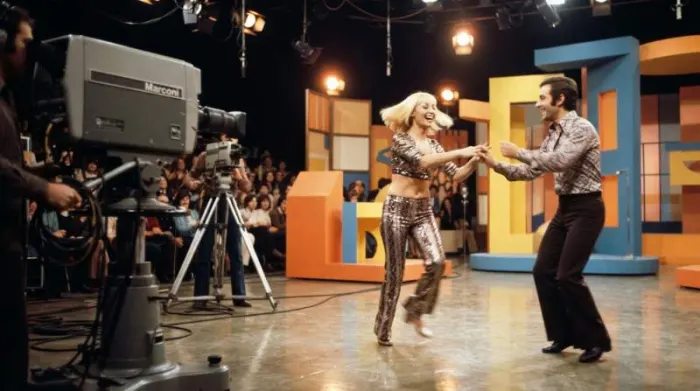
Carrà wore a tight outfit that, once again, left her midriff bare.
The reaction was immediate and volcanic. Hundreds of complaint calls flooded the broadcaster. The Vatican newspaper L'Osservatore Romano condemned it.
The dance was pulled from the air, deemed too scandalous for the national audience. It was a clear moment where popular entertainment collided with entrenched gender norms. The performance was only reinstated after popular actor Alberto Sordi intervened, insisting on performing it with Carrà himself on a later broadcast.
The Anatomy of a Scandal's Silhouette
To understand the full impact of 'Tuca Tuca,' you have to look past the dance moves and the exposed navel. The entire vintage silhouette Carrà presented was a calculated construction. Every element worked in concert.
The tight, abbreviated costume demanded a foundation garment that wouldn't intrude.
A visible panty line or a sagging stocking seam would have broken the fluidity of the choreography. It would have introduced a note of the practical, the mundane, into a performance meant to sparkle with pure, uninhibited fun [2].
The Ibici stockings provided that flawless foundation. They turned the leg into a single, uninterrupted line of motion.
This technical triumph didn't happen in a vacuum. It was part of a broader shift in fashion history, where undergarments stopped being purely functional and started enabling new forms of expression.
Consider the parallel rise of the 90s slip dress, which also relied on invisible underpinnings to achieve its effortless look. Or the earlier battles over pants prohibition for women, which were fundamentally about who controlled the silhouette.
What made the 'Modello Carrà' special was its hyper-specificity. It was designed for one person, for one context: vigorous television dancing. This focus resulted in a product that solved a problem no one had articulated so clearly before.
The Thread That Still Holds
The scandal of 'Tuca Tuca' faded, as scandals do, into legend. Raffaella Carrà's career soared, and she became an icon of Italian television. The Ibici company continued to innovate, growing to employ hundreds and offering thousands of product variants throughout the 1980s.

The 'Modello Carrà' itself eventually entered broader production, a sign of how well the design worked.
Yet the story of these stockings matters beyond a quirky footnote in vintage fashion. It's a case study in how a seemingly minor piece of clothing can enable a major cultural moment. The dance was the rebellion, but the hosiery was the enabler.
It provided the technical confidence for physical and sartorial risk-taking.
In an era where female performers were scrutinized for any hint of impropriety, controlling the narrative of one's own image was a subtle power. The perfect stocking was a tool in that arsenal. It wasn't about modesty; it was about precision.
It allowed Carrà to dictate exactly what the audience saw-the joy of the dance, the energy of the performance-and to eliminate any distracting imperfections.
Today, when we see a performer move with seemingly impossible grace in a demanding costume, there's likely a similar story of unseen engineering at work. The 'Modello Carrà' reminds us that fashion rebellion isn't always about the boldest statement on the surface. Sometimes, it's about the hidden innovation that makes the statement possible, the thread of technology woven quietly into the fabric of cultural change.
Sources
- [1]Addio Raffaella: Ibici a Busto aveva creato le calze "Modello Carrà" per i suoi balletti
- [2]Carramba che bellezza Se l'Ibici si salvasse
- [3]Carrà icona moda, dall'ombelico al caschetto
Bracketed numbers in the text (e.g. [1]) refer to the sources listed here.
Who invented the first seamless stockings that changed fashion forever?
In 1939, a chemist named Wallace Carothers at DuPont invented nylon, the first synthetic fiber, leading to the world's first seamless stockings. These stockings were a sensation, selling 64 million pairs in their first year on the market and revolutionizing hosiery forever [3].