
The Origins of Blondie's Name and a Common Misconception
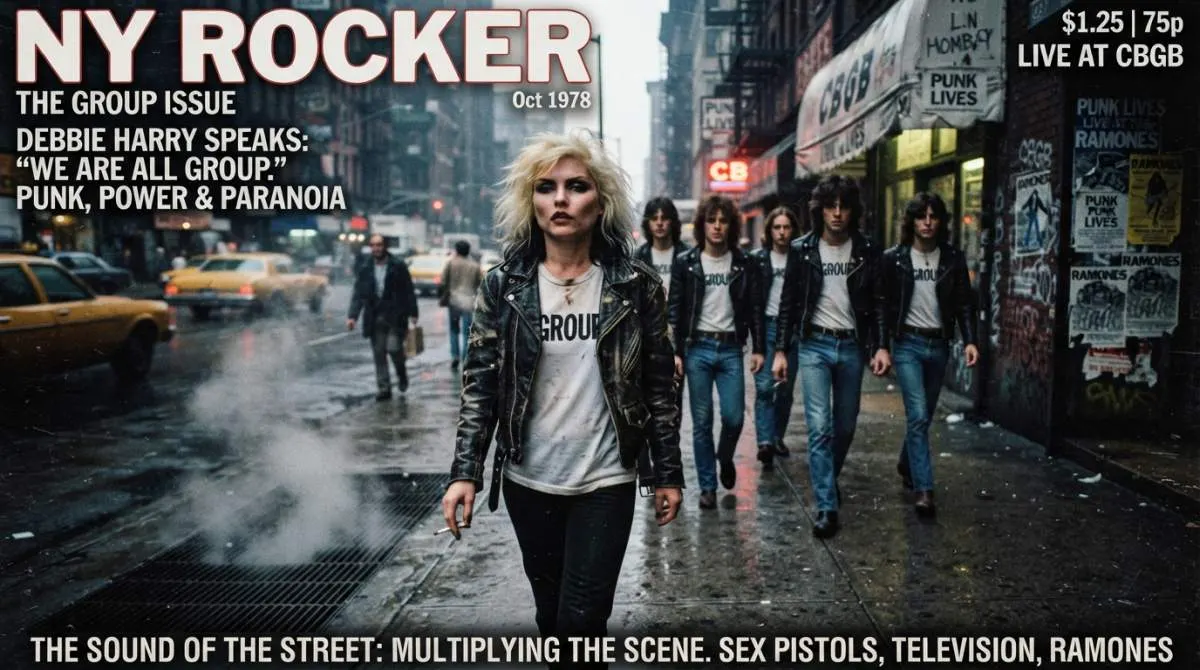
The band’s very name, Blondie, sowed the seeds of confusion from the start. It originated from the catcalls Debbie Harry received from truck drivers after she dyed her hair blonde, a slice of gritty New York street life that felt far from the polished solo act image soon thrust upon them. This origin story is deeply rooted in the mid-1970s Bowery and East Village punk scene, where Harry and guitarist Chris Stein emerged from the band The Stilettos and helped define the eclectic, art-infused sound of the seminal club CBGB [1].
Their first record label, Private Stock, saw immediate commercial potential in Harry’s striking look. For the 1976 debut album promo, they created a poster featuring a sexually suggestive image of Harry alone, which she felt exploited her and fundamentally misrepresented the collaborative unit behind the music. This tactic reflected a long-standing music industry practice of marketing bands with charismatic frontwomen as solo acts, a pattern seen with figures like Suzi Quatro or, later,Gwen Stefani and No Doubt.
This poster was the breaking point. Guitarist Chris Stein later confirmed the campaign was a direct response to such promotional tactics, stating plainly, “Anybody who knows our music knows we’re a group.” The internal tension was real; being perceived as a backing band for a star singer created friction [2].
This dynamic threatened to overshadow the contributions of keyboardist Jimmy Destri, drummer Clem Burke, bassist Gary Valentine, and later bassist Nigel Harrison. The need for a corrective statement became urgent, a way to reclaim their identity from a marketing department that saw only one salable face [3].
How the 'Blondie is a Group!' Campaign Launched in Print
In response, Private Stock itself launched the ‘Blondie is a group!’ campaign in the late 1970s. It was a rare instance of a label course-correcting its own earlier strategy, likely motivated by the band's growing influence and the risk of alienating the full ensemble.
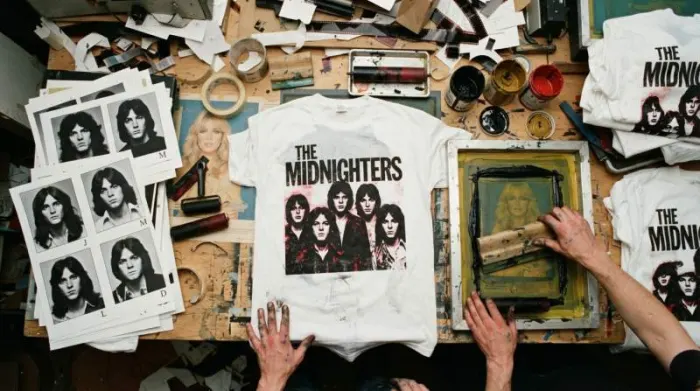
The classic design was brilliantly simple and impossible to ignore: the declarative slogan rendered in all-capital, hot pink letters on a stark black background. The color choice was culturally significant; hot pink, often associated with femininity, was here repurposed into a bold, unapologetic statement of collective identity. This wasn’t just a t-shirt; it was a walking press release, a piece of fashion history that carried a argument.
Debbie Harry has since referenced it as a “redo of a very old shirt that our first manager came up with,” acknowledging the idea had deeper roots. The merchandise became the cornerstone of their official gear-appearing on shirts, buttons, and posters.
It answered the persistent question simmering among new fans: what does the Blondie is a group shirt mean? It meant this was a band, a collective of six distinct musical personalities, not a solo vehicle. The shirt’s message directly countered a pervasive myth of the era-the false notion that the band’s name referenced Adolf Hitler's dog, a rumor Debbie Harry has repeatedly and explicitly debunked, tracing it back to the truck driver catcalls.
This era of band merch was evolving. Unlike generic logo tees, shirts like this delivered a direct, textual message, aligning with punk and new wave’s DIY ethos and the use of graphic design as protest.
Bands like the Ramones used their logo as a uniform, while The Clash’s merchandise often bore political slogans. Blondie’s shirt fit this context but was uniquely meta, commenting on the band’s own media construction. Merchandise became a medium for statements and reclaiming image from corporate control, making these shirts cultural artifacts. The campaign’s timing was impeccable, rolling out just as the band’s sound was crystallizing a blend of punk, pop, disco, and reggae that required a full band’s musicianship to execute.
Mood Match
Blondie for Every Mood
Pick the moment you are in, and let Debbie Harry do the rest.
Getting ready to go out on a Saturday night
Heart of Glass by Blondie
That cool, glittering beat is the sound of mascara going on and the night still being full of promise.
Standing up for yourself in an argument
One Way or Another by Blondie
It has just enough swagger to remind you that you do not have to be reasonable to be right.
Lacing up boots for a walk across town
Dreaming by Blondie
The drums push you forward at exactly the pace of a woman who knows where she is going.
Refusing to be reduced to one label
The Tide Is High by Blondie
It drifts between sweetness and steel, which is a fair description of most of us.
Four songs, one woman, and no apologies for any of it.
Songs checked against en.wikipedia.org.
The Campaign's Peak Success and the Band's Eventual Fracturing
The campaign was a resounding success. By the time of their 1978 international breakthrough with ‘Parallel Lines’, produced by Mike Chapman, the public widely recognized Blondie as a full band.
The infectious pop-rock of “Heart of Glass” and “One Way or Another” was undeniably a group effort, with Clem Burke’s powerhouse drums and Jimmy Destri’s keyboards as essential as Harry’s voice. The iconic shirt was everywhere, a badge of cool and a testament to their fashion rebellion against one-dimensional branding. It became synonymous with the new wave style that dominated the turn of the decade, often paired with ripped jeans, leather jackets, and plastic accessories.
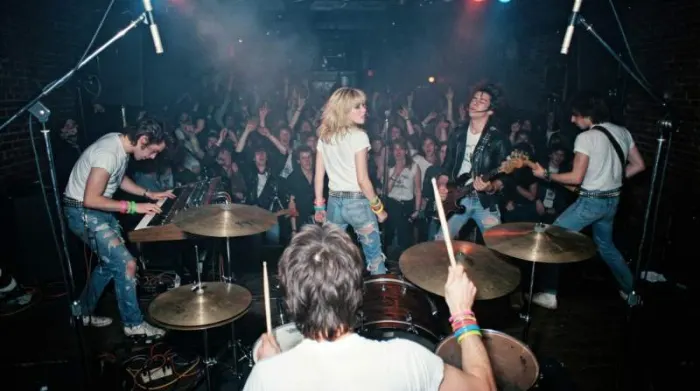
Early Blondie merchandise, once controversial, was now dominated by this corrective line. It adorned official tour shirts as they played to massive crowds worldwide, from the US to Europe and Australia.
Yet, the very fame that cemented their group identity also intensified pressures. The internal tensions partly fueled by the earlier public perception never fully dissipated, even after the campaign corrected the record. Financial disputes, creative differences, and the immense stress of global fame created rifts.
The band’s eventual hiatus in the early 1980s had complex causes, including Chris Stein’s serious illness and Debbie Harry’s solo pursuits, but the struggle over identity and credit was a lingering ghost. The shirt’s message had won in the public arena, but the personal and creative dynamics within the group faced other challenges.
For a time, the iconic black-and-pink tee faded from view, a relic of a specific, resolved battle, stored away as musical tastes shifted towards synth-pop and hair metal.
- The campaign was launched by their record label, Private Stock, to counter the solo-act misconception.
- It was directly prompted by Debbie Harry's anger over a sexualized solo poster for their debut album.
- The classic design featured hot pink, all-caps text on a black background.
- It succeeded in establishing Blondie as a recognized group by their 1978 breakthrough.
- The band's name came from street catcalls, debunking the myth it referenced Hitler's dog.
The Revival of Blondie's Vintage T-Shirts as Reissued Classics
So, where can you find vintage Blondie concert tees today? Original shirts from the late ‘70s and early ‘80s are coveted collectors’ items.
They surface on online resale marketplaces like Etsy, through dedicated vintage clothing dealers, and on auction sites, their prices a testament to their iconic status. The value hinges on factors like print quality, fabric wear, and the specificity of the tour dates listed on the back. The band’s own official store often sells modern reprints, feeding a continuous cycle of rediscovery by new generations of fans.
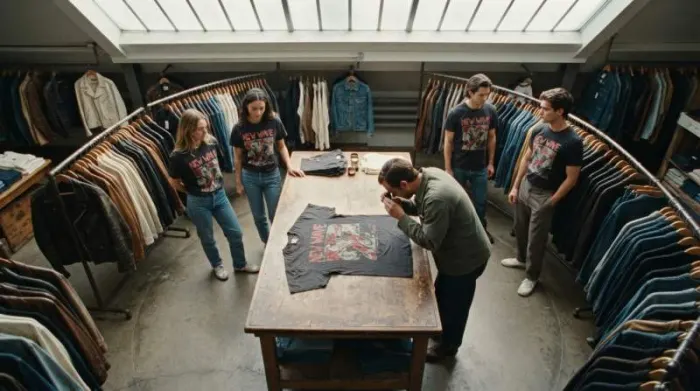
This revival isn’t just about nostalgia. The shirt’s clean, declarative design fits seamlessly into contemporary aesthetics, echoing the current appreciation for statement band merch and 1970s graphic design.
Its message about artistic collaboration resonates in an era more attuned to discussing credit and ownership in creative industries. Debbie Harry herself maintained a large personal archive of band t-shirts, including many featuring her portrait-a full-circle embrace of the image she once sought to contextualize, now viewed through the lens of her own agency. The shirt’s journey from corrective slogan to timeless icon mirrors broader trends in vintage fashion, where pieces with a authentic story and cultural resonance hold the most power.
The Lasting Legacy of Blondie's 'Group' T-Shirt Campaign
Today, the ‘Blondie is a group!’ shirt is more than a piece of music memorabilia. It’s a case study in image control, a symbol of a band asserting its collaborative truth against commercial simplification.
The message it broadcast is now a settled fact of rock history; no one questions Blondie’s status as a seminal group that helped bridge the gap between punk’s rebellion and mainstream pop. The shirt endures because its story is baked into the fabric-a story of artistic integrity, gendered perception in music, and a clever, lasting piece of communication. It prefigured later conversations about the branding of bands with female leads.
It stands as a prime example of how merchandise can transcend promotion to become narrative. In an era before social media, a t-shirt could serve as a direct channel to fans, correcting misconceptions and defining identity.
That hot pink statement on black cotton remains one of the most succinct and successful pieces of band mythology ever printed, a permanent footnote in 20th century history written in thread and ink. It encapsulates a specific moment when a band used the tools of commerce to make an artistic declaration, ensuring their legacy as a unit, not just a face.
Who designed the iconic Blondie t-shirt and what was their inspiration?
The shirt was dreamed up by a young graphic artist named Mary Jane, who was inspired by vintage pin-up posters and the bold, playful energy of New York's punk scene. She sketched the design on a napkin during a late-night diner meeting, never expecting it to become a global symbol of cool.