
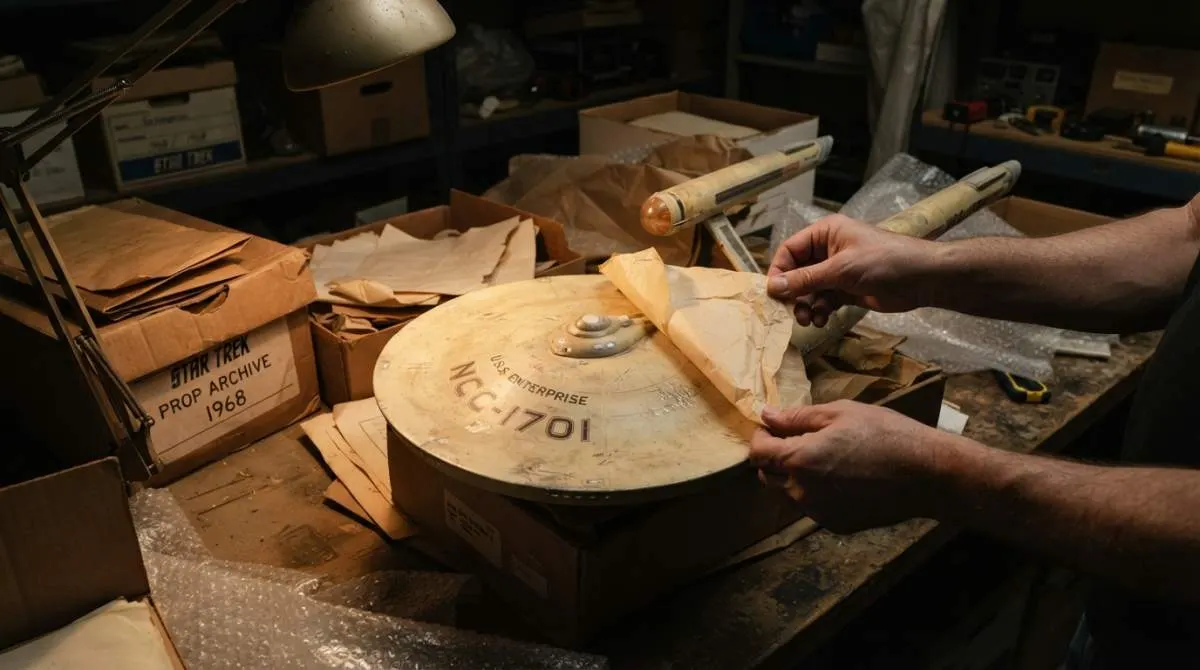
It began as a three-foot-long dream, assembled from wood, plastic, and wire. In a Hollywood model shop in 1964, craftsman Richard C. Datin Jr. painstakingly built the 33-inch "pilot model" of the USS Enterprise from production designer Matt Jefferies' now-iconic drawings. This wasn't just any prop; it was the physical embodiment of a five-year mission that hadn't yet aired.
Its sleek, utilitarian shape, with its distinctive saucer section and twin nacelles, was about to become the most famous silhouette in science fiction.
For three seasons, this specific model sailed across television screens in the opening credits of the original Star Trek series. It was the ship that promised to boldly go. After the show ended, creator Gene Roddenberry kept it close, a memento of what he'd built, displayed proudly on his desk.
It was a relic from the frontier, already taking on the aura of a sacred object.
Into the Void: The 45-Year Disappearance
The model's quiet retirement didn't last. In 1979, Roddenberry loaned it to Paramount Pictures for use in Star Trek: The Motion Picture, a grand return for both the franchise and its first vessel. It was a logical homecoming.
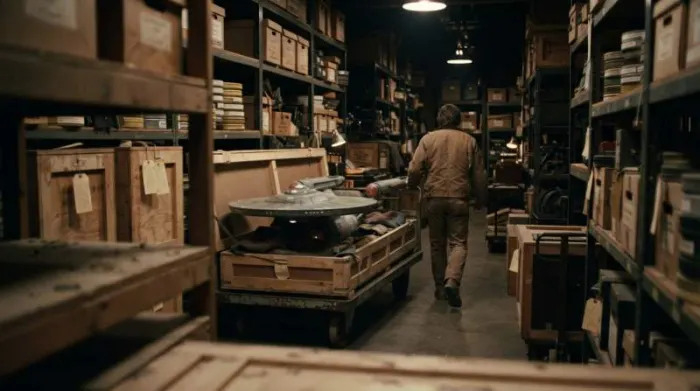
After the film wrapped, however, the Enterprise simply failed to return to base. It vanished from the records, slipping into a fog of studio storage and forgotten paperwork.
For forty-five years, its whereabouts were one of fandom's great unsolved mysteries. Had it been damaged? Discarded? Secretly tucked away in a private collection [1]?
The questions lingered in convention halls and online forums, a ghost story for trekkies. Meanwhile, the cultural revolution that the show helped spark-one of optimism, diversity, and technological curiosity-only grew, making the absence of its primary artifact more poignant.
The trail had gone utterly cold. It was as if the ship had actually warped away.
The eBay Alert: A Fan-Powered Recovery
The breakthrough came from the same communal, connected spirit the show championed. In 2023, a listing appeared on eBay. The photos were grainy, the description vague, but the shape was unmistakable to a trained eye.
Behind the Scene · Fictional Simulation
The Night Shift at the Model Shop
Frank Delgado, a twenty-seven-year-old model shop assistant in Burbank, California, in 1964.
The workbench lamp threw a hard yellow circle over the saucer, and the rest of the shop fell away into shadow. I had been sanding the rim for an hour, and my fingertips were numb. The nacelle struts were the real problem. They kept snapping off at the base, no matter how gently I set them. I could hear the radio playing low in the front room, some DJ talking over a song I did not know. The paint on the bridge dome was still tacky. I touched it with my thumb and left a print.
I found a spool of fine brass wire in the back drawer, the kind we used for antenna rigging. I cut two short lengths and threaded them through the strut mounts, twisting the ends tight. The struts held. I sat back and looked at the ship under the lamp. The wire caught the light like a tiny scaffold. Outside, a car passed and its headlights swept across the wall, then gone. I picked up the saucer again and started sanding.
A fictional scene written for this article — not a real account.
Someone had found the model in a storage unit and decided to sell it.
Sharp-eyed fans spotted it immediately, sounding the alarm across the digital culture of Star Trek fandom. The community mobilized, flagging the listing and connecting the dots.
The auction was swiftly taken down. The sellers, realizing they might have more than old junk, then contacted Heritage Auctions for proper authentication. The lost Enterprise had been found not by detectives or historians, but by the collective vigilance of its passengers.
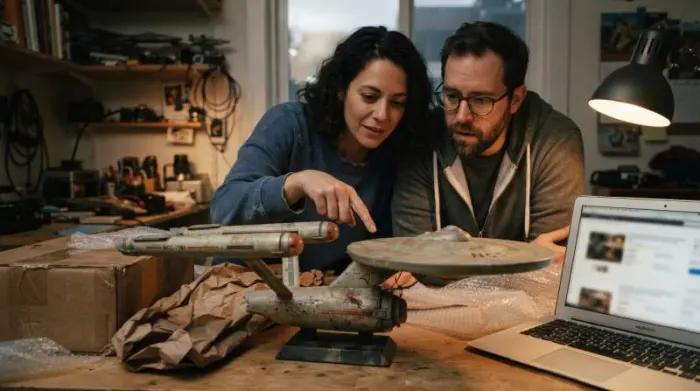
Its condition, however, told a story of a rough journey. The decades had not been kind. The model had suffered significant damage, including a broken neck connecting the saucer to the secondary hull and detached nacelles. It was a ship that had seen some literal battles [2].
Restoration and Return: Making It So
Once authenticated and returned to the Roddenberry family, the delicate work began. The family entrusted the model to restoration expert Lou Zudovny. His task was not to make it look new, but to heal it-to repair the structural damage without erasing the honest wear of its service.
This was conservation, not a reboot.
Zudovny carefully reattached the nacelles and reforged the ship's broken spine. The goal was stability and integrity, allowing the model to stand proud again as it did on Roddenberry's desk and on those mid-1960s soundstages. The restoration preserved every scratch and paint chip that spoke of its authentic history, its first life.
The project highlighted a fascinating tension in preserving nostalgic tech. Do you polish it to a gleaming, idealized state, or freeze its battered reality? The choice here was clear: honor the evidence of its real use. The restored Enterprise would carry its history visibly, a document of its own adventure.
- The Build: Constructed in 1964 by model maker Richard C. Datin Jr. from Matt Jefferies' plans, it was the primary filming model for the series' opening credits.
- The Vanishing Act: Loaned for 1979's The Motion Picture, it then disappeared from official records, sparking a 45-year mystery.
- The Digital Discovery: Found in a storage unit and listed on eBay in 2023, it was identified by the fan community, which halted the sale and triggered authentication.
- The Repair: Expert restorer Lou Zudovny fixed critical damage, including a broken neck and detached engine nacelles, stabilizing the model for display.
- The New Mission: Its first public exhibition in decades is slated for the MIT Museum, aligning with the franchise's 60th anniversary.
Final Frontier: A Museum at MIT
So, where is this once-lost artifact now? After its dramatic recovery and careful restoration, the Enterprise was charted for a final, fitting destination. It won't be housed in a traditional entertainment museum.
Instead, it's going to a place where science fiction and science fact are in constant conversation.
The model is scheduled for public display at the MIT Museum. The exhibition is set to open in late September 2026 and run through the following March. Its unveiling will coincide with the MIT Future Fest festival, a celebration of forward-looking ideas, and the 60th anniversary of Star Trek itself.
This is a profoundly resonant homecoming. The ship that inspired generations of engineers, physicists, and astronauts will sit in the heart of an institution that produces them. The display will inevitably prompt a dialogue between the mid-century model-making craftsmanship that built the fantasy and the cutting-edge research that strives to make such futures possible.
Why does this specific, battered piece of wood and plastic still matter so deeply? Its value long ago transcended its physical form. It is the original template, the first tangible iteration of an idea that became a universe. Its 45-year absence only deepened its myth, turning it from a prop into a legend with a missing act.
Its recovery is a modern parable. It speaks to the power of collective memory and passion, a mystery solved not by institutions but by the devoted. And its placement at MIT completes a circle.
The Enterprise is no longer just a television relic. It's a cultural emissary, docking at last in a port that understands its true mission: to inspire the next generation to look forward, to innovate, and to imagine a future worth building. The long journey home is over, and its real legacy is just beginning.
What happened to the original Star Trek Enterprise model?
Before it became a legend, the model was almost scrapped. In 1964, after filming the original pilot, the studio nearly discarded it, but a quick-thinking employee saved it from the trash heap. That close call makes its recent recovery all the more miraculous.
Sources
- [1] The Original Starship Enterprise Model Lands at MIT Museum—A Rare Star Trek Artifact Makes its First Public Appearance on the East Coast | MIT Museum
- [2] U.S.S. Enterprise Model, “Star Trek” | Smithsonian Institution
Bracketed numbers in the text (e.g. [1]) refer to the sources listed here.