
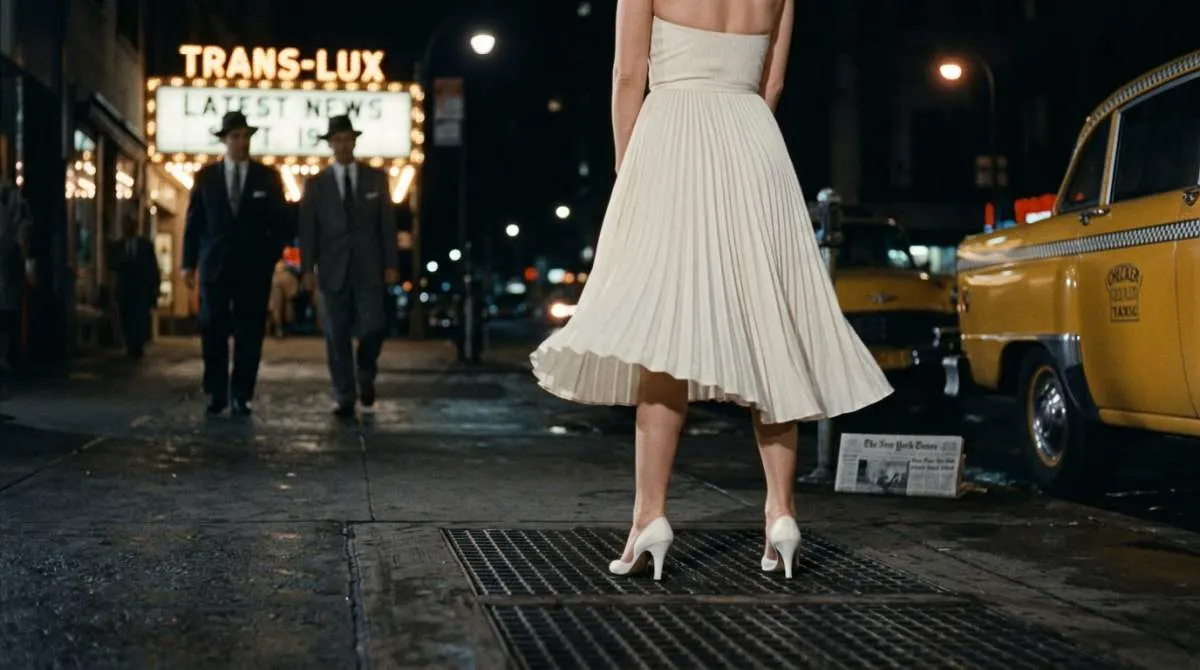
What Made the Subway Grate Scene So Electrifying?
One detail about the Marilyn Monroe white dress sticks with the viewer: not the glamour, but the specificity. The air was thick with hot pavement and cheap perfume. Summer hung in that moment, and everyone felt it.
The dress was airborne fabric, pure and simple.
The scene flickered on tiny black-and-white sets across America. The static buzzed, the image kept rolling. That dress stayed perfectly still in the cultural mind.
The country was buttoned up, but the seams were starting to strain.
On September 15, 1954, Monroe stood over a subway grate on Lexington Avenue in New York City, filming for The Seven Year Itch. A crowd of nearly 2,000 people gathered. Director Billy Wilder shot multiple takes to get the perfect lift. Police were called to control the onlookers. That night, footage made headlines before the film even premiered. The dress became a scandalous promise, a white flag of liberation in a gray decade.
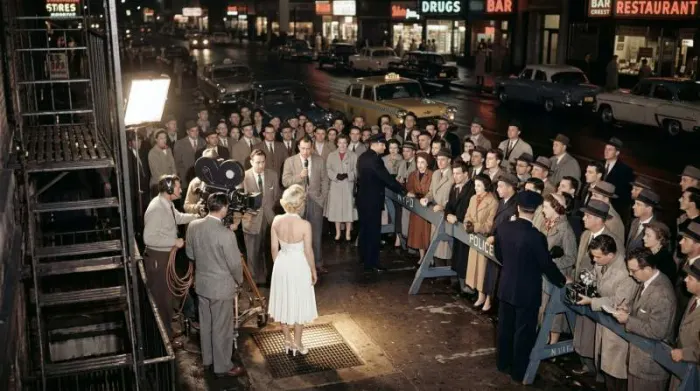
The scene was almost cut by censors. The Hays Code, which governed Hollywood morality, balked at the exposed legs and the implied wink. Wilder fought to keep it. The result was a cultural earthquake.
Women who had never worn a halter dress suddenly wanted one. The white dress was no longer just a garment. It was a gravity-defying object that rewrote the rules of desire.
How the White Dress Was Engineered to Defy Gravity
The dress was a sly piece of engineering. It looked like a simple summer thing. But it was built for a specific kind of chaos.
The Jersey and the Lift
The soufflé jersey was light but held its shape. The pleats were designed to trap air. When the wind hit, the skirt lifted like a curtain.
Designer William Travilla used over 50 yards of pleated soufflé jersey to construct the dress. The fabric was a custom weave from the French textile house Bianchini-Férier, chosen for its ability to billow without clinging. Travilla sewed lead fishing weights into the hemline at precise intervals, ensuring the skirt would snap back down after the gust. He learned this trick from theatrical costuming.
Underneath, Monroe wore a nude-colored underdress, not a slip, to avoid visible lines. The entire construction was controlled chaos. The dress had to look innocent while being ruthlessly engineered to steal a scene.
The real explosion was not on the screen. It was in the audience. People could not believe what they saw.
How the White Dress Became a Lasting Cultural Icon
That white dress has a longer life than most people. It left the subway grate and went straight into the culture machine.
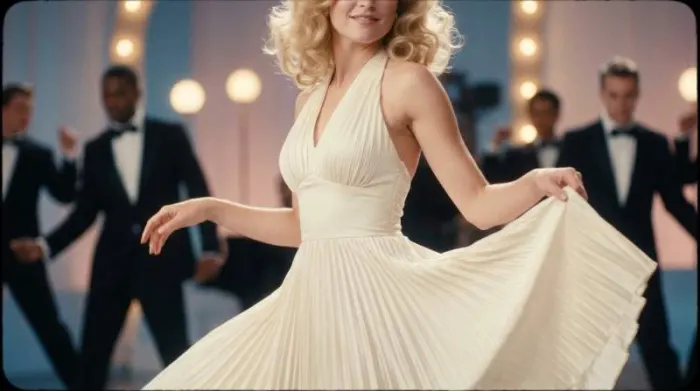
Madonna copied the pose for her "Material Girl" video in 1985. She wore a copy of the dress, but her attitude was pure ownership. She understood the trick. The dress is a prop.
Copycats and Critics
The dress became a uniform for confidence. Women wore white halter dresses to parties, to dates, to nothing special at all. They wanted that breeze.
Then men started wearing it. Drag queens made it a sacred garment.
The silhouette showed up on runways, but the real action was on the street. A woman in Brooklyn wore a white sundress with scuffed sneakers. She had no idea she was channeling history.
The Aftershock in Music and Film
- Gwen Stefani wore a white halter in the "Cool" video. It was a tribute, not a copy.
- Michelle Williams wore a white halter at the 2022 Met Gala. She called it a fantasy version of the dress.
- Every Halloween, someone in a white halter stands on a subway grate. The joke is still funny. The pose is still powerful.
The dress keeps showing up because it is simple. A white halter dress is not complicated. The person inside it makes the statement.
Quick Facts
- The Era:Filmed in 1954 with 2,000 onlookers and police.
- The Illusion:The dress looked innocent but was engineered to billow.
- The Reality:Lead weights and soufflé jersey created the controlled lift.
- Modern Echo:Madonna, Kardashian, and others recreated the pose.
That is why the image never fades. It is not about the fabric. It is about the nerve to stand there and let the wind do the talking.
In 2011, the original dress sold at auction for $4.6 million, cementing its status as one of the most valuable movie costumes ever. In 2022, Kim Kardashian wore the actual dress to the Met Gala after a controversial loan from the Ripley's Believe It or Not! museum. The dress was damaged, but the conversation proved that the power of that white fabric is still live.
How the White Dress Logic Lives On in Modern Fashion
The subway grate moment is not a museum piece. It is a living fashion reflex. Every woman in a white dress near a fan checks the hem, adjusts her posture, and smiles.

The ghost of that performance is still there.
But the real modern echo is not about owning the same dress. It is about owning the same logic. The logic of a dress that moves with you, not against you. A dress that reveals its shape only in motion.
The Dress That Works for Instead of Against
Today that logic survives in the swing dress. It is a cut that gives fabric its own voice. Designers lean into pleats, bias cuts, and airy cottons.
The goal is a silhouette that wakes up when one walks. It is a dress that does not demand a pose. It performs.
The best version appeared on a woman in a coffee shop. She wore a simple white shirtdress, nothing fancy. The fabric had weight and fell in clean lines. She moved fast, and the skirt kicked out just enough. It was not a costume. It was a practical choice that happened to look electric.
That is the secret of the subway dress. It is not a relic. It is a tool for how one wants to feel in a room.
The white color is secondary. The cut is everything.
Contemporary designers like Marc Jacobs and Dior have riffed on the silhouette. Marc Jacobs' spring 2020 collection featured a series of pleated white halter dresses that channeled the same airborne energy. On TikTok, the "subway grate challenge" went viral in 2023, with users recreating the pose in front of fans and air conditioners. White halter dresses remain a summer staple. Retailers report they are among the top-selling styles every June.
But the real revival is in the attitude: the willingness to let the fabric speak. That is the only logic worth keeping.
The modern revival is not about copying a scene. It is about understanding why that scene worked. The dress moved because the wearer was not afraid of the air. She let the wind do the styling. That attitude is the only thing worth reviving. It costs nothing. It changes everything.