
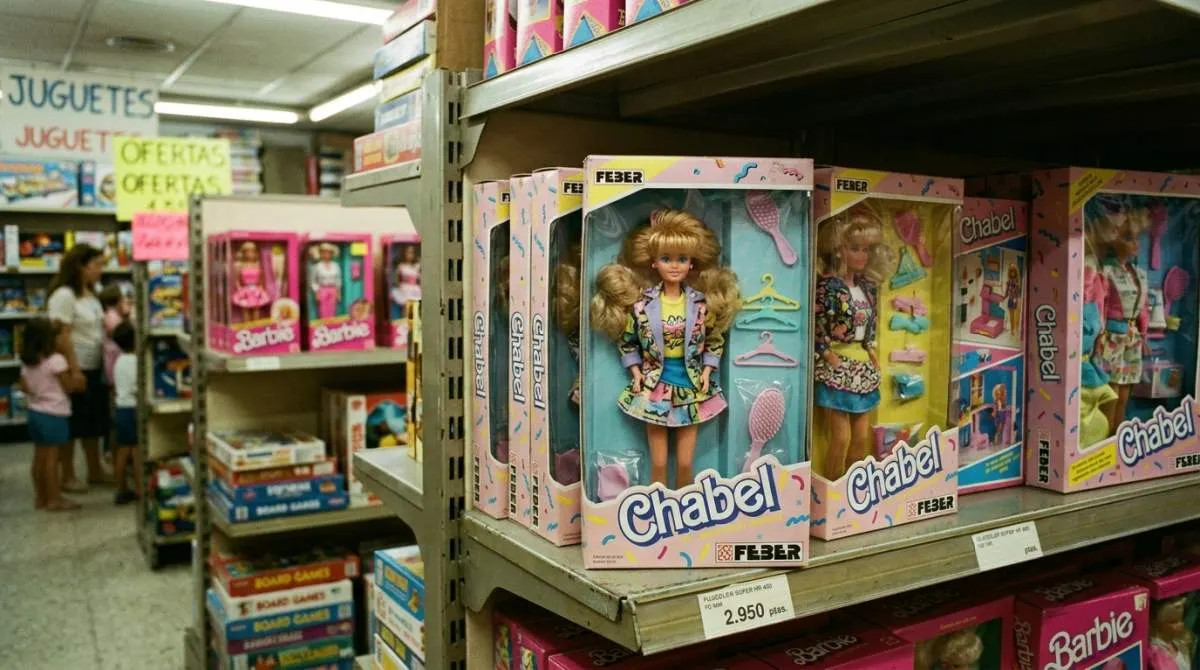
Hold her, and the first thing you notice is the hair. Thick, dark, synthetic, cut in a bob with a slight flick. Her face is friendly, open, a little more rounded than the sharp angles of her famous rival.
This is Chabel, and in the mid-1980s, she wasn't just a doll in a box. She was the Spanish teenager you could imagine being, the one with the caravan parked by the beach and the disco in her backyard.
For a generation of girls in Spain, Barbie was a glamorous, distant American aunt. Chabel was the cool older sister from down the street. Created in 1984 by the toy company Feber, based in the small town of Ibi in Alicante, Chabel was a cultural counteroffensive.
She emerged from Spain's 'Toy Valley', an industrial cluster that thrived under post-war policies that restricted imports. This wasn't just business; it was a matter of national play.
The Anatomy of a Local Heroine
Chabel's secret weapon was her relatability. While Barbie represented an idealized, sophisticated adult woman with a dream house and a corvette, Chabel was explicitly designed as a Spanish adolescent of about 16 or 17. Her world wasn't one of unattainable glamour, but of aspirational teenage life. She had sleepover pajamas, school uniforms, and casual weekend wear.
Her origins were international yet perfectly localized. Feber based Chabel on the patent of the Japanese doll Licca Chan. But the translation was key.
They molded her into a specifically Spanish context, a process that turned a licensed form into a domestic icon. This wasn't a copy; it was a reinvention for a local audience who saw their own lives reflected in her plastic smile.
At its peak in 1987 and 1988, Feber manufactured about half a million Chabel units every year. That's a staggering figure for a country just emerging from its own cultural isolation. Each doll sold was a vote for a homegrown fantasy. The success demonstrated how a protected industry could birth a champion that resonated on a deeply personal level.
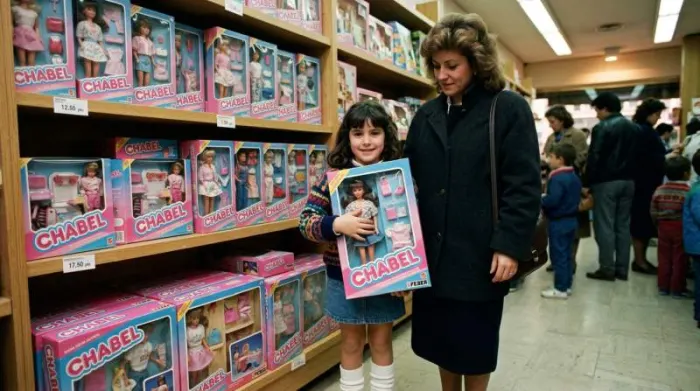
A World Built From Plastic Dreams
If Chabel was the heroine, her accessories were the epic. Feber didn't just sell a doll; they sold an entire Spanish adolescence, piece by glorious piece. You could build her universe from a catalogue of plastic dreams that felt thrillingly within reach.
- The Caravan: Not a mansion, but a mobile home for adventures. It spoke of weekend getaways, summers on the coast, a freedom that was quintessentially aspirational for a teen.
- The Disco: Complete with a dance floor, lights, and a sound system. This was the epicenter of social life, the place where Chabel and her friends would gather.
- The Villa: A more stationary home base, often styled with Mediterranean flair.
- The Hamburger Stand & Mobile ICU: Even her career aspirations were grounded. She could run a fast-food joint or work in emergency medicine.
- The Greenhouse: An oddly specific and charming accessory that hinted at hobbies, not just glamour.
This sprawling world was a masterclass in play pattern engineering. It invited narrative, the kind of storytelling where a doll could go from studying to working a shift at the burger stand to dancing at her own disco all in one afternoon. It felt more modular, more DIY, than the pre-packaged narratives of her competitors.
The Campaign That Captured a Generation
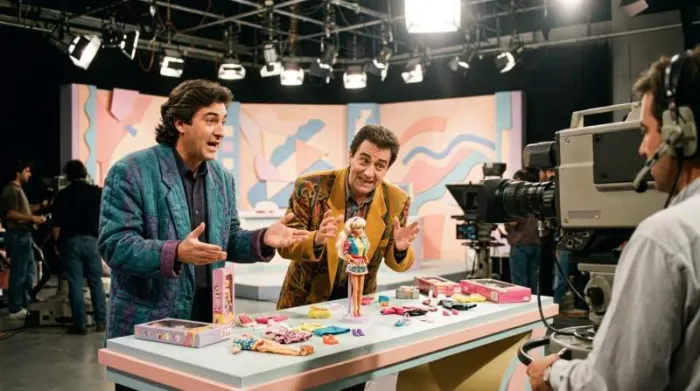
Chabel didn't just appear on shelves; she exploded onto television screens. Feber backed their creation with a media blitz that defined an era of Spanish advertising. The jingle is still instantly recognizable to millions: "Chabeel, Chabeel, ¡qué bien!" It was upbeat, infectious, and impossible to forget.
The campaigns featured the popular comedy duo Martes y Trece, lending the doll an air of cool, mainstream popularity. The ads didn't just show a toy; they showed a lifestyle-fast-paced, fun, and utterly contemporary. This synergy between product and promotion was flawless. The doll on TV was the same doll in the playroom, and her world felt just a purchase away.
By 1990, Chabel's cultural cachet was so strong that avant-garde fashion designer Ágatha Ruiz de la Prada created a collection for her. This marked the designer's first foray into toy design, a crossover that cemented Chabel's status as more than a plaything. She was a style icon, a canvas for Spanish creativity, blurring the line between the nursery and the runway in a way that felt uniquely of its moment.
The Echo in the Collector's Cabinet
Production of Chabel ceased in 1992, a full stop that transformed her from a mass-market product into a memory. That finite supply, coupled with the intense nostalgic demand from the adults who grew up with her, created a thriving collector's market. Original Chabel dolls and their accessories are now highly sought-after pieces of cultural history.
Value lies in completeness: a doll with her original clothing, the elusive caravan with all its parts, the disco with its tiny working lights. Special editions, like the Ágatha Ruiz de la Prada line, are particular grails. This isn't just about toys; it's about reclaiming a specific chapter of childhood, a tactile connection to a shared past. The hunt for these items on second-hand platforms is its own kind of archaeology.
The nostalgia reached such a pitch that it sparked an official revival. Decades after the last doll left the Feber factory, the company's owner, Famosa, reissued Chabel. They launched a limited-edition 'Chabel High School' model, meticulously faithful to a 1989 original. It wasn't a reinvention for a new generation, but a replica for the old one-a direct appeal to that powerful, generational nostalgia.
You can find the new doll in toy stores and online, a ghost from the 80s in contemporary packaging. But to feel her true impact, you need to look at the secondary market, or listen for that jingle in a compilation of vintage ads. There, in the gleam of a small plastic hamburger or the synthetic fringe of a disco jacket, you’ll find the blueprint for a million Spanish childhoods.
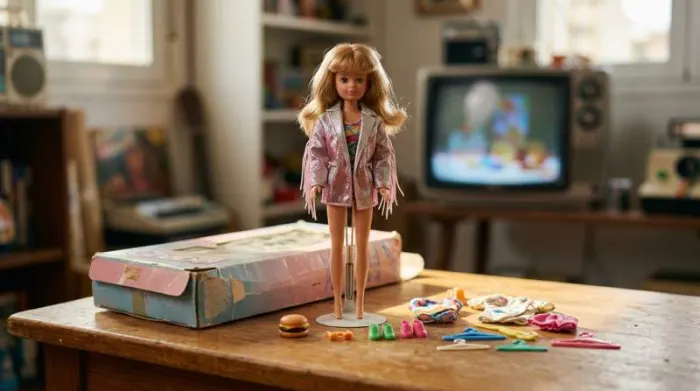
She was never just a rival to Barbie. She was an alternative universe, made in Alicante.
Sources
- "Yo prefería a Chabel": la loca historia de la muñeca Barbie de la España del pelotazo
- Vuelve Chabel, la icónica muñeca con la que creció la generación de más de 40
- Viaje al Pasado, Chabel, Famosa
The sources we read for this article.
What is the history of the Chabel doll?
Chabel's roots trace back to a licensing deal with Japan's Licca-chan, but her true magic lay in the Spanish adaptation. Feber's designers gave her a distinctly Iberian look and personality, a stark contrast to the American Barbie. This localization made her a symbol of Spain's cultural shift in the 1980s, a time when the country was embracing modernity while cherishing its own identity.