
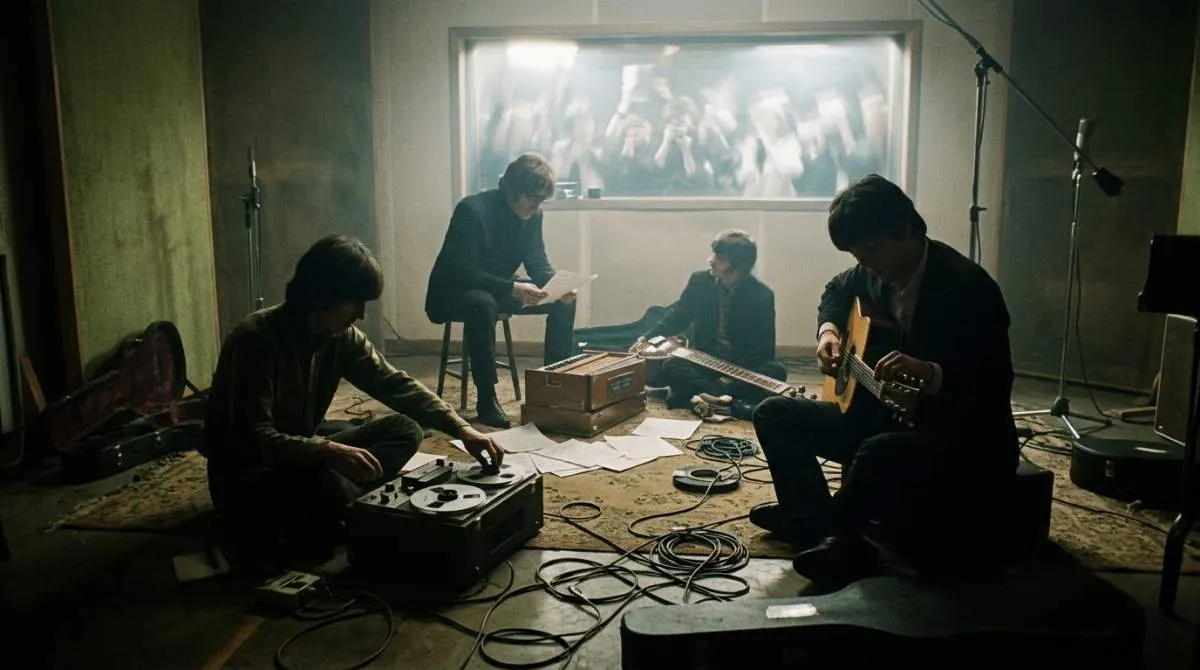
It starts with a single, resonant thrum, a sound that felt alien and ancient leaking into a pop song. That was the sitar on "Norwegian Wood," and when it first crackled out of transistor radios in December 1965, it wasn't just a new instrument. It was a door swinging open [1].
The album it heralded,Rubber Soul, arrived on the 3rd of December that year, a mere four weeks after the band wrapped its recording sessions. They'd just come off the screaming chaos of Shea Stadium, but in the studio, the energy had turned inward, focused, and quietly revolutionary [2].
This was the pivot point. Rubber Soul became the bridge between the frenzy of Beatlemania and the kaleidoscopic laboratory work of Revolver and Sgt. Pepper. It was only their second LP of all-original material, following A Hard Day's Night, but the ambition had shifted [3].
The studio, as Paul McCartney later recalled, stopped being a place just to capture performances and became a "laboratory" with very firm rules they were now determined to break. The result wasn't just a collection of songs; it was a mood, a distinct, autumnal atmosphere of introspection and acoustic warmth that pioneered the long-form pop album as a cohesive artistic statement.
The Studio as a Sound Laboratory
The shift was tangible. Before Rubber Soul, the Beatles were a brilliant live band captured on tape. After it, they were architects of sound.
The change wasn't in the gear so much as in the mindset. They began taking creative control, treating the studio as an instrument itself. Engineers pushed technical boundaries to realize their ideas, like applying extreme treble to George Harrison's guitar solo on "Nowhere Man" to make it cut like a shard of glass. They pioneered the use of Artificial Double Tracking to thicken vocals without the labor of a second take.
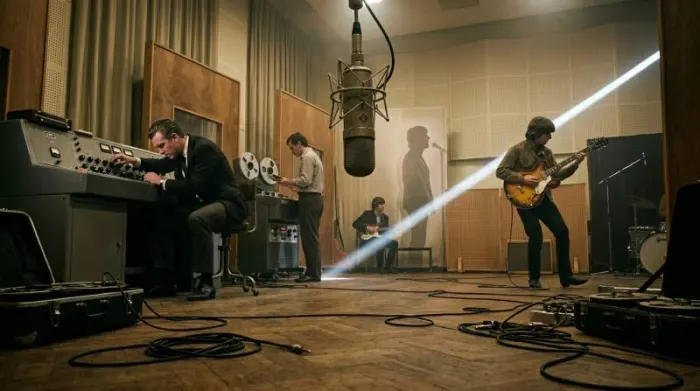
And then there were the new textures. George Harrison's sitar on "Norwegian Wood" was the most famous leap, an interest sparked after he saw one on the set of Help! earlier that year. But listen closer and you'll find the fuzz bass growling through "Think For Yourself," the harmonium wheezing on "The Word," and the intimate, almost teasing backing vocals on "Girl."
These weren't just embellishments; they were the building blocks of a new sonic vocabulary. The album's intimate,folk-rock sound wasn't an accident. It was a deliberate retreat from the stadium-shaking rock and roll, a move towards something more personal and complex.
Lyrics That Grew Up
If the music turned inward, so did the words. The simple boy-meets-girl narratives of their earlier work dissolved into something far more nuanced. Here was "Nowhere Man," a portrait of existential drift that had nothing to do with romance.
"I'm Looking Through You" channeled the souring of a relationship with weary clarity. Even the love songs matured; "Michelle" was a sweet, minor-key ballad sung partly in French, while "In My Life" became a poignant, universal meditation on memory and change.
This lyrical shift signaled a new maturity. They were writing about disillusionment, introspection, and social observation, moving their subject matter firmly into the adult world. It's why John Lennon later positioned the album as essential, saying, "You don't know us if you don't know Rubber Soul."
It was the document where they shed their matching suits, figuratively and sonically. This was the moment the cultural clash between their teenybopper image and their artistic ambitions was decisively won by the latter.
- The album pioneered the cohesive, long-form pop album as an artistic statement.
- It introduced new sonic textures like the sitar, fuzz bass, and harmonium.
- Lyrics shifted from simple romance to themes of introspection and social observation.
- The band seized full creative control, treating the studio as a laboratory.
Plot Twist
- Everyone likes to call Rubber Soul the first proper Beatles "concept album," a perfectly planned artistic statement.
- Truth is, it was recorded in a rush to meet a deadline, and even the band admits a track or two feels like a misstep in the flow.
So, what is the best Beatles album? That's a debate with no final answer, hinging entirely on whether you prize raw innovation, flawless songwriting, or studio wizardry most. Yet Rubber Soul is perpetually in the conversation, frequently cited as a top contender precisely because it captures that "thrill of future possibility."
Many critics might place Sgt. Pepper or Revolver higher for their sheer experimental bravado, but Rubber Soul is the root. It's where the leap began, the quiet before the psychedelic storm.
What made it so different? You can boil it down to three seismic shifts. First, the band seized artistic control, breaking studio rules to chase new sounds. Second, the lyrics grew up, trading adolescent romance for introspection and sharper social observation.
Finally, it achieved a new sonic cohesion. It wasn't a strict concept album, but it held together with a distinct, warm, acoustic folk-rock vibe that felt like a single, complete thought, a stark departure from the eclectic rock and roll of their earlier LPs.
The 2026 Remix: Hearing the Soul Anew
Sixty years on, we're getting a chance to hear that soul in startling new detail. A new special edition stereo mix, sourced from the original four-track tapes, arrived on the 2nd of October, 2026. This isn't just a remaster; it's a forensic reconstruction using the same de-mixing technology developed by Peter Jackson's WingNut Films team.
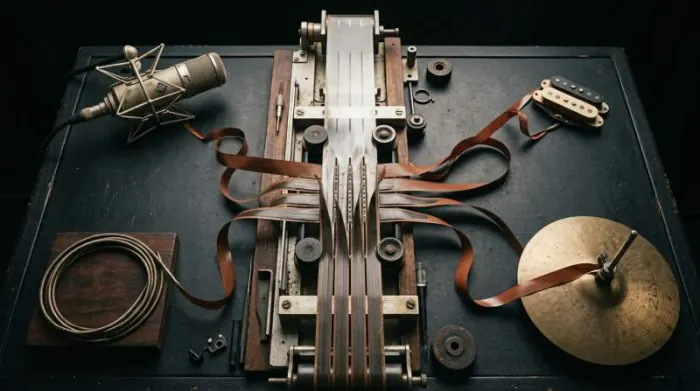
The goal is to peel apart sounds that have been blended together for decades, offering clarity and separation that was impossible in 1965.
This technological rescue mission allows us to appreciate the laboratory work with fresh ears. The breathy backing vocals on "Girl," the intricate interplay between McCartney's bass and Starr's drums on "Drive My Car," the delicate filigree of the sitar, all these elements step out of the mono and early stereo shadows.
Mood Match
Four Songs for the Weather You're In
Pick the moment you're in and let the song do the rest.
Watching rain streak the window with tea
Norwegian Wood by The Beatles
That sitar and the flat, unhurried voice suit a grey afternoon when you're staying put and thinking too much.
Driving nowhere in particular after dark
Drive My Car by The Beatles
It's the only sensible soundtrack for headlights on empty roads and no destination worth naming.
Feeling unseen in a crowded room
Nowhere Man by The Beatles
Lennon wrote it for exactly that feeling, and it still makes being overlooked feel less lonely.
Looking back on a year that changed you
In My Life by The Beatles
It's a gentle, honest look back, and it never asks you to pretend the year was easy.
Play them in order if the evening calls for it. There's no wrong way.
Songs checked against en.wikipedia.org.
It's a reminder that the MTV revolution in visual presentation was still years away; for The Beatles in 1965, the entire spectacle was crafted for the ear. The new mix strips away the sonic haze, making their bold studio choices feel present and immediate, not just historical.
Where can you feel its echo today? It's in any artist who treats the album as a singular canvas rather than a batch of singles. It's in the continued reverence for the intimate, lyric-driven singer-songwriter.
The album taught a generation that pop music could be personal, complex, and artistically ambitious all at once. It proved that the biggest band in the world could stop chasing the scream and start listening to their own evolving ideas. The remix isn't just a nostalgia trip; it's a high-definition postcard from the moment pop music grew up, and the invitation to hear that revolution all over again.
What vintage tape machine did the Beatles use to slow down their
voices on Rubber Soul?
They borrowed a worn-out EMI BTR2 tape recorder from Abbey Road's storage, then ran vocals at half speed to get that dreamy, deeper tone. It was a happy accident that turned a technical quirk into a signature sound.