
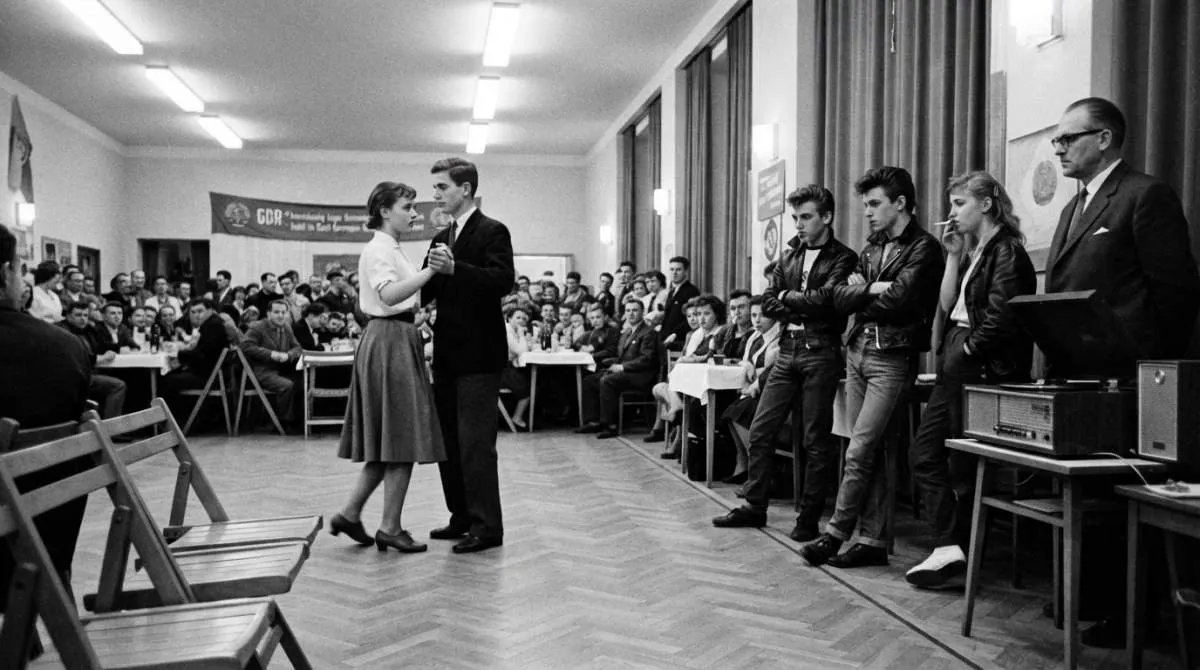
Picture a newspaper page, crisp and authoritative, laid out on a canteen table in Leipzig. It wasn't reporting on a tractor quota or a party congress. It was a dance diagram.
On February 7, 1959, the SED's official mouthpiece,Neues Deutschland, dedicated a full page to teaching citizens the Lipsi. Here was the state's answer to Elvis Presley: a numbered step sequence, arrows indicating foot placement, a diagrammed vision of socialist harmony. This act of publishing dance steps in the party organ was unprecedented, treating social recreation with the same grave importance as industrial production plans.
This wasn't a trend bubbling up from youth clubs. It was a cultural directive, handed down from the very top. The Cold War wasn't just fought with missiles and spies; it was waged on the dance floor. To Walter Ulbricht's regime, the twisting, individualistic frenzy of Western rock 'n' roll wasn't just music.
It was seen as a psychological weapon, part of a "cultural imperialism" that promoted egoism and threatened the socialist collective. The East German Ministry of Culture had already banned "boogie-woogie" and "unrestrained dancing" in public venues in 1957. So, they decided to build a better dance, one that would embody socialist values of order, partnership, and modesty.
The Blueprint for a Proper Dance
The Lipsi was engineered in late 1958, a collaboration between Leipzig composer Rene Dubianski and dance instructors Helmut and Christa Seifert. Its creation followed a direct call from the FDJ (Free German Youth) leadership for a "modern couple dance for our youth." Its official unveiling was a state-managed affair at a dance music conference in Lauchhammer on January 13, 1959. The regime didn't just promote it; they filed for a worldwide patent, declaring it a 'Paradebeispiel sozialistischer Nationalkultur'-a parade example of socialist national culture. This attempt to patent a cultural form highlighted the regime's view of culture as an industrial product that could be owned and exported.
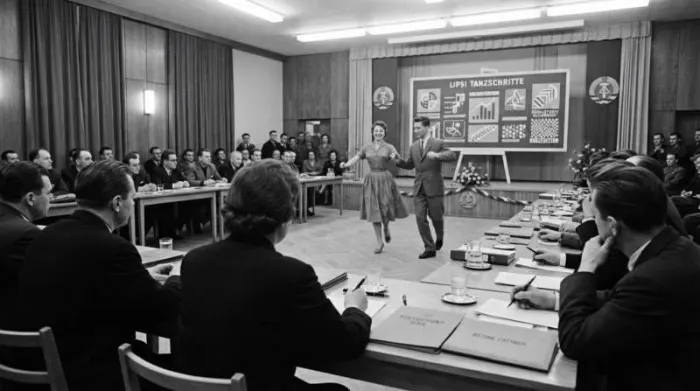
So, what was the Lipsi dance? It was a six-quarter-time step sequence, a hybrid that borrowed the rotating structure of a waltz but clamped it into a specific, memorized pattern. The basic step went: step-tap-step-tap step-close. The unusual 6/8 time signature was chosen specifically to be incompatible with the 4/4 beat of rock 'n' roll, making musical subversion difficult.
Partners were to move decorously, in both closed and open hold, their movements controlled and distinctly separated by gender. The goal was harmonious togetherness, not sexualized individual expression. Dance manuals emphasized "natural, graceful posture" and warned against "exaggerated movements."
Mood Match
Four Ways to Dance a Lipsi
Here is a little test of your own dance-floor memory, so match the moment to the tune.
Obeying the party line on the dance floor.
Heute tanzen alle jungen Leute by Helga Brauer.
It is bright, willing and on-message, the sort of song that lets you join in without ever having to think about it.
Practising the six-quarter step at home.
Lipsi Nr 1 by Rundfunk-Tanzorchester Leipzig.
The orchestra holds a steady, patient beat that is perfect for counting quietly to yourself in the front room.
Watching the dance floor stay stubbornly empty.
Messe-Lipsi by Rundfunk-Tanzorchester Leipzig.
It has all the right intentions and none of the pull, so the floor clears while the band plays on regardless.
Humming the tune the state hoped would win.
Willibalds Lipsi by Martin Möhle Combo.
You catch yourself humming it anyway, which is exactly what the planners were counting on.
The Lipsi never quite caught on, but the tunes are still in my head.
Songs checked against kulturrat.de.
The propaganda machine cranked into high gear. By spring, singer Helga Brauer was commissioned to record the catchy, state-sanctioned tune 'Heute tanzen alle jungen Leute Lipsi' (Today All Young People Dance the Lipsi). The FDJ organized mass Lipsi lessons in schools and factories, and the dance was made a compulsory part of the curriculum for state dance instructors. The message was clear: this was the new, proper way to have fun.
It was a direct, top-down replacement for the corrupting influence of American rock 'n' roll, twist, and boogie-woogie. Newspapers ran glowing reports of "Lipsi balls" where hundreds of young couples danced in perfect, state-approved unison.
The Youth Vote With Their Feet
The state provided the diagram, the music, and the mandate. The youth of East Germany provided the rejection. They found the rhythms uninspiring and the choreographed steps difficult to remember.
More importantly, they found the whole enterprise deeply uncool-a clumsy, obvious piece of state engineering that lacked the spontaneity and energy of Western music. The Lipsi's very name, a diminutive of Leipzig, felt provincial compared to the exotic allure of "Rock and Roll."
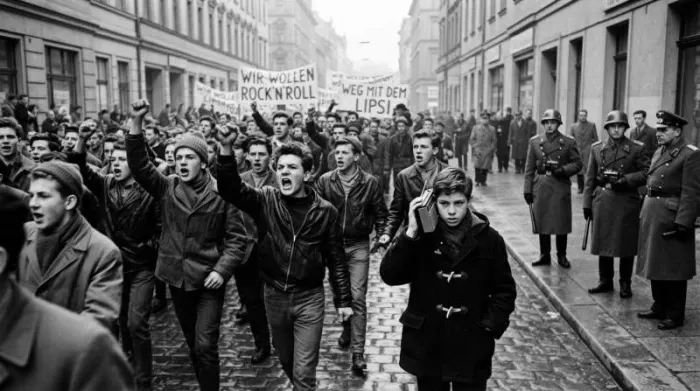
Resistance wasn't passive. It spilled into the streets. On November 2, 1959, a demonstration in Leipzig saw protesters chanting not for the Lipsi, but for Bill Haley and rock 'n' roll. The cultural clash was out in the open. This protest was part of a wider pattern of youth unrest in 1959-60, where dance preferences became a proxy for political dissatisfaction.
While officials envisioned orderly ballrooms,young people craved the raw, rebellious energy emanating from the West, listening to RIAS (Radio in the American Sector) broadcasts under blankets. This episode perfectly encapsulates Cold War era dance trends: one side championing individual freedom, the other attempting to mandate collective conformity.
The regime's attempt to create an East German alternative to rock and roll wasn't just a minor flop. It was a revealing failure of ideology. You couldn't patent cool. You couldn't diagram authenticity.
The Lipsi disappeared from popular culture after only a few years, a footnote in the history of state-sponsored culture that proved youth culture, then as now, operates on a different frequency. By the mid-1960s, even the SED had to relent, allowing beat music and more liberal dancing as a safety valve to maintain control, leading to the rise of officially sanctioned bands like the Klaus Renft Combo.
- The Inventors: Leipzig composer Rene Dubianski and dance instructors Helmut and Christa Seifert, tasked directly by the state.
- The Launch: Officially presented at a state dance conference in Lauchhammer on January 13, 1959.
- The Propaganda Push: A full-page step guide in Neues Deutschland, a promotional song by Helga Brauer, and an application for a worldwide patent.
- The Sound: A six-quarter-time structure, combining waltz elements with a strict step-tap-step-tap step-close sequence.
- The Rebellion: Leipzig protests in late 1959 where youth openly chanted for Bill Haley over the state-mandated dance.
The Echo of Engineered Culture
The story of the Lipsi is a prime case study in the history of government-created dances. It's rare to see the mechanics so clearly: a regime identifies a cultural threat, commissions specific artists to create an antidote, and deploys the full force of state media to promote it. The Lipsi's bluntness-from its patented status to its newspaper instructions-lays bare the anxiety of a government trying to control not just politics, but pleasure. This was part of a broader "Kulturpolitik" (cultural policy) that sought to create a distinct socialist personality in every aspect of life.
This anxiety never really vanished. You can see later echoes in various moral panics over music, where authority figures attempted to regulate the rhythms young people moved to, from the Soviet Union's persecution of jazz in the 1940s to China's crackdown on disco in the 1980s. The Lipsi was an early, physical attempt to stop a cultural clash before it could even start, by replacing one set of movements with another.
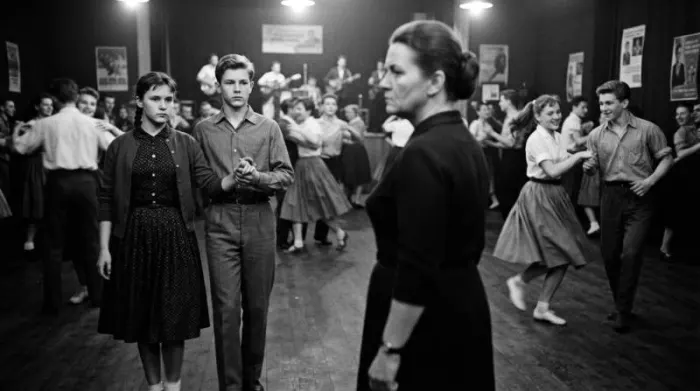
Its swift failure is the key lesson: culture, especially youth culture, is notoriously resistant to central planning. The episode demonstrated that the "soft power" of Western popular culture could penetrate the Iron Curtain more effectively than any state-mandated alternative.
Today, you won't find Lipsi nights at Berlin clubs. But you can find the concept in archives and historical reviews-a curious artifact of a time when a government believed it could choreograph joy itself. It stands as a perfect, awkward monument to the limits of control, a reminder that on the dance floor, as elsewhere, mandated fun is usually no fun at all. The Lipsi's legacy is as a symbol of the profound disconnect between a rigid political system and the dynamic, unpredictable nature of human expression and desire.
Sources
- JUKEBOX: Ticky, Real Ticky, TIME
- „Heute tanzen alle jungen Leute …“ | Deutscher Kulturrat
- Lipsi (dance), Wikipedia
The sources we read for this article.
What was the Lipsi dance in East Germany
The Lipsi's unusual 6/8 time signature wasn't just a musical choice-it was a deliberate tactic to make it impossible to dance to rock 'n' roll's 4/4 beat. The name itself, a diminutive of Leipzig, was meant to evoke hometown pride, but instead felt embarrassingly provincial to young East Germans. Today, the original sheet music and dance diagrams are prized collector's items among Cold War memorabilia enthusiasts.