
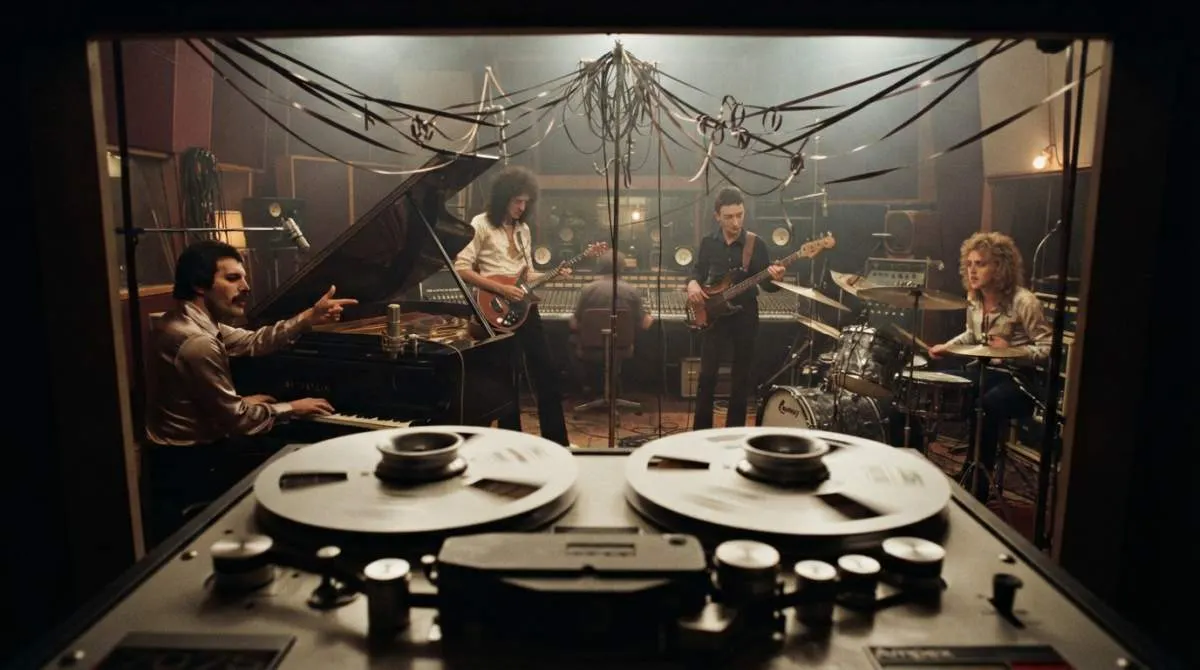
It began not with a bang, but with a piano figure in a rented farmhouse. In the summer of 1975, Queen decamped to Rockfield Studio 1 in Wales, a place far removed from the glittering excess of the era's disco palaces. The studio, located on a working farm near Monmouth, was a stark, rural contrast to the band's previous sessions in London's more polished facilities. While Studio 54 fashion history was being written in New York with unbuttoned silk shirts and sequined gowns, Freddie Mercury was holed up in Monmouthshire, obsessively layering vocals on a song that would break every rule in the book.
The track was "Bohemian Rhapsody." And before it was a global anthem, it was a logistical nightmare. Recording began on August 24, after a three-week rehearsal period where the band mapped out Mercury's sprawling vision [1].
The song's creation coincided with a period of immense pressure for Queen; their previous album had not met commercial expectations, and their record label was skeptical of their extravagant studio habits [2].
The Birth of a Frankenstein's Monster
The song was conceived in three distinct, jarring sections: a melancholic ballad, a mock-operatic interlude, and a blistering hard rock finale. This structure deliberately mirrored the classical sonata form, an ambitious framework for a pop single [3].
This wasn't a single; it was a suite. Producer Roy Thomas Baker and engineer Mike Stone became co-conspirators, helping the band realize a sound that was, by design, impossible to categorize. Their approach was cinematic, treating the studio as an instrument to build an aural film.
The operatic section alone consumed about three weeks. The band painstakingly built a human orchestra from their own voices, layering up to 160 separate vocal overdubs onto 24-track tape. They manually spliced tape to extend sections, creating a dense, choir-like wall of sound that was both grandiose and oddly intimate.
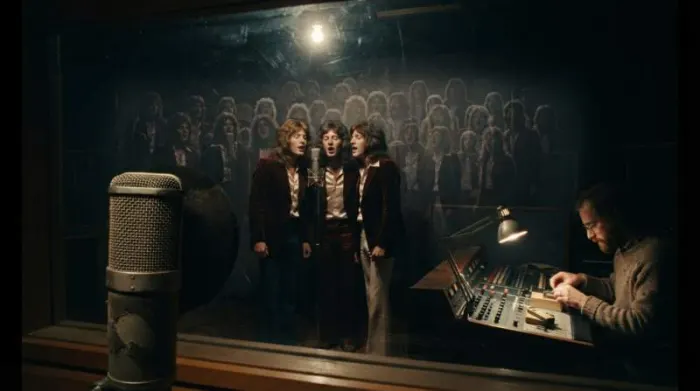
The process was physically demanding, requiring the band to sing the complex harmonies for hours, with Mercury often conducting their vocal "orchestra."
Brian May later described the parent album, 'A Night at the Opera,' as their 'Sgt Pepper' in terms of sheer ambition. The album's title itself was a nod to the Marx Brothers film, reflecting the band's love for theatrical comedy and high art.
The recording was an exercise in controlled mania, a far cry from the streamlined, four-on-the-floor music dominating the airwaves. While disco promised escape, Queen was constructing a labyrinth of confession, drawing more from the progressive rock and art-rock movements than from contemporary chart trends.
The Controversy No One Saw Coming
When the band presented the finished track to EMI, the reaction was not excitement, but panic. The nearly six-minute length broke the unspoken radio rule for singles, which typically clocked in under three and a half minutes. Executives doubted any station would touch it.
At over five minutes and fifty-five seconds, it was one of the longest songs ever to be released as a commercial 7-inch single.
It was, in their eyes, commercial suicide. The song's very structure was a provocation-a defiant middle finger to convention. In an era of clear-cut genres, it was a glorious, pompous mutt.
The band's insistence felt like folly, especially given the substantial studio costs which they had personally covered.
Mood Match
Three O'Clock in the Morning
Pick the moment you are in and let the song do the rest.
Lying awake with too many thoughts
Bohemian Rhapsody by Queen
Nothing settles a racing head like a six-minute epic that wanders through every feeling you are having and then quietly lets you go.
Cleaning the house on a Sunday
Mamma Mia by ABBA
That piano riff turns dusting into a small celebration, and you will find yourself dancing with the duster before the chorus lands.
Closing the bar at last call
I'm in Love with My Car by Roger Taylor
The last stragglers need something loud and a little ridiculous to carry them out the door, and this does it beautifully.
Some songs are not about the music at all. They are about where you were standing.
Songs checked against en.wikipedia.org.
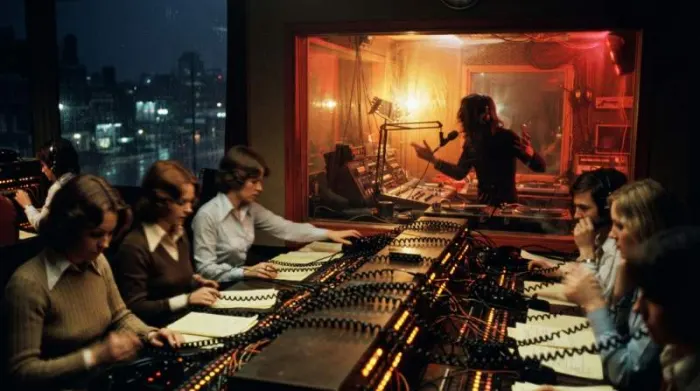
Then, DJ Kenny Everett intervened. A close friend of the band, he got a copy and, against explicit instructions, debuted "Bohemian Rhapsody" on his Capital Radio show. He famously played it fourteen times over one weekend, declaring it a masterpiece.
Listener phones lit up. The public, it turned out, had no such rules. Everett's act of rebellion was the crack that shattered the dam, creating a public demand that commercial radio could not ignore.
The song's strangeness became its strength. It wasn't just heard; it was studied, debated, and belted out in pubs. Questions about its meaning were met with Mercury's famous deflection.
He called it 'rhyming nonsense,' a move that preserved its mystique and invited every listener to find their own truth within it. This intentional ambiguity fueled endless speculation, from interpretations about Mercury's personal life to allegories of murder and judgment.
- The operatic section used the phrase "Galileo" not for profundity, but because Mercury liked the sound of it. He reportedly shouted "Galileo!" during a take, and the band decided to keep it.
- The iconic a cappella opening was recorded first, setting the tone for the entire vocal-heavy production. It established the song's intimate, confessional atmosphere before its dramatic shifts.
- All four band members sang the operatic parts, their voices blended into a single, multi-octave entity. May and drummer Roger Taylor provided the soaring high notes.
- The hard rock section was recorded with a raw, live energy, a deliberate shock after the orchestral drama. May's guitar solo was largely improvised in one take.
- The final piano chord was spliced in from a different take, as the original ending felt too abrupt. The subtle, decaying chord provides a haunting sense of closure.
The Strange Afterlife of a 'Nonsense' Song
In the decades since, "Bohemian Rhapsody" has transcended its origins as a hit single. It has become a cultural shorthand, a rite of passage, and a canvas for projection. The widespread theory that it chronicles Mercury coming to terms with his sexuality, supported by his manager John Reid, adds a layer of poignant resonance to the surreal imagery of confession and turmoil.
It soundtracked a riotous scene in 'Wayne's World,' introducing it to a new generation who embraced its inherent ridiculousness and genius in equal measure. The film's headbanging car scene re-contextualized the song as an anthem of joyous rebellion, cementing its cross-generational appeal.

It became a staple of karaoke nights and stadium singalongs, its very improbability making it a communal experience. The song outlived its detractors, its era, and even its creator, re-entering the UK Top 10 in 1991 following Mercury's death.
Its influence rippled out, subtly informing later theatrical acts like The Darkness, My Chemical Romance, and the "poperatic" genre, proving that pop music could be both massively popular and profoundly weird. It stood as a monument to studio artistry in an age increasingly dominated by minimalism and later, digital production.
The song's legacy is one of permission-it gave other artists the nerve to be ambitious, strange, and uncompromising, demonstrating that commercial success did not require playing it safe.
Why the Rhapsody Still Resonates
Fifty years on, the song's power lies in its defiant construction. It is a meticulously built artifact that feels like a spontaneous eruption of feeling. It answered to no trend, no A&R man, no radio programmer.
It was the sound of four musicians and their collaborators deciding, with absolute conviction, to follow a bizarre idea as far as it would go. The track captures the pre-digital era's spirit of hands-on craftsmanship, where sonic ambition was limited only by tape, time, and imagination.
In a way, it predicted the fragmented, genre-blending future of music itself. It understood that listeners could hold multiple truths at once-the ballad, the opera, the rock anthem.
It trusted the audience to keep up. That gamble, more than any technical achievement, is its lasting gift. The song functions as a microcosm of the human emotional spectrum, moving seamlessly from vulnerability to fury to camp theatrics.
"Bohemian Rhapsody" endures because it is, at its heart, a story about defiance. It's the story of a band in a Welsh studio, ignoring every warning to build something too big to ignore.
It’s the story of a DJ playing a forbidden record. And ultimately, it's the story of a song that taught us the rules were only ever suggestions. Its journey from "commercial suicide" to one of the best-selling singles of all time remains a powerful testament to artistic vision over commercial calculation.