
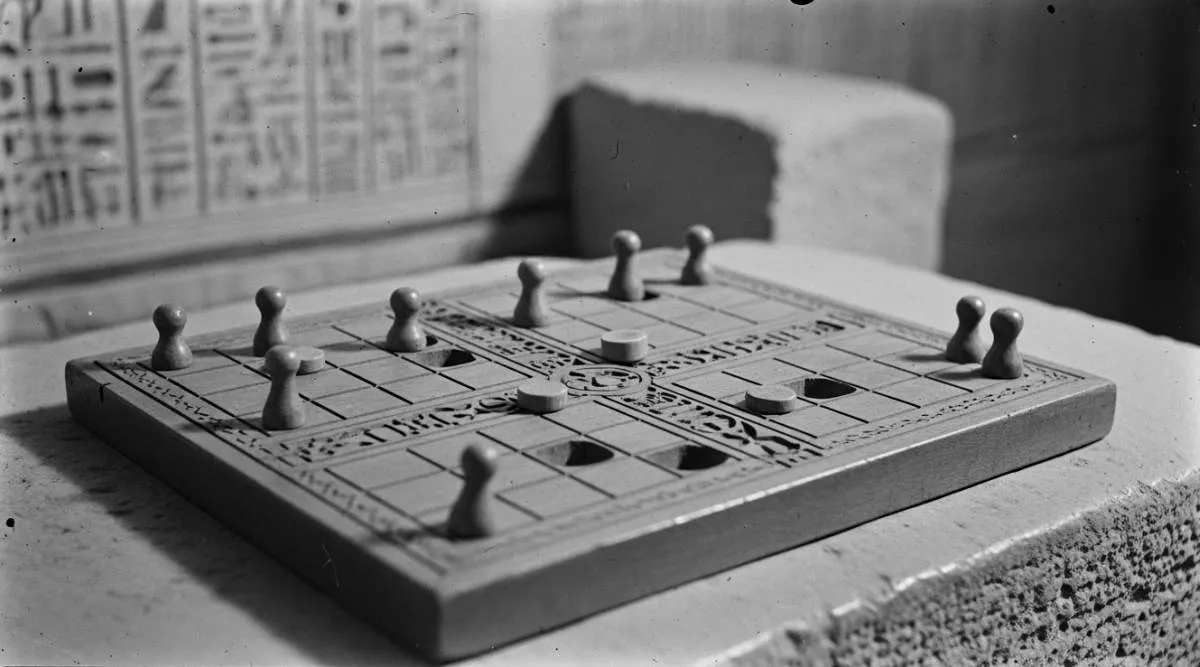
The Oldest Game in the Book
Imagine a game so important it was packed alongside gold and jewels in a pharaoh's tomb. That game is Senet, the ancient Egyptian board game. For over 5,000 years, it was far more than a way to pass the time. It was a sacred ritual, a symbolic journey through life, death, and the afterlife played by everyone from kings to commoners.
This was never mere entertainment. Every move on the Senet board was tied to a profound hope for a blessed outcome in the life to come. It represented a form of aspirational play, a dress rehearsal for the soul's final journey. When you hold a Senet piece, you're touching a direct link to how an entire civilization understood existence itself.
More Than Meets The Eye: How Senet Was Played
At first glance, the Senet board looks deceptively simple: a grid of 30 squares arranged in three rows of ten. Players would move their pieces from one end to the other. But the rules, pieced together by archaeologists from tomb paintings and game fragments, reveal a world of strategy and deep symbolism.
Movement was determined by throwing simple sticks or knucklebones, an early form of dice. This mix of luck and choice was central to the experience. The board itself was the real storyteller, with certain squares marked as special.
Squares of Fate and Rebirth
Some squares on the Senet board were safe havens, while others presented peril. A square marked with a water symbol, for instance, could force a player to lose a turn or slide backward, a metaphor for setbacks in the spiritual journey. The final five squares were the most significant, representing the climax of the soul's passage.
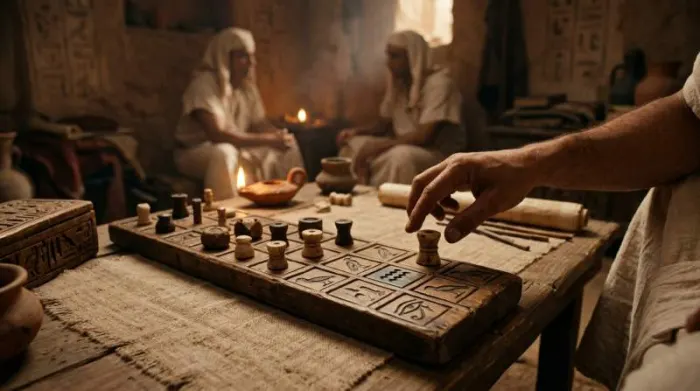
These last squares often depicted stages of spiritual transformation, ending in the ultimate goal: rebirth or a meeting with the gods. The game was a live enactment of the soul's trials in the underworld, making victory not just about winning, but about achieving symbolic eternal life.
A Pharaoh's Companion: The Archaeological Discovery
The world's understanding of Senet's importance was sealed with the discovery of Tutankhamun's tomb. Among the glittering treasures were not one, but four exquisite Senet boards. This wasn't an accident or a simple leisure item left for the boy king's amusement.
Finding multiple boards in a royal burial chamber confirmed that Senet was considered an essential magical item for the afterlife. It was a tool the pharaoh would need to navigate the dangers of the underworld and reach paradise. This discovery, during the peak of global Egyptology fever, forever cemented Senet in our modern image of ancient Egypt.
A Game for Everyone
While Tutankhamun's boards were works of art in ebony and ivory, Senet was not exclusive to royalty. Archaeologists have found game boards carved into the stone floors of temples and in the humble graves of commoners. This ubiquity tells a powerful story.
It shows that the spiritual anxieties and hopes embodied by the game were shared by all levels of Egyptian society. For thousands of years, it served a dual purpose: a popular pastime for friendly competition and a deeply personal spiritual practice. The sheer number of boards found gives us an incredible window into daily life and belief.
The Rules of the Journey: Piecing Together Ancient Gameplay
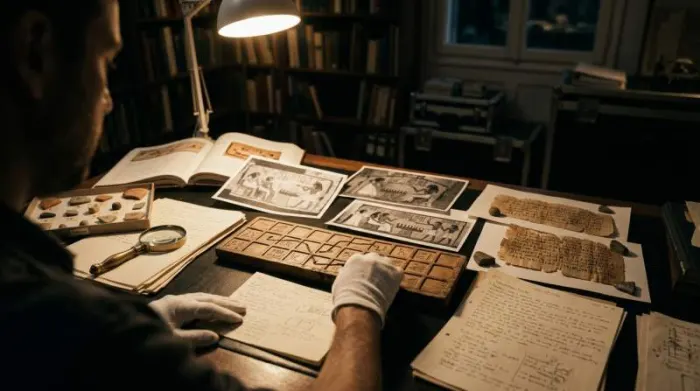
Rebuilding the exact rules of Senet is an exercise in careful historical detective work. Scholars combine clues from board designs, fragmentary texts, and artistic depictions to form a plausible picture. The goal was to be the first to move all your pieces off the board, but the path was fraught with symbolic challenges.
Players could block each other's pieces or send them back to the start. Landing on certain "house" squares offered protection. The game required both tactical thinking to outmaneuver your opponent and a resignation to the whims of fate, as represented by the throw sticks. This blend is what made it so compelling for centuries.
From Ritual to Recreation
Over its long history, Senet's character evolved. In its earliest forms, it may have had a stronger divinatory purpose, used to seek guidance from the gods. Over time, while never losing its spiritual resonance, it became more standardized as a popular board game.
This evolution mirrors how cultures often formalize ritual into recreation. The core symbolism remained, but the act of playing also became a social activity, a way to connect with family and friends. This adaptability is a key reason for its enduring presence across dynasties.
Senet's Modern Rebirth
Today, Senet is experiencing a remarkable comeback. You can find beautifully crafted wooden sets in museum gift shops and from specialty artisans, allowing anyone to own a piece of history. More accessible than ever, digital versions of Senet are available for phones and computers, introducing the game to a whole new generation.
This revival is fueled by our enduring fascination with ancient Egypt and a broader cultural trend. The modern love for hands-on, analog experiences, part of what some call nostalgia tech culture, has created a perfect environment for Senet's return. It offers a tangible, thoughtful counterpoint to fast-paced digital entertainment.
A Living Link to Antiquity
Playing Senet today does something unique. It creates a living link to the ancient world. When you make a move, you are participating in the same fundamental activity as an Egyptian artisan or a royal scribe three millennia ago. This connection transcends time.
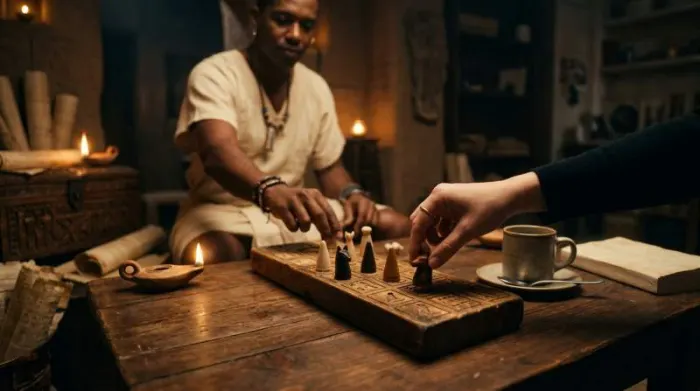
It also invites interesting comparisons. Looking at Senet alongside mid-century toys like G.I. Joe highlights a profound shift in the purpose of play, moving from an object imbued with spiritual meaning toward one focused primarily on entertainment and commercial design. Senet reminds us of play's deeper, older roots.
The Eternal Lesson of the Board
In the end, Senet teaches us that games are never just games. They are cultural artifacts that carry the weight of their creators' worldviews. Senet reflects the ancient Egyptians' deepest concerns: morality, fate, death, and the hope for salvation. It was a microcosm of their universe on a board.
Its journey from the tombs of pharaohs to our coffee tables today speaks to a timeless human need. We all need play. We need strategy, story, and a means to make sense of our place in the world. Senet provided that for an ancient civilization, and in its modern revival, it continues to fascinate and teach.
Whether you see it as a historical curiosity, a challenging strategy game, or a spiritual relic, Senet proves its eternal appeal. It is a game about the journey, and its own journey through history is perhaps its most winning story of all.
What is the oldest board game in the world
While Senet is one of the oldest known board games, the title of the oldest is often given to the Royal Game of Ur, which dates back to around 2600 BCE in Mesopotamia. Senet, however, predates it by at least a few centuries, with the earliest known boards from around 3500 BCE. Both games share a similar race-to-the-end structure, but Senet's deep spiritual ties set it apart as a tool for navigating the afterlife.