
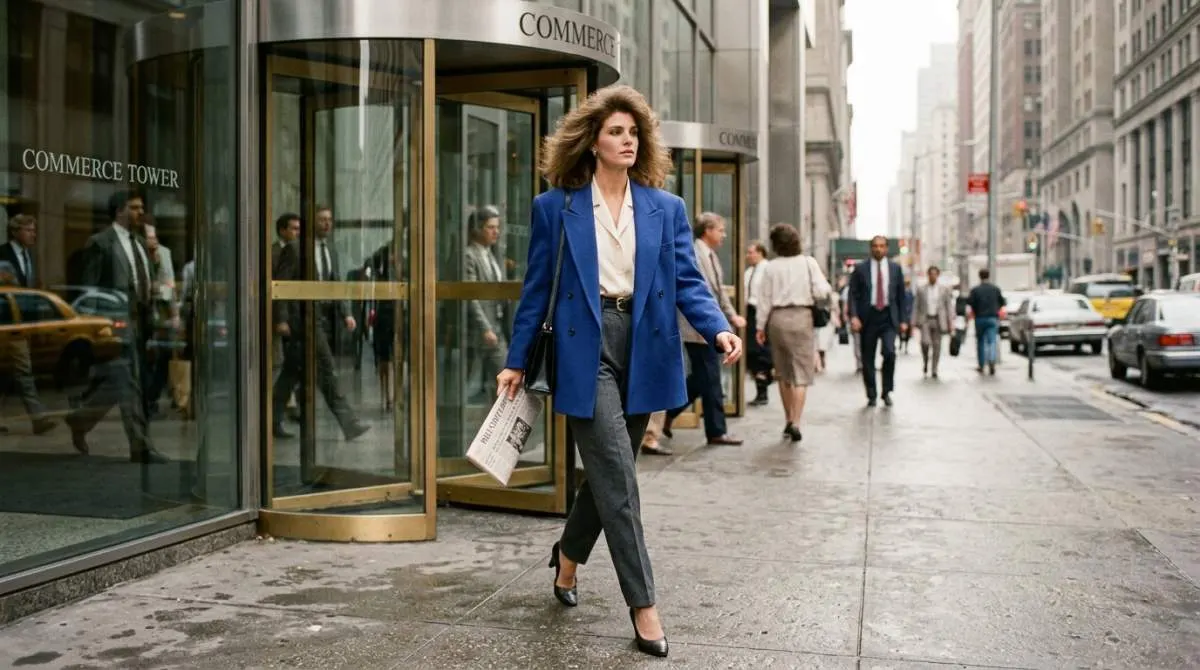
Why the 80s Power Blazer Was a Silent Room-Taking Machine
Power dressing never arrived with fanfare. It slipped in through a side door. The office was a battlefield before anyone spoke, and your suit was your armor [1].
The shoulder line was the first move. My aunt shuffled into a meeting, her blazer huge and squared off like a linebacker. She was a junior accountant, but that jacket said she owned the numbers on the table.
The fabric itself had a voice. Polyester blends whispered when you moved. Wool crepe snapped with authority, cutting through the chatter [2].
This was the mid-1980s, the peak of the yuppie era. The stock market was booming, and corporate culture demanded a uniform. Television shows like Dynasty and Dallas made the power suit a household image [3].
Joan Collins's shoulder pads were so large they seemed to enter a room before she did. On Wall Street, the mantra was "greed is good," and the suit was the badge of that ambition. The blazer's silhouette was a statement: I take up space, and I deserve it.
Color played a role too. Navy and charcoal ruled, but a red blazer was a warning shot. Accessories completed the armor: gold chains, pearl earrings, and a structured briefcase that could double as a weapon.

The click of heels on linoleum was a metronome of power. Every detail was designed to signal competence before a word was spoken.
Architecture for the Body: Foam Triangles and Hidden Scaffolding
Shoulder pads were the hidden scaffolding. They lifted the whole silhouette away from the soft curves of the 1970s. Suddenly, you took up more space in a room, and that space felt like leverage.
Here is the boring mechanical truth: a small foam triangle pinned inside a jacket could square off anyone's posture.
Why the Big Shoulder Worked Like a Crowd-Control Device
The secret spread because it solved a real problem. Offices were male-dominated, and women needed a visual shortcut to authority. A sharp jacket with a defined shoulder line signaled competence before a single word was spoken.
Then it got stranger. The bigger the shoulder, the smaller the waist looked by comparison. This created the iconic V-shape: aggressive but feminine at the same time.
That contradiction was the secret sauce. You couldn't look away from it, and you couldn't slouch in it either. The construction forbade it.
The Hidden Engineering Behind the Power Silhouette
The real trick of 1980s power dressing was never the fabric. It was a geometry lesson. Clothes became architecture for the body, and blazers were cut like buildings.
The air in those rooms was thick with ambition. Perfume and hairspray mixed with Xerox toner. You could smell the effort before the meeting started.
The hair was part of the architecture too. Big and sprayed and frozen in place like a halo of control.
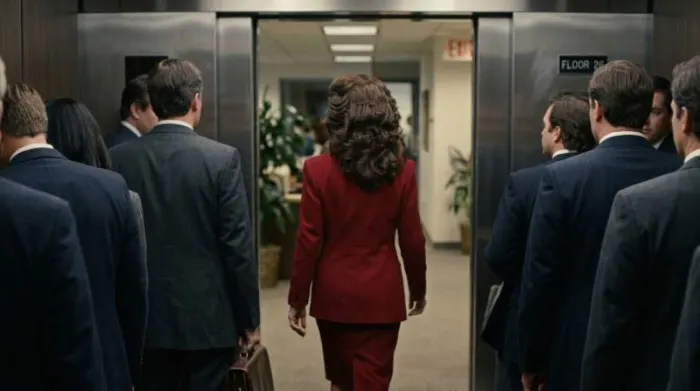
Walking in that suit was a performance. Every step was a footfall of intent. The shoes clicked on the linoleum like a metronome of power.
But the construction itself was a marvel. The shoulder pad wasn't just foam; it was a carefully engineered triangle of padding, often layered with cotton batting and stitched into the lining. The lapel was cut wide to emphasize the chest, and the jacket was nipped at the waist using darts that created a structured hourglass.
The Era:Mid-1980s peak of yuppie corporate culture. The Illusion:Shoulder pads created a V-shape of authority. The Reality:Foam triangles inside jackets squared off posture. Modern Echo:Designers like Armani kept softened power shoulders.
Designers like Thierry Mugler and Claude Montana took this to extremes, with sharp, almost robotic lines. Giorgio Armani, meanwhile, softened the shoulders slightly but kept the power. The suit became a uniform for women entering the workforce in record numbers; by 1985, nearly 60% of women with children were employed. The clothes were designed to help them be taken seriously.
The Psychological Crutch That Kept You Tall
That foam pad was a psychological crutch, and it worked. It made you feel taller, like a crown of ambition. The silhouette was a question asked by the body, and the answer was always yes.
Mood Match
Press Play Before You Walk In
Pick the moment you are about to face, then let the right song do the rest.
Striding into a meeting you are dreading
Everybody Wants to Rule the World by Tears for Fears
That calm, unhurried groove gives you somewhere to hide your nerves while you look like you own the room.
Getting ready to ask for a raise
Express Yourself by Madonna
It is a straight-backed reminder that you do not need anyone's permission to say what you are worth.
Walking into a party where you know no one
I Wanna Dance With Somebody (Who Loves Me) by Whitney Houston
That opening burst of joy is a friend you can carry in with you, even if nobody there knows your name yet.
Rewriting your resume after being passed over
Don't Stop Believin' by Journey
It starts quiet and builds, which is exactly what you are doing at the kitchen table on a Tuesday night.
Some songs are not background music. They are the pep talk you give yourself.
Songs checked against .
The Nineties Fought Back
Then the nineties arrived with a grudge. Grunge bands wore flannel like a protest flag. The message was clear: no more boardroom drag.
But the movies never let go. Every ruthless boss in a sharp suit became shorthand for ambition. Music kept it alive too.
Madonna owned the conical bra, but she also owned the blazer.
Donatella Versace turned power dressing into a second skin. MTV vJs wore oversized jackets to seem older. Anime characters like Motoko Kusanagi used the look for authority.
Rappers borrowed the sharp lapel for album covers. Vogue editors kept the silhouette in every September issue. The power blazer trickled into fast fashion by the 2000s.
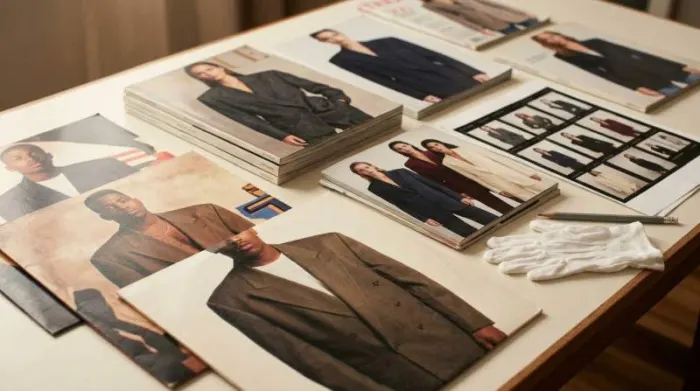
So the look never really died. It went underground. It waited for a generation that wanted to feel strong again.
In the 1990s, even as grunge dominated, the power suit found refuge in unlikely places. The film Working Girl (1988) had already cemented the shoulder pad as a symbol of female ambition. By the mid-90s, the oversized silhouette was adopted by hip-hop artists like TLC and Salt-N-Pepa, who wore blazers over baggy jeans.
The 2000s saw a revival in the form of the "power blazer" in fast fashion, often paired with skinny jeans. The legacy of the shoulder pad is visible in the structured jackets of streetwear brands like Off-White and Supreme. The 80s blazer never left; it just evolved.
Why the Power Blazer Feels Like Armor Again
The open-plan office is quiet. But the video call is a battlefield. We need visual authority now, and we need it fast.
That is why the 80s blazer makes sense again. It was never just fashion. It was a tool for survival.
It is not a costume. It is a psychological shortcut. The modern revival is not about nostalgia but about claiming physical space in a digital world.
The New Rules of the Power Shoulder
Today's version is softer than the original. But the 80s power shoulders are still there. They just hide in stretch wools and relaxed linens.
You feel the structure, but you don't look like a linebacker. A strong shoulder line does that instantly. You don't need a boardroom, you just need a strong line.
Post-pandemic, the power blazer has returned with a vengeance. Zoom dressing requires a top half that commands attention, and the shoulder pad is the perfect tool for that. Brands like Saint Laurent, Balenciaga, and Celine have all debuted oversized blazers with pronounced shoulders.
The visual authority of a sharp collar and a padded shoulder translates beautifully on screen. It's not about replicating the 80s verbatim, it's about borrowing its psychological armor for a world where we need to project strength from a small rectangle. The revival is a reminder that some clothes are more than fabric; they are a declaration of intent.
What was the purpose of shoulder pads in the 1980s
Beyond the boardroom, shoulder pads had a secret life in 1980s pop culture. They were a favorite of sci-fi and fantasy costume designers, who used them to make characters look otherworldly and powerful-think of the sharp, angular shoulders on the villains in 'Flash Gordon' or the heroic armor in 'He-Man.' This borrowed authority from the corporate world and turned it into a visual language for strength in fiction.
Sources
- [1] Power Dressing: How Women Weaponized Clothes to Break the Glass Ceiling · Fashion History
- [2] Greed Was Good, Clothes Were Key, and Barneys Was at the White-Hot Center | Vanity Fair
- [3] Break out the shoulder pads: 'Dynasty' style is happening
Bracketed numbers in the text (e.g. [1]) refer to the sources listed here.