
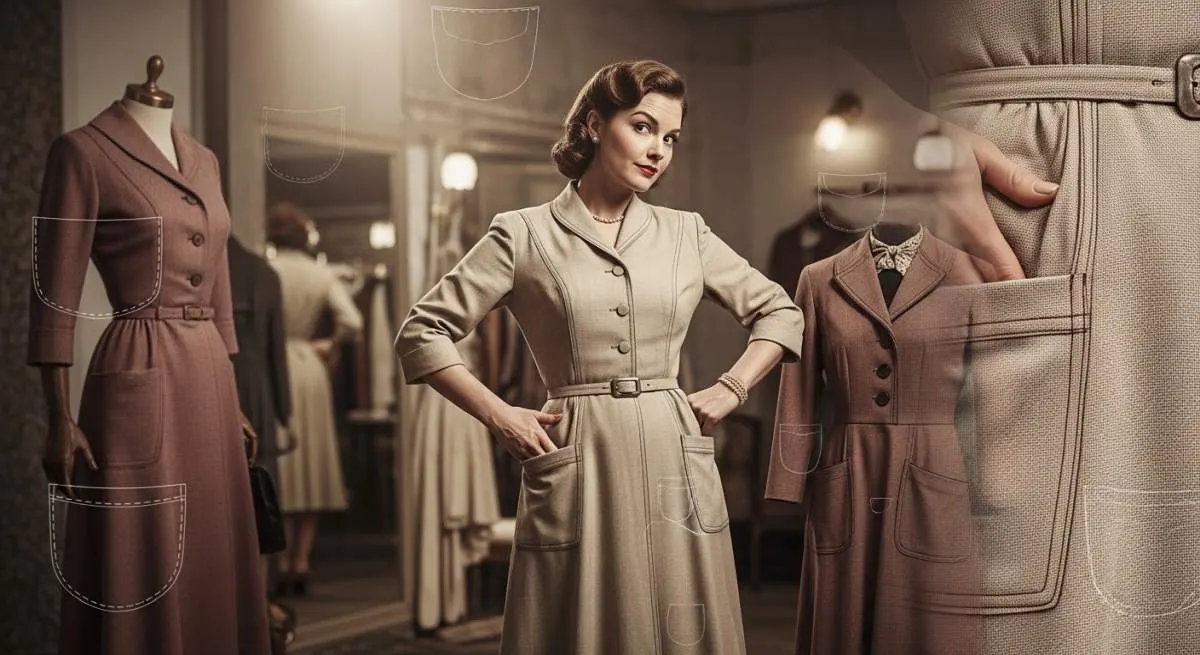
The Pocket Conspiracy: A Stitch in Time
There's one detail about vintage fashion that always sticks with me, and it's definitely not the glamorous part. I remember spotting a beautifully tailored 1950s suit jacket in a vintage boutique once, perfect nipped waist, elegant peplum, and one thing just wouldn't leave my head: there were no functional pockets.
Just stitched-up flaps, mocking any hope of usefulness. Meanwhile, men's suits from the same era had deep, real pockets for wallets, keys, or cigarettes.
This wasn't just a design quirk; it felt like architectural sabotage aimed at half the population.
This isn't about looks; it's about power. Historically, a man's pockets gave him agency, a private space for essentials, money, identity. A woman, on the other hand, was expected to carry a separate accessory: a handbag.
Cute and fashionable, sure, but also an undeniable tether, a constant reminder that her clothes wouldn't provide what she needed. Was women's fashion designed to make us dependent on handbags?
The evidence strongly suggests yes.
When I dug into my grandmother's late 1940s and early 1950s sewing patterns, I found intricate buttonholes and perfect pleats, but never a decent pocket pattern piece, not even for a lipstick. In contrast, 1970s boho patterns often came with functional pockets alongside bell sleeves.
Watching her still struggle to find her glasses in that cavernous purse really drove home how deeply this dependency was passed down through generations. It's more than an inconvenience; it's a cultural inheritance. This was a calculated move, rooted in societal norms that saw women's roles very differently.
As the 19th century gave way to the 20th, even with whispers of women's liberation in the air, the practical pocket stayed mostly absent. Men walked with their hands in their pockets, a gesture of casual command, while women clutched their bags, constrained, always needing an extra piece of baggage.

The shift from internal pockets (worn under skirts in the 18th century) to the external reticule, then the handbag, was more than a style evolution, it was a quiet revolution in control. Back in the 1790s, when neoclassical dresses became sheer and clingy, women's pockets were literally stripped away and replaced with tiny drawstring bags called reticules. Those bags were too small for keys or money, making women depend on male companions for practical needs.
It was a visible statement about women's shrinking access to personal, private space. Without being able to secure money or papers directly on their person, women were inherently less independent.
A wallet in a jacket feels secure; a hand-held bag demands constant vigilance, an easy target. This isn't just about carrying keys; it's about control, about limiting autonomy, stitch by stitch.
How Fake Pockets Enforced Handbag Dependency Through History
The fake pocket was a societal blueprint, quietly shaping women's everyday lives. This deliberate omission, often brushed off as an aesthetic necessity, carried a heavier social weight than most people realize. It left a legacy that stretches from our wardrobes into the streets, workplaces, and even the psychology of how we handle our personal belongings.
For generations, the lack of real pockets in vintage women's clothes wasn't about saving fabric. It was about maintaining a certain feminine ideal, making the handbag feel absolutely necessary.
The fake pocket became a silent symbol of constraint, a subtle but powerful tool of gendered fashion that reinforced women's dependence on handbags. While men's plentiful pockets signaled utility, women's lack of them implied a constant need for an external receptacle. This historical gap in pocket availability wasn't just a fashion footnote; it marked very different societal expectations.
Early feminists saw it for what it was, a restriction on autonomy, and demanded functionality and the right to carry their own essentials.
Ironically, many designers kept churning out garments with decorative but non-functional pockets. Consumers often accepted the 'sleek silhouette' excuse. Even today, plenty of us instinctively reach for a non-existent pocket, a phantom limb of convenience.
The impact ran deep into women's corporate fashion, where the handbag became a must-have, making up for the lack of practical pockets in professional attire. The story of women's pockets and handbags is, at its core, a story of adapting under constraint.
- This dynamic turned the handbag from a stylish accessory into an absolute necessity, inflating its market along the way.
- It reinforced gendered expectations about utility and personal autonomy.
- It created lingering frustration and practical inconvenience in daily life.
- It sparked a quiet, enduring demand for functional clothing.
The ripples are still felt today. Even with a slow, grudging return of functional pockets, that handbag dependency is deeply ingrained. The historical sexism of fake pockets might seem like a niche detail, but its cultural imprint, quietly shaping how women move and operate, is undeniable.
Fashion isn't just fabric; sometimes, it's about control.
The Modern Battle for Functional Pockets and Autonomy
The historical evidence is clear: the fake pocket was no innocent oversight. It was a deliberate design choice, a subtle nudge, often a forceful shove, meant to keep women reaching for a handbag.
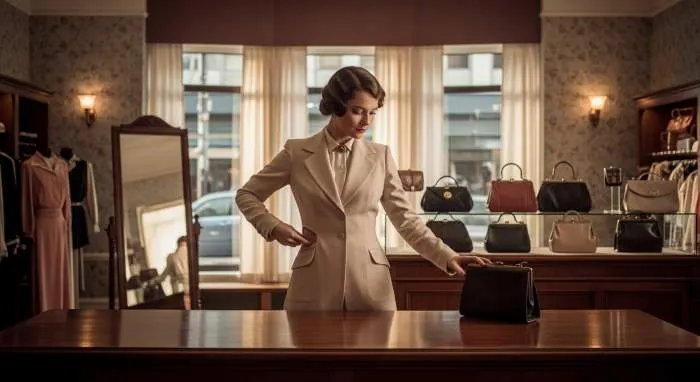
This sartorial legacy isn't some act of rebellion, it lingers. The deliberate absence of pockets in vintage women's clothes created a learned dependency that just won't go away. Decades after suffragettes sewed pockets into their skirts as an act of rebellion, we're still dealing with the fallout.
Walk into any clothing store today. Men's sections are full of deep, functional pockets for keys, wallets, and phones. Women's sections, though, still often feature ghostly outlines where no real pocket exists, or pockets so shallow they're basically useless.
Those habits and expectations have outlived the era that created them. Last week at a coffee shop, I watched a woman fumbling to pay, phone tucked precariously under her arm, wallet clutched in her hand. Without a bag or pockets, her hands were literally full, juggling her life.
It looked exhausting. In stark contrast, my male colleague just pulled his card from his jeans without a second thought.
The scene highlighted a grim reality. The outcry for functional pockets is a constant battle. Women are tired of being treated like we have nothing to carry; we're demanding utility over mere aesthetics.
We want to carry our essentials without juggling or being forced into another purchase. This isn't just about convenience, it's about autonomy, about having the space to exist in the world without an extra appendage. This is women's style defiance in action, a direct answer to the question of why women's clothes have no pockets.
We're seeing a slow, grudging shift. Some designers are finally catching on, advertising 'real pockets!' as a revolutionary feature instead of a basic necessity.
It's a small victory, a ripple against decades of engineered inconvenience.
The default should be utility, not its absence. This isn't over. The ghost of the fake pocket still whispers, reminding us how easily freedom can be withheld, stitch by deliberate stitch.
Why did women's clothes not have pockets in the 1950s
In the 1950s, women's clothes often lacked pockets because designers prioritized a smooth, unbroken silhouette, which was considered more feminine and elegant. But there's a deeper story: during World War II, women's workwear did include functional pockets for tools and ration books, yet after the war, fashion magazines and advertisers pushed handbags as a way to restore a 'ladylike' image, effectively erasing that wartime practicality. This shift wasn't just about style; it was a deliberate move to reinforce traditional gender roles in a time of social change.