
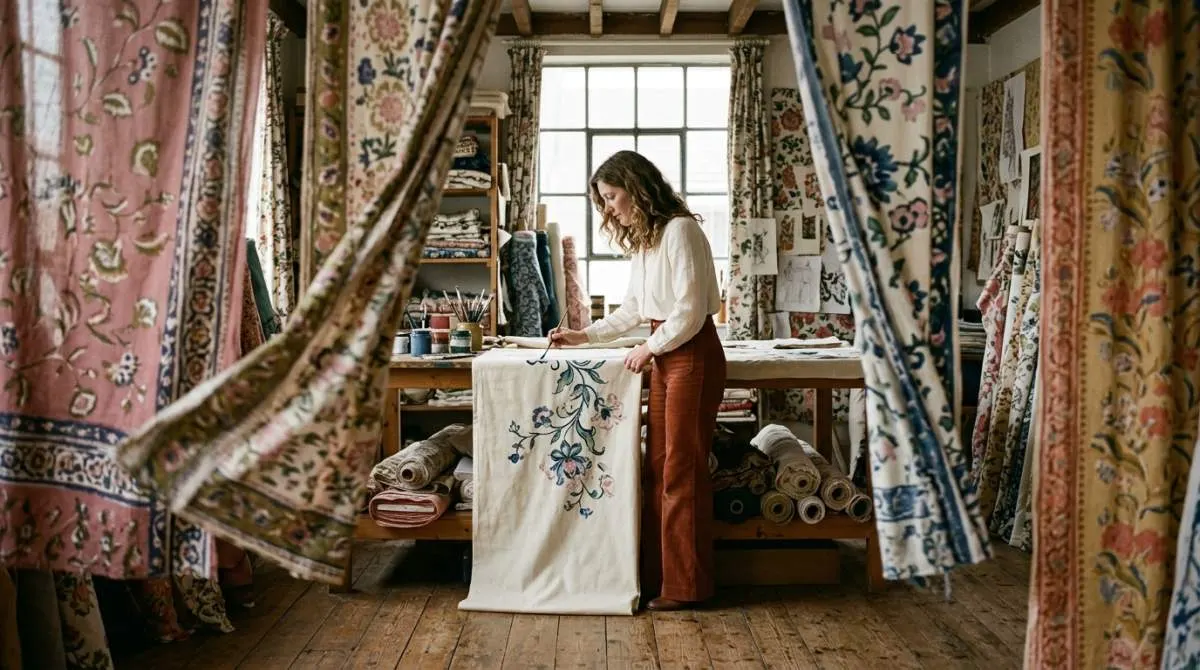
Picture a bolt of silk chiffon, unspooling across a worktable in a London studio. It’s 1969, and the fabric is alive with swirling, painterly peonies and bold, graphic stripes, a riot of color that feels both ancient and utterly new. This is the moment before the dress, before the model, before the flashbulbs.
This is the print. And for a generation that defined a certain romantic, liberated London bohemian style, that print could only belong to one artist: Celia Birtwell.
While the swinging sixties had many architects, its most enduring visual texture came from Birtwell’s hand. Her designs weren’t just patterns on cloth; they were the very skin of the era. Worn by everyone from rock stars to aristocrats, her work with designer Ossie Clark created a signature look: fluid, sensual, and defiantly feminine.
But to reduce her story to that famous partnership is to miss the richer, more independent narrative of an artist who first sold a design to Heals, became a muse to David Hockney, and, after a long hiatus, built a second act in interior design that proved her talent was always hers alone.
Celia Birtwell's Art School Roots and Collaborative Alchemy
Celia Birtwell’s journey began far from the London salons, at Salford School of Art. Her eye was trained not on fashion magazines, but on the masters: Picasso, Matisse, and the classical world. She drew deep inspiration from sources like Leon Bakst’s exotic costumes for the Ballet Russes, translating that theatricality into repeat patterns meant for living in.
Her first professional break was tellingly independent. She sold her very first textile design to Heals, the prestigious furnishings store, marking her entry into the world of applied art. But the alchemy that would ignite her career came in 1965, when she began designing textiles specifically for the collections of a young designer named Ossie Clark. He was the sculptor of the body; she was the painter of its surface.
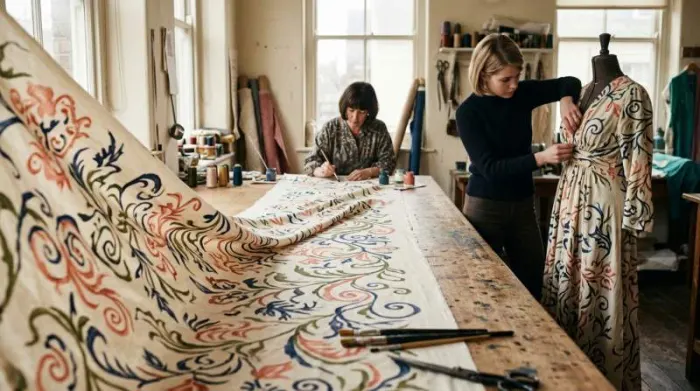
Their collaboration was a perfect, volatile fusion. Birtwell would create her bold, romantic, and feminine prints. Clark would then take these printed fabrics: luxurious silk chiffon, delicate jersey, soft crepe de chine, and sculpt them into garments that moved with the wearer.
The result was clothing that felt like a second skin, adorned with art. It was a look that caught fire, earning international critical acclaim and defining the visual language of the London scene.
- Her first commercial success was selling a textile design to the Heals furnishings store.
- She formed a legendary creative partnership with fashion designer Ossie Clark.
- Her work was celebrated in David Hockney's famous portrait 'Mr and Mrs Clark and Percy'.
- She later launched an independent career in interior design with her own shop.
- Her prints remain influential in both vintage fashion and modern bohemian style.
Celia Birtwell's Muse Circle: Hockney, Clark, and a Bohemian Wedding
Birtwell’s life became inextricably woven with the era’s other great creatives. She married Ossie Clark in 1969, in a union that was as much a creative partnership as a personal one. The wedding itself was a snapshot of the scene, with artist David Hockney serving as best man.
Hockney had already drawn Birtwell in 1968, and she quickly became one of his most significant muses. Their friendship, spanning over half a century, was built on deep mutual admiration and a refreshing honesty. He famously captured her domestic life in the iconic double portrait ‘Mr and Mrs Clark and Percy’ (1970-71), cementing her image in the art historical canon just as her prints were defining the fashion one.
The ripple effect of this creative circle extended further than London. Yves Saint Laurent himself was influenced by Ossie Clark’s designs after visiting his shops, immediately adapting elements of the style for his own collections. The Birtwell-Clark vision, born in a shared studio, was echoing on the world’s most prestigious runways.
Plot Twist
- It’s easy to think Celia just made the pretty prints for Ossie’s dresses and that was the end of her story.
- Truth is, she sold a design to Heals long before that partnership, and after a break, she opened her own shop in 1984 and built a whole new career as an interior design powerhouse.
Celia Birtwell's Career Beyond the Dress: The Independent Line
The myth of the muse is a powerful one, but it often obscures the artist. The common misconception that Birtwell’s success was solely derivative of Clark’s, and that she faded after their split, is stubborn but completely false. Her first commercial step was alone, selling that design to Heals.
And her most significant later step was taken alone, too. After stepping back from the fashion world in 1973, Birtwell returned over a decade later not as a collaborator, but as a proprietor. In 1984, she opened her own shop in Notting Hill.
Here, she transitioned her signature aesthetic from the body to the home, establishing herself as a major force in interior design. Her prints now adorned curtains, cushions, and wallpapers, bringing that same romantic, art-inflected sensibility into domestic spaces.
This second act was no nostalgic retreat. It was a robust, successful expansion of her artistic vision. She later circled back to fashion through collaborations, but on her own terms, working with brands like Cacharel and John Lewis. This trajectory proves a vital point: her voice was always distinct, and her talent was always durable.
Where Celia Birtwell's Print Legacy Lives On
So where can you feel the Birtwell effect today? The most direct route is through the vintage fashion market. Original Ossie Clark garments featuring her prints are highly collectible artifacts, hunted through specialist dealers and auctions.
To hold one is to feel the weight of that silk chiffon and the precise, playful energy of her designs: a world away from the sometimes soulless prints of fast fashion. Her influence also permeates modern aesthetics. The resurgence of romantic, flowing silhouettes and painterly prints in contemporary bohemian style often channels her spirit.
More concretely, her later interior design fabrics sometimes surface in vintage homeware markets. And for a curated hit of history, museums like London’s Fashion and Textile Museum have exhibited her work, placing those iconic textiles in their proper cultural context.
Celia Birtwell’s legacy is a pattern that repeats, but never exactly the same. It’s in the swirl of a peony on a 1972 dress and in the echo of that swirl on a modern cushion. She was the muse who always held the brush, the collaborator who never lost her own line.
In the end, her story isn’t just woven into the fabric of the sixties and seventies. It’s the proof that the most enduring prints are the ones an artist makes for themselves.
What did Celia Birtwell design for Ossie Clark
Celia Birtwell's prints for Ossie Clark were often hand-painted directly onto silk before being screen-printed, a technique she learned from her father, a textile printer. This gave each design a painterly, one-of-a-kind feel that mass production couldn't replicate. Her peony and stripe patterns became so iconic that they were later referenced in the 1998 film 'Velvet Goldmine'.