Picture a teenager in Milan, her hand hovering over the radio dial. It’s 5:39 PM on a Saturday in late 1965. The room is tense with anticipation.
Then, a blast of twanging guitar and driving rhythm fills the air-Rocky Roberts’s ‘T Bird.’ The show’s signature theme was a declaration of intent before a single word was spoken. This was the weekly call to order for Italy’s first media-defined youth tribe.
That show was Bandiera Gialla . It first aired on October 16, 1965, on RAI’s Secondo Programma.
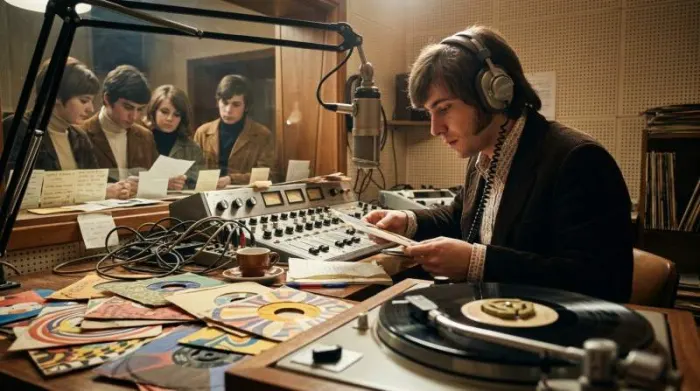
Conceived by two young hires, Gianni Boncompagni and Renzo Arbore, it wasn’t just a music program. It was a carefully constructed clubhouse.
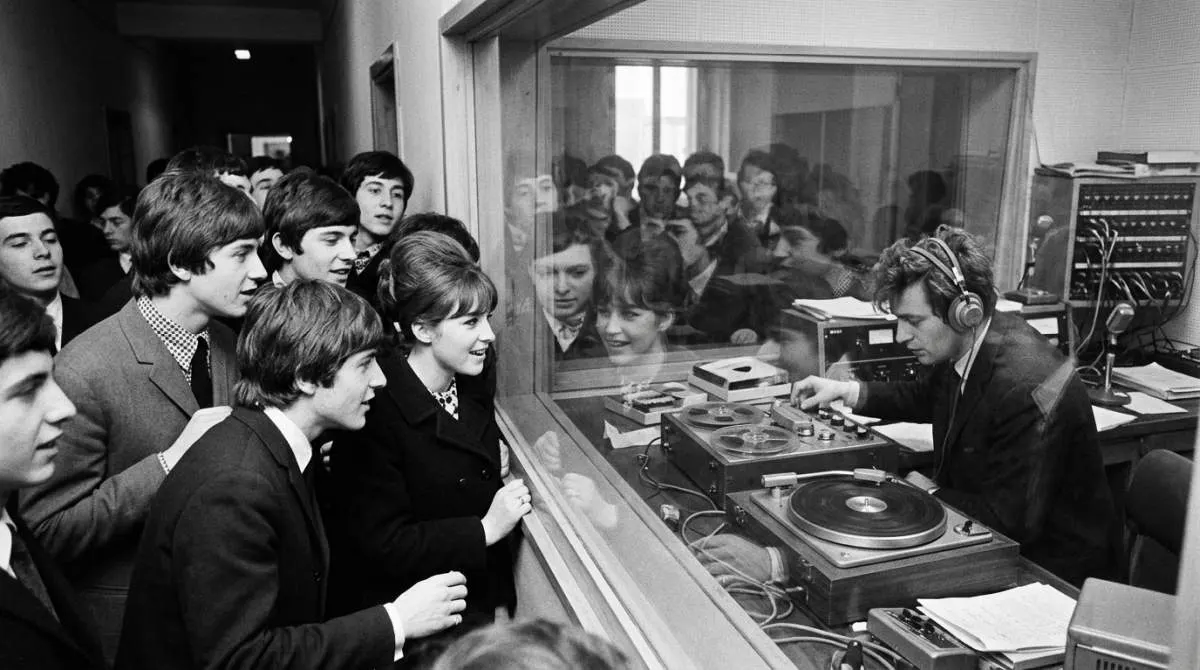
Its format was deceptively simple: a competition. Twelve new songs, presented in groups of three, were voted on by a live studio audience of teenagers using small yellow flags.
Mood Match
Four Moments Worth a Needle Drop.
Here is a little list for the days when you need a song to match the feeling, not fight it.
Dancing alone in the kitchen.
T-Bird by Rocky Roberts.
That loose, swaggering beat is made for bare feet on lino and a wooden spoon for a microphone.
Waiting for the radio countdown.
Ragazzo triste by Patty Pravo.
Patty's melancholy voice drifts through the wait perfectly, all longing and static and held breath.
Arguing with your parents again.
Ma che colpa abbiamo noi by The Rokes.
The title asks the question you have been shouting all evening, and it asks it far more gracefully.
Losing gracefully at something small.
Bisogna saper perdere by The Rokes.
The song says you have to know how to lose, which is exactly the lesson you were hoping not to hear.
Play them in order, or shuffle. Nobody is marking you.
Songs checked against en.wikipedia.org.
The weekly winner earned the title ‘disco giallo.’ For a country still navigating a post-war identity, this was a quiet but profound cultural revolution. Radio, often seen as the medium of the past, suddenly became the frontier of the future.
The Coded Rebellion of a Yellow Flag
Every episode opened with the same phrase, delivered by Boncompagni with mock-serious authority: ‘rigorosamente riservato ai giovanissimi.’ Strictly reserved for the very young. Adults over 18, the announcement warned, listened at their own risk. This wasn’t just a gimmick. It was a brilliant piece of social engineering.
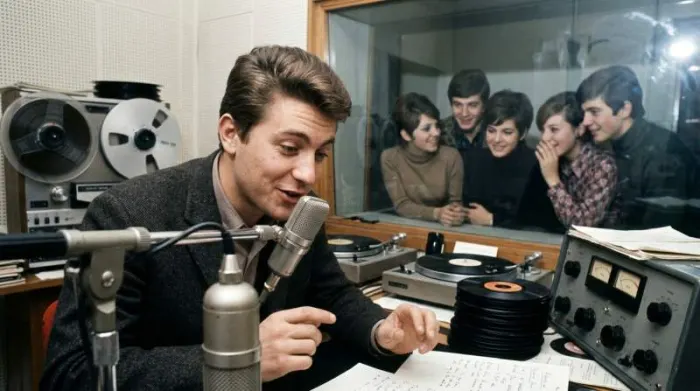
In a media landscape still dominated by paternalistic figures and formal language, this exclusion was revolutionary. The show’s ‘rebellious’ stance was, by necessity, somewhat cautious.
RAI was a state broadcaster, not a pirate radio station. So the hosts used a familiar framework-the song competition, akin to the venerable Sanremo Festival-as a Trojan horse.
Inside that safe format, they could promote the new, the foreign, the beat. As Renzo Arbore later explained, the voting system with the yellow flags was an ‘alibi.’ It allowed them to play a record multiple times, to launch it, while claiming it was purely the audience’s democratic choice. The show's very name, 'Yellow Flag,' was a subtle nod to quarantine flags-a metaphor for a space isolated from the 'contagion' of adult culture. This was particularly resonant in a society where youth were expected to swiftly transition from childhood to adult responsibilities, with little space for a distinct teenage identity.
The Saturday Afternoon Ritual
The ritual was as important as the music. The show aired at 5:40 PM on Saturdays. It demanded participation, turning listening from a passive act into a communal event. You weren’t just hearing songs; you were taking sides in a battle for the ‘disco giallo.’
For the select few in the studio, the physical act of raising a yellow flag was a moment of tangible power. For the millions listening at home, it was an act of imagination and alignment. The timing was strategic, falling after the traditional Saturday lunch and before the evening's family activities, creating a protected pocket of autonomy. Sociologists later noted how this weekly appointment helped standardize the teenage weekend across Italy's diverse regions, from industrial Turin to rural Sicily.
The music itself was a guided tour through a changing world. The playlist mixed international acts like The Beatles and The Rolling Stones with emerging Italian artists riding the ‘beat’ wave. It was here that many Italians first heard the sounds that would score their adolescence.
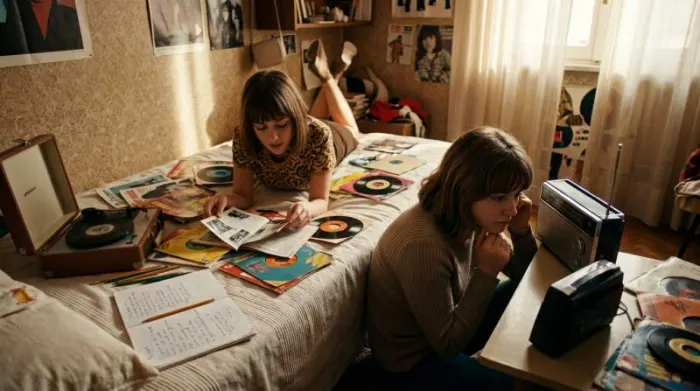
Beyond British and American hits, the program introduced Italian audiences to the French yé-yé of Françoise Hardy, the raw energy of homegrown beat groups like I Corvi or I Giganti, and even early forays into psychedelia. This curation was a deliberate education in contemporary pop, contrasting sharply with the traditional canzone and orchestral music that dominated RAI's other channels.
- The show’s iconic theme was ‘T Bird’ by Rocky Roberts, a slice of American-style rock and roll that set an energetic, modern tone.
- Hosts Gianni Boncompagni and Renzo Arbore were hired by RAI in 1964 specifically to refresh its music programming for a younger demographic.
- The ‘disco giallo’ (yellow record) was the weekly winner, a tangible prize that carried significant weight in the emerging Italian pop charts.
- The live audience was composed entirely of selected teenagers, making their judgment the sole arbiter of a song’s success on the program.
- This model represented a seismic shift from RAI’s older, conservative programming to a format built on youth participation and contemporary taste.
- The show's aesthetic extended beyond audio; its minimalist studio set, focused on the host's desk and the audience with their flags, became an iconic visual of the era.
- Bandiera Gialla's success directly influenced RAI to launch other youth-oriented programs, creating the first dedicated 'circuit' for teenage listeners.
The Legacy in the Static
Bandiera Gialla didn’t last forever-it ended its original run in 1970. But its echo is profound. It successfully carved ‘youth’ out as a distinct media category in Italy. It proved there was an appetite, and a market, for programming that spoke directly to the teenage experience without condescension.
This paved the way for everything that followed in Italian vintage audio culture, from the radio DJ as a celebrity to dedicated youth channels. Its format was a direct precursor to the audience-participation models of later shows like *Deejay Television* and the call-in votes of modern talent competitions. Furthermore, it established a template for the radio DJ as not just an announcer, but a curator, tastemaker, and trusted peer-a role perfected by later icons like Radio DJs like Claudio Cecchetto.
Today, the nostalgia for Bandiera Gialla isn’t just for the songs. It’s for that specific, weekly moment of collective anticipation. It’s for the thrill of the warning announcement, a spoken barrier that made you feel chosen.
For a generation, the crackle of the radio at 5:40 on a Saturday became the sound of their world opening up. The program is now recognized as a key cultural artifact of Italy's 'economic miracle' period, a symbol of the new consumer and media power of the younger generation. Its archive serves as a crucial sonic document of Italy's rapid social modernization in the late 1960s.
Sources
- La nascita di "Bandiera gialla", 1965, Rai Teche
- 50 anni fa nasceva alla radio Bandiera Gialla con la strana coppia Boncompagni Arbore, ANSA
The sources we read for this article.
What does bandiera gialla mean in italian
In Italian, 'bandiera gialla' literally means 'yellow flag.' But its cultural meaning goes deeper: it was a sly reference to quarantine flags used on ships to signal isolation. The show's creators used this metaphor to carve out a space for youth, separate from the adult world-a clever nod to the teenage desire for independence.