
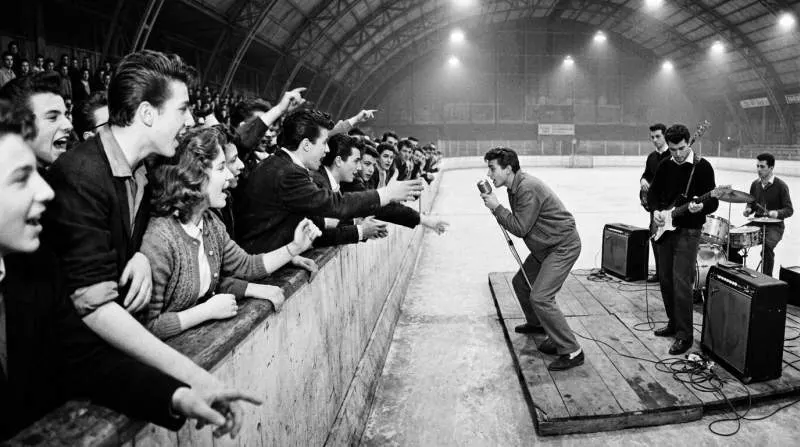
The air inside Milan’s Palazzo del Ghiaccio was thick with the smell of damp wool, cigarette smoke, and something new: teenage rebellion. On the makeshift stage, a lanky young man in a borrowed suit was twisting his hips in a way that made the chaperones in the back shift uncomfortably. His knees seemed to have a life of their own, a syncopated bounce that would earn him a nickname before the night was over.
Outside, the line of kids stretched down the block, a sea of freshly acquired blue jeans and leather jackets, all waiting to get into the Trofeo Oransoda. They had no idea they were about to witness the birth of Italian rock 'n' roll.
This was May 18, 1957. Post-war Italy was a place of reconstruction and rigid social codes, where popular music meant melodic crooners and orchestrated ballads. The American rock 'n' roll explosion of Elvis and Bill Haley was a distant radio signal, a thrilling but foreign noise. The idea of a homegrown festival dedicated to this alien sound was, to most adults, absurd.
Yet Bruno Dossena, a young dancer from the city’s jazz cellars, saw a different future. He conceived and directed this event, betting that Milan’s youth were ready to make the sound their own. The festival was sponsored by Oransoda, a popular orange soda brand, which exemplified how burgeoning consumer culture and youth marketing were beginning to intersect in Italy's "economic miracle."
The Band That Wasn't Supposed to Be
The story of the Rock Boys reads like a backstage farce. According to Enzo Jannacci, the band began with just him on piano and his friend Giorgio Gaber on guitar. They needed a frontman, someone with the charisma to sell this strange new music. Their first choice fell through.
In a pinch, they recruited Adriano Celentano, a local character known more for his dead-on Jerry Lewis impressions than his musical prowess. They added saxophonist Luigi Tenco. This was the hastily assembled, somewhat accidental group that took the stage as Celentano and his Rock Boys.
They weren’t the only act. The bill featured La Original Lambro Jazz Band and Swing Parade, names that hinted at a safer, more familiar jazz-and-swing tradition. But the Rock Boys were the wild card.
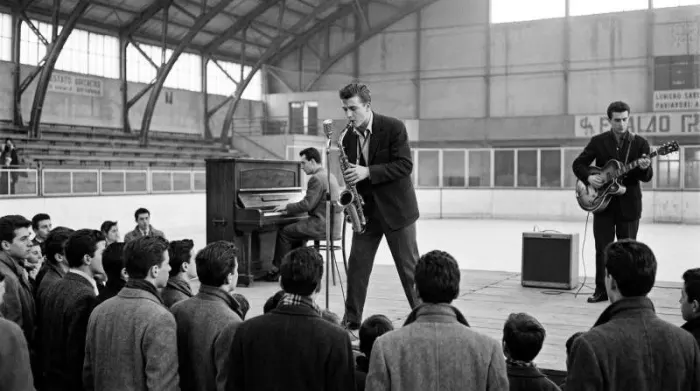
Their sound was a rough, enthusiastic approximation of American rock, filtered through the melodic sensibility of Italian song. The instrumentation itself was a cultural hybrid: the piano and saxophone came from jazz, the guitar from folk and emerging pop, all repurposed for a new, driving rhythm.
When they launched into their competition piece, 'Ciao ti dirò,' it wasn't a perfect imitation. It was something else entirely: a translation. The song's structure, while borrowing rock's energy, retained a distinctly Italian melodic line, foreshadowing the "cantautore" (singer-songwriter) tradition that would later define Gaber, Jannacci, and Tenco.
7,000 Kids and a Nickname Forged in Chaos
The festival drew a crowd its organizers could scarcely handle. About 7,000 youths, aged 14 to 20, crammed into the ice rink. This wasn't a polite listening audience; it was a pulsing, kinetic mass. The sheer number was a shock to the city's establishment, signaling the scale of a pent-up demand for new cultural forms.
The American-style uniforms of jeans and leather jackets were a deliberate sartorial manifesto, a rejection of the formal wear expected at public dances. This fashion was not mere imitation; it was a uniform of affiliation, visually separating the new youth cohort from their parents' generation. The energy tipped into minor chaos, a joyous, slightly frightening upheaval that kept the city awake. Reports described scenes of youthful exuberance spilling into the streets, a novel spectacle in a society still largely governed by post-fascist conformity.
And at the center of it all was Celentano. His dancing was unorthodox, a spastic, compelling jerking that one newspaper critic compared to a marionette with loose strings. The legend goes that a mix-up with a French dancer named Jack La Cayenne led to him being dubbed 'Il Molleggiato': The Springy One.
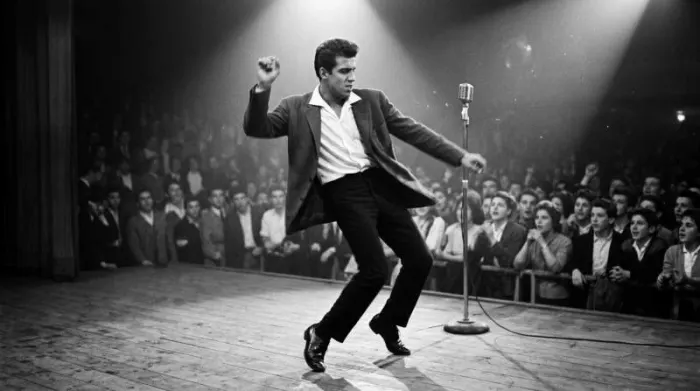
This nickname did more than describe; it mythologized. It turned an idiosyncratic style into a marketable persona, a precursor to the modern pop star image.
The name stuck, perfectly capturing the elastic, unpredictable physicality that became his trademark. That night, the performer was born. His stage presence offered a physical counterpart to the musical rupture: where the music broke auditory rules, his body broke physical decorum.
- The event was officially patronized by the Christian Democracy party, a fascinating detail that shows how this 'Italian variant' of rock was initially framed not as political rebellion, but as harmless, American-inspired youth fun. This patronage was a strategic attempt to co-opt and sanitize a potentially subversive foreign influence, channeling it into an acceptable, apolitical consumer activity.
- Hidden in that heaving crowd was Walter Guttler, an important Italian record producer. He wasn't there for the politics or the fashion; he was listening. What he heard in Celentano and the Rock Boys convinced him there was a market for this new hybrid sound. Guttler represented the emerging Italian music industry, which was cautiously seeking new talent to capitalize on the changing market.
- The band's win with 'Ciao ti dirò' was more than a trophy; it was validation. It proved that a group of Italian kids could command this genre and make an entire arena scream for it. The victory provided crucial legitimacy, demonstrating that rock 'n' roll could be successfully domesticated and resonate with a local audience.
The Aftershocks of an Ice Palace Earthquake
The Trofeo Oransoda was a one-night stand, but its vibrations reshaped the Italian cultural landscape. For Celentano, it was the launchpad. Guttler’s presence led directly to his first recordings, transforming the 'Molleggiato' from a local stage phenomenon into Italy’s first true rock 'n' roll star.
His career would become a billion-dollar industry, but it started with those shaky spotlights on an ice rink stage. His early hits, like "24.000 Baci," directly channeled the raw energy of that night into a polished, yet still rebellious, product for the masses.
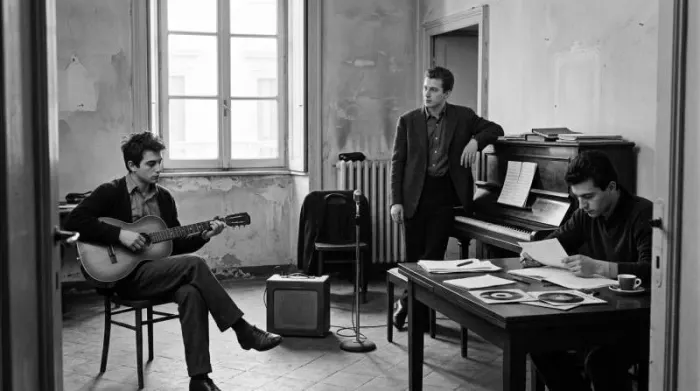
For his bandmates, it was the first chapter in legendary careers. Gaber, Jannacci, and Tenco each evolved into profound and influential singer-songwriters, using the attention and energy of that rock beginning to forge deeply Italian modes of musical storytelling. The Rock Boys disbanded, but their legacy was the proof of concept: rock could be Italian.
The event also hinted at the coming cultural clash between generations, a dress rehearsal for the more overt social battles of the 1960s. It established a template where youth could gather en masse around a shared cultural identity that was distinct from, and often opposed to, that of their elders.
Historically, the festival marked a pivotal moment in Italy's Americanization: not a passive import, but an active, creative adaptation. It showed how global cultural currents were being locally processed in a Europe still rebuilding from war. The ice rink, a symbol of leisure, was temporarily transformed into a crucible for a new national popular culture.
You can’t visit the moment, but you can stand on the spot. The Palazzo del Ghiaccio still stands in Milan. If you press your ear to its cold walls, you won’t hear the ghost of a guitar solo. But you might sense the echo of 7,000 foot-stomps, the residual crackle of a circuit overloading.
That night, Italy didn’t just import a genre; it spliced the gene. The nervous, springy kid on stage, backed by his friends, fused American rhythm with Italian soul. They didn’t just play rock 'n' roll.
They made it theirs. The Trofeo Oransoda proved that the future of Italian music would not be found in pure imitation, but in this very act of creative, defiant synthesis.
What song became the surprise hit of the 1957 rock gathering?
A local singer named Adriano Celentano debuted his catchy tune 'Il Tuo Bacio' at the gathering, and it quickly became a sensation. The song's lively rhythm and heartfelt lyrics captured the spirit of the moment, spreading joy far beyond the chilly venue.