

The Mary Jane Before Grunge
The Mary Jane shoe has roots stretching back to the early 1900s, when it appeared in children's fashion as a practical, buckled flat with a rounded toe. The name likely came from a popular comic strip character of the same era, though the exact origin remains debated among fashion historians. For decades, the shoe stayed firmly in the schoolgirl realm: patent leather, pristine, a symbol of obedience and propriety. Mothers bought them for their daughters. Teachers approved. The Mary Jane was innocent by design and by cultural agreement [1].
Turning Sweetness Into Defiance
Courtney Love didn't invent grunge fashion, but she weaponized it in a way that no male musician in the Seattle scene had managed. While Kurt Cobain and the men of grunge wore thrift-store flannel and ripped jeans as a kind of accidental uniform, Courtney approached her look with theatrical precision. She understood that pairing innocent symbols with aggressive styling created a visual jolt that made people uncomfortable, and that was exactly the point [2].
She took the Mary Jane, that emblem of obedience and girlhood, and paired it with ripped fishnets, smeared dark lipstick, slip dresses worn over band t-shirts, and cardigans that looked like they'd been salvaged from a dumpster. The shoes stayed buckled and neat while everything else fell apart. It was a deliberate clash of innocence and anarchy, femininity and rage. The Mary Jane became a symbol of reclaimed power, not submission [3].
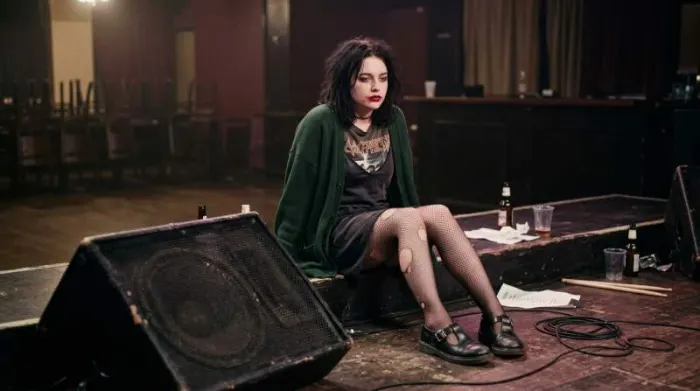
This wasn't accidental thrifting. Courtney was making a statement about how women could occupy space in rock music and counterculture without erasing their femininity or pretending to be one of the boys. The Mary Jane, worn with intention and attitude, became proof that you could be both pretty and dangerous, both girl and grunge.
The Look That Defined a Generation
By the early 1990s, Courtney's style was everywhere: in music videos, on magazine covers, in the pages of The Face and i-D. Teenage girls who had never heard of Hole or cared much about Seattle's music scene suddenly wanted Mary Janes. But they didn't want them pristine. They wanted them scuffed, worn, paired with visible socks and attitude. The shoe became a shorthand for a whole aesthetic: the slip dress worn as outerwear, the baby tee under a vintage slip, the choker, the dark lipstick, the deliberately messy hair.
What made Courtney's version of grunge different from the male-dominated Seattle sound was its relationship to femininity. She didn't reject it; she weaponized it. The Mary Jane, in her hands, became a way to say: I can be feminine and fierce. I can wear what little girls wear and still be dangerous. That contradiction was the whole point.
Rebellion Against the 80s and 90s Preppy Ideal
The late 1980s had been dominated by power suits, shoulder pads, and a very specific vision of femininity: polished, controlled, expensive. The preppy aesthetic, which had roots in East Coast wealth and exclusivity, celebrated pristine loafers, crisp collars, and an air of untouchable perfection. Grunge emerged partly as a direct rejection of that world. It was anti-fashion in theory, though in practice it became a very specific look.
For women in grunge, the challenge was different than it was for men. Male grunge musicians could simply wear what they already owned: flannel shirts, jeans, work boots. They looked like they weren't trying. Women, by contrast, were expected to be decorative, and grunge offered a way to opt out of that expectation without looking like you were trying too hard to opt out. The Mary Jane, worn with ripped tights and a slip dress, solved that problem. It looked like you'd grabbed whatever was in your closet, but it actually required a very specific kind of intentionality.
The Philosophy of Looking Innocent and Edgy
The styling of the grunge Mary Jane look was never just about clothes; it was a carefully constructed attitude. It required a specific kind of intentionality that looked effortless, a way of layering sweetness with an edge. The look thrived on contradictions: a silky slip dress worn over a thin knit top, or a babydoll dress in dark velvet paired with scuffed shoes. Visible socks, ribbed or sheer, became a signature, adding a layer of texture and a hint of schoolgirl practicality turned subversive.

This aesthetic extended beyond the wardrobe. Beauty was looser and messier than the polished 80s ideal, but it was a deliberate mess. Hair was tousled, not neglected; smudged eyeliner felt more blended and refined than haphazard. The goal was to infuse your own personality, to lean into the sweetness or amplify the edge as you saw fit. It was a look that said you understood the rules of femininity well enough to break them on your own terms.
For those curious about how to integrate this spirit today, the key is in the mix. An oversized, luxurious knit cardigan can soften a tougher slip dress, while delicate chokers layered with bolder chain necklaces play with scale and intention. The modern take is less about replicating a 1994 outfit and more about capturing the philosophy, the smart, personal choices that make a classic schoolgirl Mary Jane shoe feel defiant all over again.
Not So Kinder
- Everyone thinks Courtney Love herself came up with the term 'kinderwhore' to describe her iconic look.
- Actually, the term was coined by a music journalist, and Courtney herself had a more complex, ironic take on the aesthetic.
Source: dazeddigital.com
How the Look Changed Across Decades
By the early 2000s, grunge had already become a reference point rather than a living movement. Courtney Love's Mary Jane look was revived by fashion designers and worn by celebrities who had no connection to the Seattle scene. The shoes appeared in high-fashion editorials, styled with expensive fabrics and polished hair. The contradiction that had made the look powerful, the clash between innocence and aggression, began to flatten into pure aesthetics.
In the 2010s, the Mary Jane experienced a full-scale revival, appearing in collections from Prada, Gucci, and other luxury brands. The shoes were expensive now, made from premium leather, sometimes embellished. They were worn by fashion bloggers and Instagram influencers who styled them with carefully curated outfits. The grunge attitude was still there in theory, but the economic reality had shifted. A Mary Jane from a luxury brand cost what a teenager in the 90s might have spent on an entire outfit from a thrift store.
Today, the Mary Jane exists in multiple registers at once. You can buy a vintage pair for ten dollars at a thrift store and style it with the original grunge attitude. You can buy a designer version and wear it as a statement of ironic nostalgia. You can wear it as a genuine fashion choice, divorced from any reference to the 90s at all. The shoe has become flexible enough to contain all of these meanings simultaneously.
Why Courtney Love Endures as an Icon
Courtney Love's influence on 90s fashion extended far beyond the Mary Jane. She showed that a woman could be messy, angry, sexual, and powerful all at once, and that her appearance could reflect all of those things without apology. She didn't dress for approval. She dressed for impact.
The Mary Jane, in particular, became a symbol of that philosophy. It was a shoe that said: I can wear what you think is innocent and still be dangerous. I can be feminine and fierce. I can reject your expectations while wearing the very symbols of those expectations. That contradiction, that refusal to choose between sweetness and aggression, is what made the look so powerful and why it continues to resonate today.
The Mary Jane style endures because it champions authenticity and rebellion. It reminds us that femininity is powerful, that it can be imperfect, and that the most effective fashion statements are often the ones that make people slightly uncomfortable. Today, we draw inspiration from that original grunge spirit, wearing it with a knowing smile rather than just a snarl. It remains a versatile, iconic look precisely because it refuses to be pinned down to a single meaning.