
The Tomb That Shook the World
In November 1922, archaeologist Howard Carter peered into a small opening in Egypt's Valley of the Kings and whispered the now-famous words, "I see wonderful things." The discovery of Tutankhamun's nearly intact tomb sent shockwaves far beyond the archaeological community. Newspapers and newsreels splashed images of golden sarcophagi, jeweled collars, and the boy king's magnificent death mask across the globe, igniting a public obsession.
Within months, a full-blown Egyptomania had taken hold. It was a cultural fever that gripped fashion, film, and home decor in ways no one could have predicted. The world was hungry for glamour and mystery after the grim years of World War I, and the treasures of a lost civilization provided the perfect escape. This wasn't just a passing interest; it was a full-scale cultural collision that would redefine the look of an entire decade.
The Birth of Tutmania
The phenomenon, dubbed "Tutmania," exploded in late 1922 when Carter's sponsor, Lord Carnarvon, cabled the sensational news to London. By early 1923, department stores in New York and Paris were already capitalizing on the craze, selling Egyptian revival jewelry, scarab brooches, and lotus-patterned fabrics. The romantic mystery of a young pharaoh buried with unimaginable wealth captured the public imagination completely.
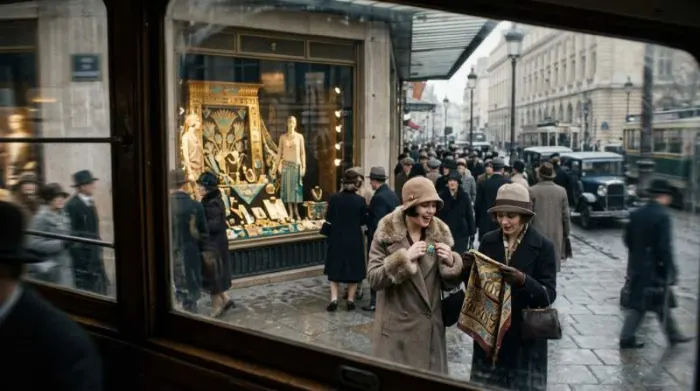
Daily newspaper updates kept the story alive, and people lined up for hours to see traveling exhibits of replica artifacts. The mania was so intense it even inspired popular songs like "Old King Tut" and a brief, silly dance called the Tutankhamun Trot. It was a consumer frenzy driven by a newfound accessibility to the exotic, bringing ancient royalty into the modern marketplace.
Flappers Find Their Pharaoh
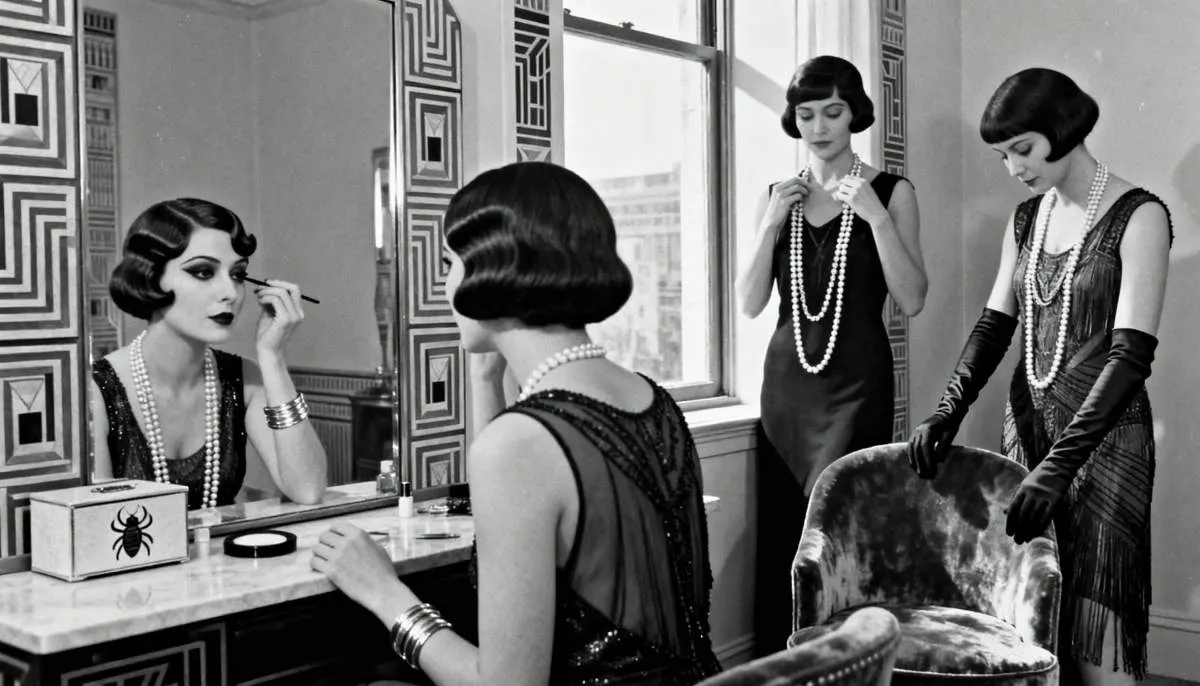
The young women of the 1920s, known as flappers, were already rejecting Victorian restraint with their short hair, shorter skirts, and bold behavior. They found a perfect, powerful symbol in ancient Egyptian glamour. The dramatic kohl eyeliner seen in tomb paintings gave them a new, exotic weapon in their beauty arsenal, a way to define their eyes that was worlds away from the pale, natural faces of their mothers.
They applied black eyeliner in thick, winged shapes that extended past the outer corners, directly mimicking the elongated eyes of Egyptian pharaohs and deities. For evening wear, they layered gold eyeshadow and metallic powders over the liner, creating a look that was both rebellious and regal. This was makeup as statement, a visual declaration of independence and modern sophistication.
Cosmetic companies were quick to respond. Brands like Coty and Max Factor introduced cream eyeliners and gold-dust compacts marketed with "Egyptian" or "Cleopatra" shades. Crucially, these items were stocked at drugstores and five-and-dime counters, making the luxurious trend accessible to working-class women and not just the social elite. Every shopgirl could now afford a little pharaonic power.
The Gilded Gown
The iconic flapper dress itself underwent an Egyptian transformation. The straight, loose silhouette of the 1920s, already ideal for dancing, became a canvas for ancient motifs. Designers added geometric patterns inspired by tomb art: zigzags, lotus blossoms, and stylized scarab beetles rendered in gold and turquoise beading.
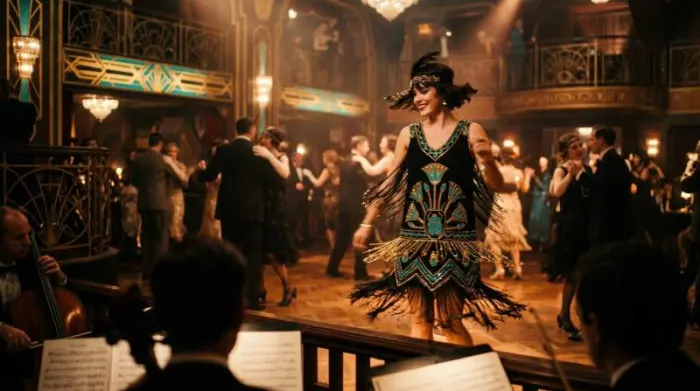
Evening gowns shimmered in metallic lamé or heavy silk velvet embroidered with gold thread. Beaded dresses became more elaborate than ever, with thousands of tiny gold and blue beads painstakingly sewn into repeating hieroglyphic-inspired patterns. Under the gaslight or the new electric chandeliers of a jazz club, the effect was absolutely dazzling, catching light with every Charleston step.
These dresses commanded a high price, often costing a week's wages for a secretary. Yet, the demand was so immense that manufacturers created affordable versions using painted gold patterns on rayon or cotton. This democratization of style meant that women who couldn't afford the real thing could still participate in the trend, stitching their own version of ancient glamour.
Egyptian Motifs Everywhere
Tutmania seeped into every corner of daily life, far beyond clothing and makeup. Costume jewelry makers produced thousands of scarab bracelets, ankh pendants, and lotus earrings, often crafted from painted metal or the new plastic, Bakelite. These pieces flew off the shelves at department stores and through mail-order catalogs.
Home decor followed enthusiastically. Sofas and armchairs were upholstered in fabrics printed with Egyptian scenes of pyramids and palm trees. Lamps were designed with lotus-shaped bases, and shades were painted with pharaohs and processions. Even mundane objects like ashtrays and cocktail shakers were molded into the shapes of sphinxes or pyramids.
The trend reached its architectural peak with movie palaces. The most famous example is Grauman's Egyptian Theatre in Hollywood, which opened in 1922, complete with a courtyard and hieroglyphic decorations. This style gave moviegoers a sense of entering a grand, exotic world before the film even started, blending ancient spectacle with modern entertainment.
Hollywood's Golden Touch
Silent film stars had already popularized exotic roles, but Tutmania made Egyptian themes mainstream. The 1923 Cecil B. DeMille epic "The Ten Commandments" featured lavish Egyptian sets and costumes that further cemented the look in the public's mind. Actresses like Clara Bow and Louise Brooks were photographed for magazine spreads wearing Egyptian-inspired headdresses and elaborate collars.
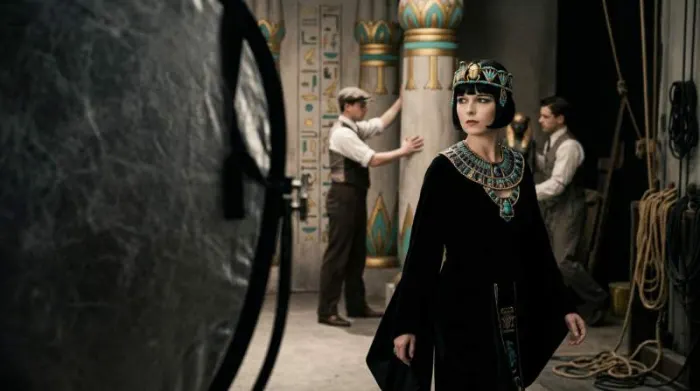
These images, published in Vogue,Harper's Bazaar, and Photoplay, reached millions of women, broadcasting the message that ancient Egypt was the height of chic. The trend even crossed gender lines in a novel way; fashionable men sported scarab-shaped cufflinks and tie pins, and tuxedo lapels were sometimes subtly embroidered with gold thread in geometric patterns.
The Legacy of a Craze
Like all intense crazes, the white-hot peak of Tutmania began to cool by the late 1920s. The Great Depression shifted priorities away from extravagant fashion. However, the influence never fully vanished. Key elements, the geometric patterns, the love of metallic finishes, were absorbed into the burgeoning Art Deco movement, which dominated design throughout the 1930s.
A major revival erupted in the 1970s when the "Treasures of Tutankhamun" exhibition toured the United States. Millions lined up to see the actual artifacts, and fashion responded with a vengeance. Designers like Yves Saint Laurent created entire collections dripping in gold lamé, featuring bold kohl eyeliner and dramatic Egyptian motifs, introducing a new generation to the power of the pharaonic aesthetic.
This cycle of rediscovery is what historians call Egyptomania, a recurring fascination that proves some styles are never truly buried. The 2020s have seen gold eyeshadow and sharply winged eyeliner remain beauty staples. Fast-fashion brands regularly release Egyptian-themed collections, especially around Halloween or a blockbuster film release. The motifs may be simplified, but the core appeal, ancient royalty, mystery, and untold wealth, remains potent.
What Tutmania Teaches Us
The phenomenon demonstrates how swiftly a historical event can become a pervasive cultural force. It showed that fashion is never just about fabric; it's a form of storytelling and identity-making. For the flappers, adopting Egyptian eyeliner and gold was a way to reject the immediate past (the Victorian era) by borrowing authority from a much older, seemingly more powerful one.
They weren't engaging in accurate historical reenactment. They were creating a modern fantasy of liberation, power, and exotic glamour. This same impulse, to plunder the past to define the present, drives every fashion revival, from 1970s bohemia to 1990s grunge. Trends reveal what a culture desires to believe about itself at a given moment. In the optimistic, forward-rushing 1920s, the golden treasures of King Tut provided the perfect symbol for a new, glittering age.
Nearly a century later, the lineage is still visible. Every time a designer sends a metallic goddess down the runway or a makeup artist sketches a sharp winged eye, there is an echo of that dusty expedition in the Valley of the Kings. Tutmania proved that a single discovery, rich with visual splendor, could instantly rewrite the rules of contemporary glamour, leaving an indelible mark on the endless story of style.
What did flappers wear in the 1920s
Flappers often wore cloche hats, which were bell-shaped and pulled low over the forehead, a style that perfectly complemented their bobbed haircuts. These hats were sometimes adorned with Egyptian-inspired motifs like scarabs or lotus flowers, blending practicality with the era's obsession with ancient glamour.