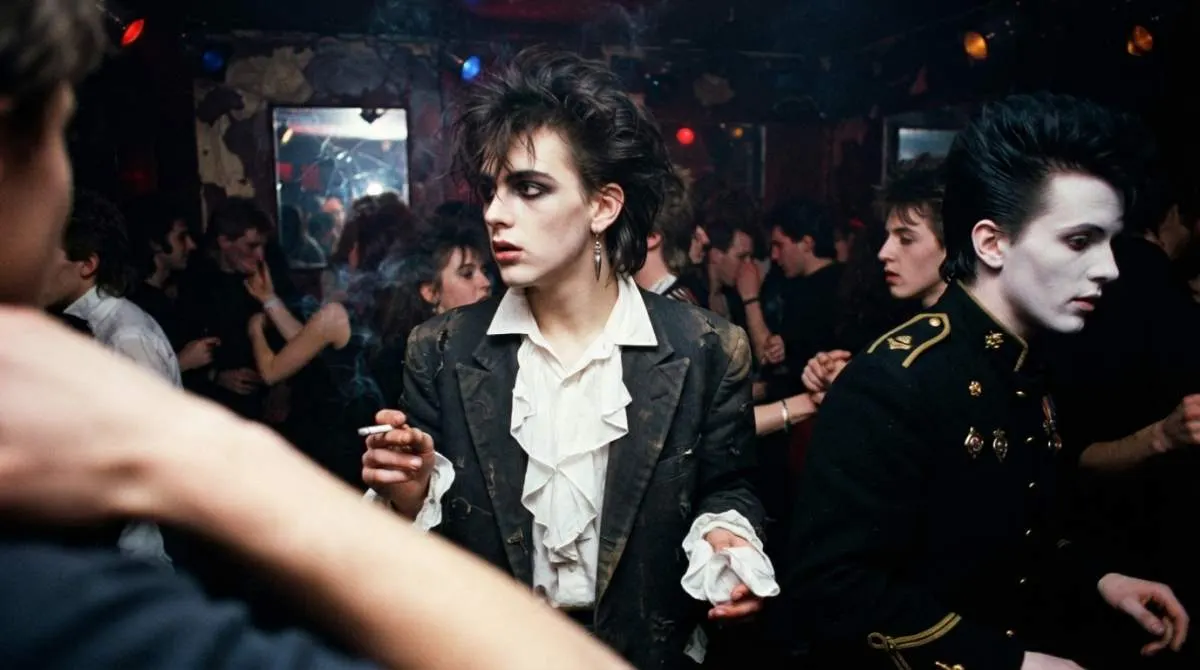
Imagine holding a small, round mirror, its surface catching the dim light of a Covent Garden streetlamp. You're not checking your lipstick. You're the gatekeeper. "Are you a member?" you ask, your voice flat, your eyes scanning the hopeful, extravagantly dressed queue.
This was Steve Strange's tool of choice, and on a Tuesday night from 1979 to 1981, it was the only way into the most exclusive party in London. The mirror itself became a potent symbol of reflection-both literal and metaphorical-forcing aspirants to confront their own constructed image before facing Strange's judgment.
The venue was the Blitz, a wine bar at 4 Great Queen Street with a decidedly odd theme: World War II nostalgia, complete with sandbags and wartime memorabilia. The club night rented the space on Tuesdays for one simple, pragmatic reason-it was cheap.
This choice of venue was itself a form of cultural scavenging, repurposing the aesthetic debris of a recent, traumatic past into a stage for fantasy. Yet, from that unlikely, kitschy cradle, a movement was born.
The Door Policy That Built a Scene
Co-hosted by Steve Strange and DJ Rusty Egan, the Blitz night wasn't just a club; it was a curated experiment. Its exclusivity was legendary. Strange didn't just glance at you; he used that mirror, turning applicants away with a cold stare if their look wasn't up to his exacting, theatrical standards.
The policy was infamously inconsistent, adding to its mythic status; even established faces could be turned away on an off night.
This wasn't snobbery for its own sake. It was a deliberate reaction. Punk's ripped tees and safety pins had become a uniform, and mainstream conformity offered no escape.
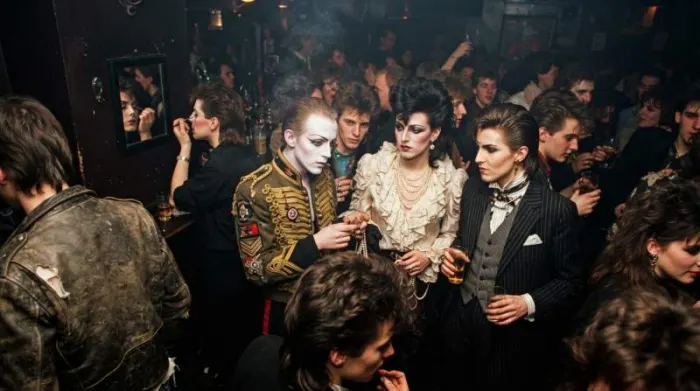
The Blitz offered a third way: a glamorous, self-invented universe. You had to earn your entry with creativity. This curation created a self-reinforcing hothouse environment where the audience was the spectacle, a living installation that blurred the line between performer and patron.
The attendees who made the cut became known as the 'Blitz Kids.' They were a tight-knit crew of art school students, musicians, and working-class creatives. Future members of Spandau Ballet mingled with a young Boy George, who worked the cloakroom.
Fashion students like Stephen Jones used the dancefloor as a live, breathing catwalk. Other notable figures included designer Melissa Caplan, milliner Stephen Jones, and artists like Grayson Perry, who found early expression in the scene's embrace of costume and persona.
It was a high fashion rebellion staged by kids with sewing kits and imagination, a direct rejection of both high-street blandness and punk's studied nihilism. Their looks were crafted, not bought, echoing a broader DIY aesthetic but with a romantic, decadent twist.
Inspiration was drawn not from contemporary runways but from library books on history and art: Napoleonic military wear, Romantic poets, Weimar cabaret, and Hollywood golden age glamour were all plundered and reinterpreted.
Mood Match
Four Moments, Four Records
Here is the moment you are in, and here is the record that belongs to it.
Waiting in line at an exclusive club
Heart of Glass by Blondie
Debbie Harry sounds like she has already glided past the rope while you are still shuffling forward, which is exactly the right sort of envy for a queue.
Strutting into a party in a new outfit
Le Freak by Chic
That opening groove announces you before you have said a word, and the whole room turns to check who just walked in.
Swaying slowly with someone at the end of the night
The Look of Love by ABC
Martin Fry croons it like a slow dance under a glitterball, so it belongs to the last half hour when the lights come up and nobody wants to leave.
Play them in order, one per moment, and let the evening tell you when to stop.
Songs checked against en.wikipedia.org.
The Sound and the Fury of Synth
While the looks were historical-pirate shirts, Regency waistcoats, military frogging-the soundtrack was relentlessly futuristic. Rusty Egan's decks spun a sharp, electronic pulse: the robotic rhythms of Kraftwerk, the icy glamour of late-period Bowie (particularly the "Berlin Trilogy"), the playful synth-pop of Japan and Yellow Magic Orchestra.
Egan also championed early electronic disco from Italy and the emerging British synth sounds of acts like The Human League and Fad Gadget.
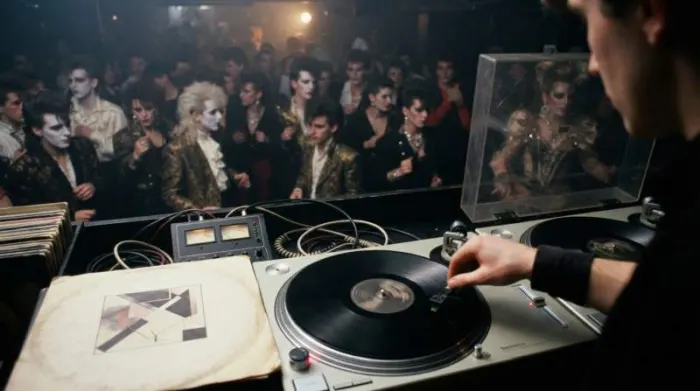
This marriage of sound and vision was the alchemy. The music provided a clean, modern canvas for the baroque fashion. It wasn't guitar-driven rock, which carried its own sartorial baggage.
This was the sound of a new decade, and the Blitz Kids were dressing for it. The synthetic, often drum-machine-driven beats created a detached, cool atmosphere that complemented the posed, theatrical nature of the fashion, fostering a style of dancing that was more about striking poses than losing oneself.
The club's influence quickly bled out of its Tuesday night confines. David Bowie, always an antenna for cultural shifts, recruited a group of Blitz regulars-including Strange and Egan-to appear in his 1980 'Ashes to Ashes' video, cementing their status as the new avant-garde.
The media, searching for a label, settled on 'New Romantics,' a term borrowed from earlier fashion journalism that the scene's pioneers often disliked for its simplification. Journalist and former punk Caroline Coon is credited with first applying the term in print to describe the Blitz crowd.
So, what was the New Romantic movement? It was this very synthesis: a flamboyant, historically-inspired, and often androgynous fashion sense, inextricably linked to the rising tide of synth-pop. It represented a wholesale shift from punk's anger to a more theatrical, escapist form of self-expression, emerging during a period of economic recession and social tension in Britain.
It was a conscious retreat into fantasy and artifice as a form of resistance.
The Legacy in Sequins and Synthesizers
The Blitz itself was fleeting, its Tuesday night reign lasting only a couple of years. But the shockwaves it created defined the visual and musical language of the entire 1980s. The club proved that a scene could be built not on geographic proximity or shared poverty, but on a shared aesthetic and sonic vision.
Its alumni directly formed or inspired the first wave of commercially successful New Romantic bands: Visage (fronted by Strange), Spandau Ballet, Culture Club, and Duran Duran, whose early style was a direct export of the Birmingham club scene that emulated the Blitz.
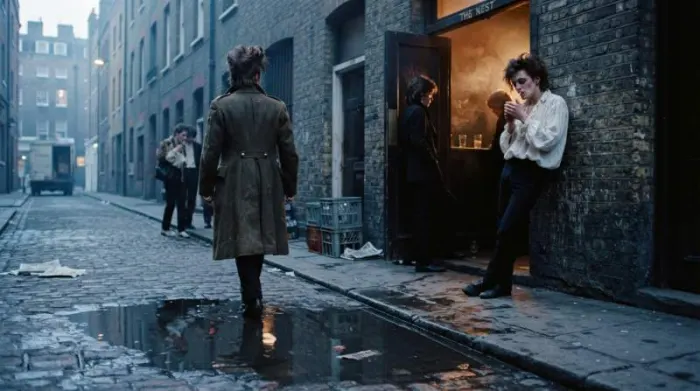
Its ethos of gender-fluid, DIY glamour directly launched the New Romantic look into the mainstream. The theatricality, the bold makeup, the emphasis on individualistic, crafted style over off-the-rack fashion-you can trace it all back to those Tuesday nights.
The movement democratized high fashion concepts, making them accessible through customization and thrift-store finds, a practice that permanently altered street fashion.
Key elements that defined the Blitz Kids' approach included:
- A rejection of punk's austerity in favor of romantic, historical silhouettes from pirates and dandies, often sourced from charity shops and army surplus stores.
- The use of the club as a live studio and catwalk for fledgling designers, a practice that directly influenced the rise of London Fashion Week as a showcase for theatrical, conceptual designers.
- A strict door policy that curated a community based on creativity, not celebrity, creating an incubator for collaborative talent.
- A soundtrack of pure electronic and synth-based music, avoiding rock traditions, which helped legitimize synthesizers as primary instruments in pop music.
- An androgynous, makeup-heavy presentation that challenged gender norms of the time, paving the way for greater gender fluidity in mainstream pop culture.
Where can you feel its echo today? It's in the continued celebration of clubland as a site of identity creation and safe haven for subcultures. It's in the cyclical revival of exaggerated silhouettes and gender-blurring fashion on runways and in movements like the "Peacock Revolution" of the 2000s.
It's in the enduring power of a synthesizer hook, now a foundational element of pop production. The legacy is also evident in the curator-as-creator model of modern club nights and the strategic use of exclusivity in brand marketing.
Most of all, it's in the idea that culture can be forged in the most unlikely places. A cheap Tuesday slot in a gimmicky bar, a mirror, and a determined few can, for a glittering moment, change everything.
The Blitz didn't just host a party; it built a blueprint, proving that the most potent revolutions often start not with a bang, but with a carefully chosen guest list and an unwavering commitment to a singular, spectacular vision.
What was the original name of the record shop where the New
Romantics bought their first singles?
Before it became a hangout for the scene, the shop was called Xtravision, a tiny vinyl den run by a former DJ who stocked obscure imports. Fans would save up their pocket money for a single that cost just 99 pence, hoping to find a sound that felt like tomorrow.