
IN THIS ISSUE:
Savannah Chic or Sordid Stain? YSL and the Safari Jacket
The jacket with roomy pockets, structured shoulders, often in shades of khaki or sand, has long been shorthand for chic adventure. It symbolizes effortless cool, whispering tales of far-flung escapes and daring expeditions. It's an icon of high fashion.
But its designer reincarnation isn't just a stroke of genius; it's a deeply complicated story steeped in colonial history. We're pulling back the curtain on one of fashion’s most enduring — and arguably most problematic — garments: the safari jacket. This isn't just about threads and trends; it's about power, perception, and a legacy that still stings.
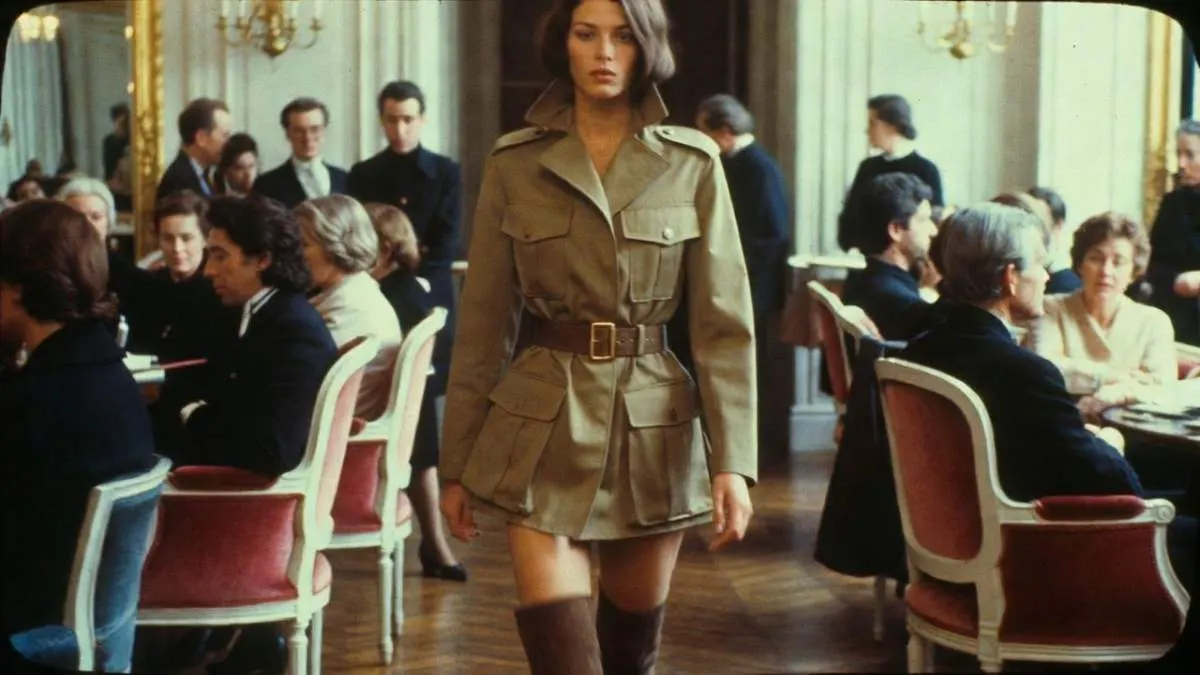
In Paris, 1968, the fashion world buzzed. Amidst the cultural revolution, Yves Saint Laurent, a fashion titan, introduced his Spring-Summer collection. He took a utilitarian piece of gear, previously associated with big-game hunting and African expeditions, and elevated it to haute couture. This was a defiant statement, turning practical wear into pure luxury. It defined an era, launching a garment that would forever bear his indelible mark. Source.
The garment's origin, however, tells a different, grittier tale. It wasn't born on the runways of Paris but in the scorching sun of colonial Africa and India, designed for European settlers, explorers, and military personnel navigating harsh landscapes.
It was the uniform of empire, a practical garment enabling the subjugation of vast territories and peoples. Thus, a discussion of the safari jacket's history cannot ignore the elephant in the room. Was this transformation a brilliant reinterpretation, or an uncomfortable act of colonial appropriation, sanitizing a contentious past for aesthetic gain?

That’s the core of the safari jacket scandal. We’re going to unpack how this rugged utility jacket went from protecting colonial adventurers to gracing the covers of Vogue, and what that journey truly means. The threads of history here are more tangled than a lion’s mane, leading directly to some uncomfortable truths about fashion’s gaze.
Khaki's Loaded Past: Unpacking Colonial Threads
The safari jacket, that chic utility piece we see everywhere, carries a heavy, often unacknowledged history, deeply entangled with colonialism, power, and exploitation. To understand its so-called "scandalous" transformation by Yves Saint Laurent, its true origins must be understood.
From Battlefield to Bush: The Utilitarian Roots
The safari jacket, or more accurately, its direct ancestor, was born out of pure military necessity in the late 19th and early 20th centuries. British officers stationed in India and Africa needed practical gear, as standard wool uniforms were a death sentence in scorching climates. They adapted, wearing lightweight, breathable cotton drill jackets – usually in khaki, a color that blended into the dusty landscapes.
These garments weren't about style; they were about survival and function. They featured pleated pockets for maps, ammunition, and other essentials, shoulder epaulets for rank insignia, and often a belt to cinch the waist, keeping things tidy and ready for action. It was a uniform for men asserting control in foreign lands.
The Colonial Connection: Power Dressed in Khaki
This isn't a benign origin story. That "bush jacket" became synonymous with big-game hunting, exploration, and the broader colonial enterprise. It evokes imagery of pith helmets and armed men venturing into territories they considered "untamed." The imagery wasn't just about discovery; it was about conquest, about the subjugation of land and people.
The khaki jacket became a symbol of European dominance, an outward expression of a specific kind of authority wielded by settlers, administrators, and hunters across vast stretches of Africa and India. It literally clothed those who were establishing and enforcing colonial rule. Its origins are steeped in profound power imbalances.
YSL's Reimagination: When High Fashion Met a Problematic Past
Fast forward to 1968. While Stanley Kubrick challenged humanity's place in the universe with 2001: A Space Odyssey, Yves Saint Laurent challenged fashion norms. Already a provocateur, famous for bringing masculine codes into women's wardrobes – such as his iconic 'Le Smoking' – that year he unveiled his take on the safari jacket, and it was a revelation. It wasn't about rough utility anymore.

YSL took the core elements – the four pockets, the belt, the neutral color – and re-tailored them into something sleek, sensual, and undeniably chic for women. He removed the rigidity, softened the lines, and infused it with an effortless elegance.
This marked a pivotal moment in the YSL safari jacket's history. He wasn't just designing a jacket; he was transforming a loaded symbol. His version, famously modeled by Veruschka in Marrakesh, aimed to strip away its military and colonial associations. It became an emblem of adventurous sophistication, a garment for the liberated, stylish woman. This marked the moment YSL launched the safari jacket into the high-fashion stratosphere. The controversy, as many see it now, isn't about the design itself, which was brilliant.
It's about how high fashion, in its pursuit of novelty and glamour, often appropriates symbols without acknowledging their complex, sometimes brutal, origins. Many argue that YSL's safari jacket was colonial appropriation, precisely because it presented a garment deeply tied to colonial power as simply a stylish piece, effectively erasing or at least glossing over its problematic roots for a new, glamorous narrative. It’s a classic example of fashion's double-edged sword: transformative power, yet often blind to historical context.
Threads of Empire: YSL's Safari Jacket Rewrote Fashion's Rules
Before Yves Saint Laurent put his stamp on it, the safari jacket was pragmatic kit. It was the functional uniform of European adventurers, hunters, and colonial administrators in Africa and Asia. We're talking sturdy cotton, big pockets, epaulets – gear designed for utility, not runway glamour. It's crucial to grasp these origins to understand the seismic shift that followed.
The real game-changer arrived with his 1968 Spring/Summer collection, when YSL launched "the Saharienne." This wasn't just a jacket; it was a statement. He took those utilitarian elements – the four patch pockets, the belted waist, the often khaki hue – and elevated them. Suddenly, it wasn't about surviving the savanna; it was about owning the city sidewalk. This was a pivotal moment in the safari jacket's history.
The impact was immediate and massive. Women, tired of restrictive formal wear, embraced its blend of masculine functionality and feminine tailoring. It was liberating, chic, and powerful.
It wasn't just a piece of outerwear; it was an emblem of a new kind of modern woman – independent, adventurous, and effortlessly stylish, pairing it with everything from trousers to mini skirts, even some daringly choosing high heels. But beneath the gloss, a complex question brewed: was YSL's safari jacket colonial appropriation?
This isn't a simple yes or no. On one hand, YSL democratized fashion, pulling inspiration from unexpected places and pushing boundaries. He undeniably made it high fashion, taking a garment associated with power and control and recontextualizing it for a new era of female empowerment. He wasn't the first designer to adapt military or utility wear, but his Saharienne was widely credited as the most iconic and successful.

However, the YSL safari jacket controversy stems from the fact that it cannot be entirely divorced from its problematic roots. For many, its visual language still echoed the very systems of colonial dominance it was originally part of.
To take a uniform intrinsically tied to the exploitation of colonized peoples and turn it into a luxury item for the privileged felt, to some, tone-deaf at best, and deeply appropriative at worst. The garment carried an undeniable historical baggage that a fashion veneer couldn't completely erase.
Its cultural impact continued to reverberate. From films like Out of Africa to countless celebrity endorsements, the safari jacket, largely thanks to YSL's initial push, became a perennial style staple. It’s been reinterpreted by countless designers, showing up everywhere from casual wear brands to other haute couture houses.
The debate over whether YSL's safari jacket was colonial appropriation hasn't disappeared, but it's evolved. Today, designers are often more conscious of the historical narratives their inspirations carry, making YSL's Saharienne a fascinating case study in how fashion both innovates and sometimes inadvertently perpetuates uncomfortable histories. It reminds us that even seemingly innocuous fashion choices can carry profound cultural weight.
...It reminds us that even seemingly innocuous fashion choices can carry profound cultural weight.
"When I first found a 70s-era Saharienne in a Brussels thrift shop, I was struck by its heavy cotton and masculine cut. It felt like wearing a piece of a complicated puzzle. Styling it today with gold hoops and a silk scarf is my way of acknowledging the past while moving the conversation forward. What do you think—is it possible to wear history without repeating it?"
— Retro Editor
Reclaiming the Narrative: Styling the Safari Jacket Today
The safari jacket, as popularized by Yves Saint Laurent, carries some serious baggage. It rose from colonial gear, specifically designed for European expeditions into Africa and other colonized lands, becoming a symbol of a problematic era.
When Yves Saint Laurent launched his iconic Sahara collection in 1968, re-contextualizing this garment for high fashion, it sparked a conversation – some say controversy – about cultural appropriation. Was it a brilliant design coup, or an uncomfortable nod to a colonial past? Maybe both. But fashion moves on. Today, you can wear this jacket, distancing it from its fraught origins, by styling it with intention and a modern sensibility. It's about reclamation, not repetition.
Here’s how to make it work in your wardrobe now:
- De-militarize It: Ditch the khaki-on-khaki look. Pair a utility-style safari jacket with dark wash denim, crisp white t-shirts, or even tailored trousers in unexpected colors like navy or charcoal. The goal is to strip away any overt "expedition" vibe.
- Layering is Key: Throw it over a knit sweater for a smart casual vibe in cooler weather. Or, wear it open over a thin turtleneck or a striped Breton top for a European chic aesthetic.
- Balance the Volume: Safari jackets can be boxy. Balance that out with slimmer pants or a flowing midi-skirt for women. For men, a well-fitted chino or a slim-cut jean works wonders.
- Unexpected Fabrics & Colors: While the original safari jacket was typically cotton drill in beige, modern versions come in linen, suede, or even technical fabrics. Look beyond the traditional olive or beige; consider black, deep forest green, or even a bold blue.
- Dress It Up (or Down): It's surprisingly versatile. For a smarter look, wear it over a light button-down shirt with loafers. For ultimate casual cool, pair it with sneakers and a graphic tee.
- Accessorize Thoughtfully: Forget the pith helmet. Think modern accessories: a minimalist leather tote, sleek sunglasses, or a simple watch. These ground the jacket in the present, not the past.
The safari jacket, regardless of its origin story, persists because of its practical design and undeniable swagger. It's got those functional pockets, that relaxed silhouette. But the challenge, and the opportunity, lies in how we wear it today.
By consciously choosing to integrate it into contemporary outfits, steering clear of any styling choices that might echo its colonial past, we redefine what it represents. It’s no longer about conquest; it’s about classic utility dressed up for the 21st century. Make it yours, and leave the ghosts of exploration behind.
Beyond the Four Pockets: A Legacy Untamed
Yves Saint Laurent's safari jacket, first paraded in '68, didn't just become a fashion statement; it cemented his place as a provocateur and a visionary. No one's disputing its aesthetic power, its sleek lines, or how it empowered women by offering a new kind of chic utility.
He took what was essentially a uniform of colonial exploration and repackaged it, presenting it as effortless high fashion. That's a seismic shift, like it or not.
But the controversy isn't a minor detail. It's fundamentally woven into the garment's very DNA. Was it colonial appropriation? Many serious critics argue that it absolutely was. YSL, intentionally or not, drew from a history of exploitation, then scrubbed those problematic origins clean for a shiny new narrative of Parisian elegance.
The fashion industry, often quick to embrace the "exotic" without acknowledging its problematic roots, largely celebrated it. It's a classic case of selective memory, divorcing an object from the power dynamics that made it accessible to the colonizers in the first place.

Today, the safari jacket’s presence is undeniable. You see its hallmarks everywhere, from upscale boutiques to mainstream high street brands. It’s a perennial classic, almost universally accepted. But for those who delve into its full, uncomfortable story, that connection to colonial adventures, to the exploitation it symbolized, cannot truly be forgotten. It's a potent reminder that fashion, for all its innovative flair, often navigates a deeply complex ethical landscape.
Yves Saint Laurent's genius was undeniable, but so too was the unaddressed shadow cast by his chosen inspiration. It forces us to keep asking: can we truly appreciate a design without grappling with its complex, sometimes unsavory, roots? This isn't just about a jacket; it’s about acknowledging fashion's tangled past and demanding more from its future.

