
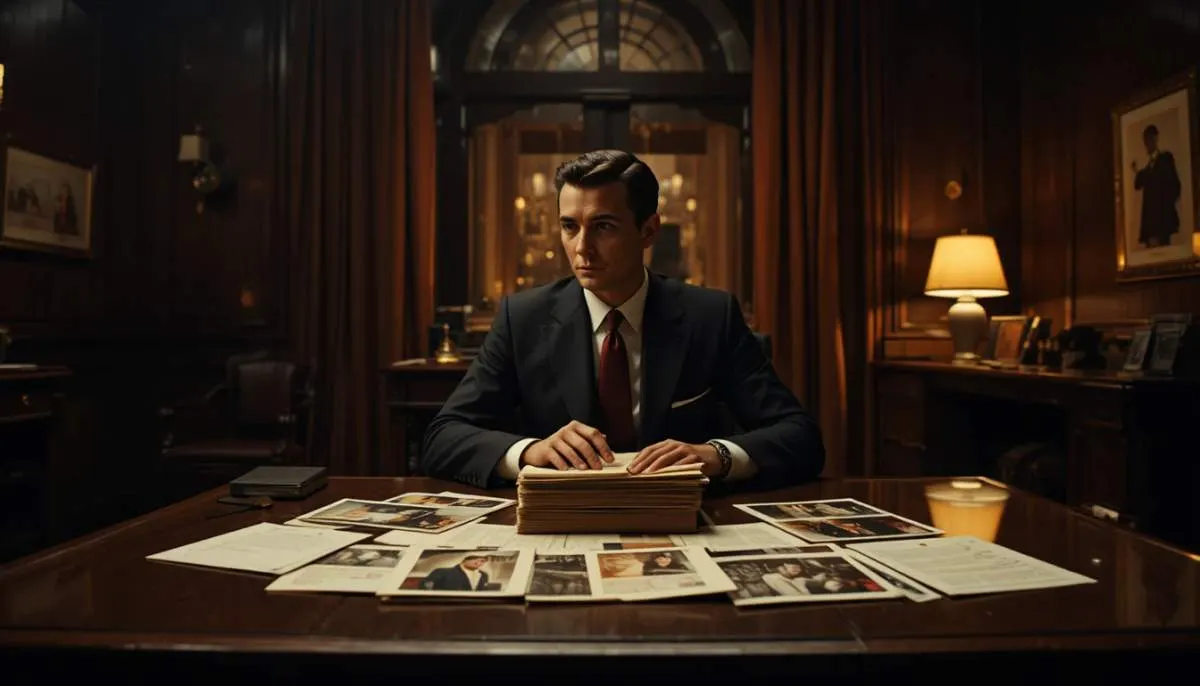
Celluloid Shadows: The Truth Behind Hollywood's Golden Façade
Behind every glittering premiere and every scandal that never made the papers stood the studio fixers. These were the men hired to keep the dream factory's seams invisible, long before the cameras even rolled. An entire machinery of silence was already in place, ready to bury anything that threatened the box office or the pristine image of a star.

Their toolkit was both brutal and ingenious. It included strategic "leaks" to friendly tabloids, designed to divert attention from a bigger, uglier truth. High-stakes non-disclosure agreements silenced accusers and whistleblowers before their stories could gain traction. Aggressive legal action was a constant threat, used to scrub damaging whispers from the public record whenever they surfaced.
These fixers also mastered the art of "dark PR," a tactic to systematically discredit anyone who posed a risk. Carefully staged apologies and rehabilitation tours were orchestrated to rebuild a shattered public image. The goal was never just to hide a fact, but to control the entire narrative surrounding it, ensuring the Hollywood fantasy remained intact for the paying public.
The Blueprint of Silence: How the System Worked
In the Golden Age, information was a commodity tightly controlled by the studios. Unlike today, where everyone has a camera and a platform, the fixers' power came from their monopoly on the media. Newspapers and magazines often relied on studio goodwill for access and advertising, creating a symbiotic relationship of silence.
The modern "fix" has evolved, but the core impulse remains. Today, it's less about hiding facts entirely and more about manipulating their interpretation or burying them under a deluge of other content. Specialized crisis PR firms now handle the fallout, but they operate on a blueprint first drawn by men like Howard Strickling. While some stories explode into public consciousness, countless others are still meticulously suppressed through legal means, financial settlements, and sophisticated reputation management.
This constant effort reminds us that despite all technological advancements, the battle to control the truth is a timeless one. Reputation management has grown into a multi-billion dollar industry, a direct descendant of the classic Hollywood fixer's role. The language is updated, but the cold calculation about human capital and brand perception is hauntingly familiar.
The Ghost in the Machine: Howard Strickling and MGM
When discussing Hollywood fixers, one name towers above the rest: Howard Strickling. As the head of publicity for Metro-Goldwyn-Mayer, he wasn't just a spin doctor; he was the studio's private police chief, wielding power that often rivaled the city's own. His job was to protect the MGM brand at all costs, and his methods were legendary for their ruthlessness.
Strickling's operations were shrouded in secrecy. Vintage Hollywood gossip insists he maintained a secret morgue on the studio lot, a macabre tool for managing untimely deaths away from prying eyes. His most infamous act, according to industry lore, was staging a fake car crash to cover up a star's suicide, crafting a more palatable narrative for the press and the public. These men operated in the shadows, ensuring the silver screen's shine was never dimmed by the tarnish of real-life tragedy.
They weren't working alone. The system relied on deep complicity, from police chiefs to newspaper editors, all invested in upholding the industry's carefully constructed fantasy. This network of silence enforced strict moral codes like the Hays Code in public, while privately orchestrating cover-ups that violated every one of them. The fixer was the crucial gear in this machine, the one who made the unpleasant realities simply disappear.
The Unseen Stain: Scandals That Shaped an Era
The true legacy of the fixers isn't just in the stories they buried, but in how they fundamentally reshaped our understanding of an entire era. The biggest Golden Age scandals are the ones that never saw daylight, leaving an unseen, spectral stain on history. We are left to wonder about the true cost of the glamour we so cherish.
Imagine a version of classic Hollywood where Virginia Rappe's tragic death in 1921, linked to comedian Roscoe "Fatty" Arbuckle, wasn't instantly managed by studio enforcers. How would the narrative of early Hollywood's wild party culture differ? Consider the affair between actress Mary Miles Minter and director William Desmond Taylor, which ended in Taylor's murder, a case riddled with suppressed evidence and studio interference. These weren't isolated incidents; they were patterns.
This culture of impunity, built on fear and coercion, warped lives and broke spirits. It left a trail of ruined careers and hushed-up tragedies, all sacrificed to maintain a marketable myth. The fixers protected more than individual careers; they protected an image the public was all too willing to embrace. Their work created a blueprint for silence that taught generations of executives that control was paramount, and truth was merely an inconvenience.
The Enduring Legacy of the Fix
While the Golden Age has ended, its whispers still ricochet through Hollywood's halls. The fixers are gone, but their legacy plays on a loop, just beneath the surface of every red carpet event and press junket. The machine grew savvier, outsourcing its dirty work, but the core impulse to protect the brand, often at a profound human cost, never truly faded.
This pervasive coldness serves as a reminder of how much was sacrificed to maintain the illusion. It wasn't just about box office receipts; it was about preserving a power structure. The lessons of that era, that narratives can be manufactured, that secrets can be bought, and that people are expendable, echoed forward, shaping the industry's crisis response for decades to come.
Today, we see a different kind of spectacle, played out in real-time on social media. Yet, the shadow of the old system remains. When a scandal breaks, the frantic behind-the-scenes work to shape the story, to provide context, or to negotiate a quiet settlement continues unabated. The players have changed, and the tools are digital, but the game is eerily familiar. The dream factory's seams are still being stitched, just out of sight, by a new generation of guardians for whom the show must always, always go on.
What did studio fixers do in old Hollywood
Studio fixers were the industry's secret guardians, often former journalists or private detectives who knew exactly which reporters to bribe and which police chiefs to call. Their most creative trick was planting fake stories in rival newspapers to make a real scandal seem like a jealous competitor's lie, a tactic that worked because the public trusted print media implicitly.