
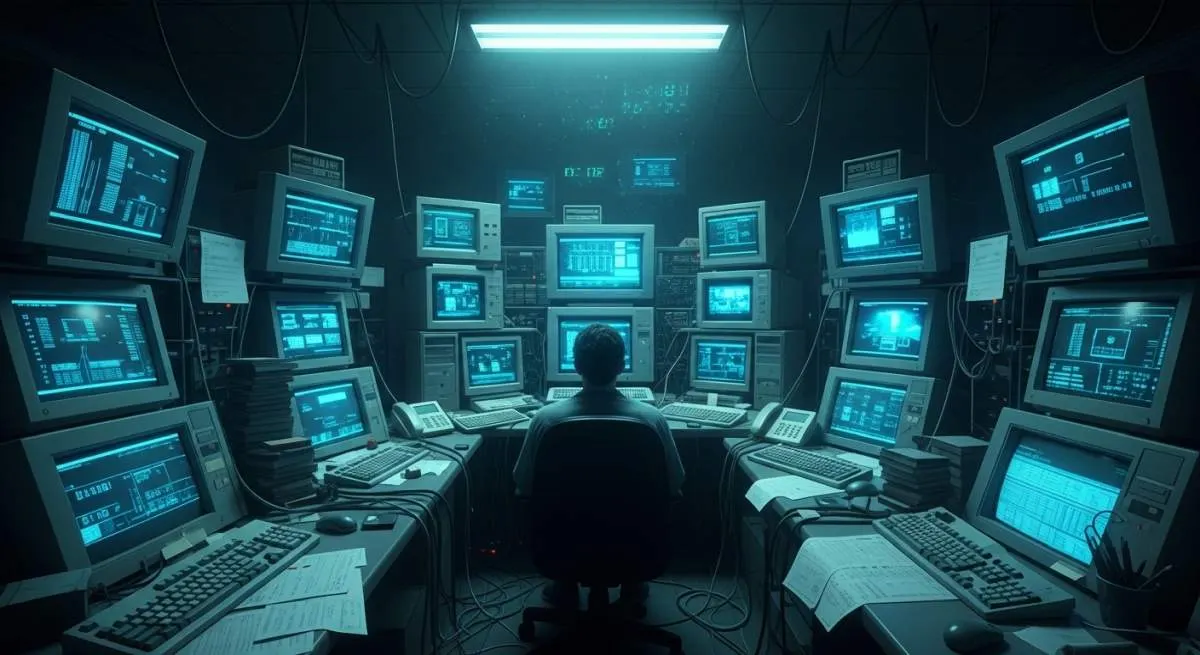
As the final seconds of 1999 ticked away, a strange quiet fell over much of the world. In living rooms and bunkers alike, people held their breath, half-expecting the lights to flicker and die. The Y2K bug panic had built for years into a crescendo of global anxiety, a bizarre mix of technical reality and apocalyptic fantasy. When dawn broke on January 1, 2000, and the planes kept flying, a collective sigh of relief was quickly followed by a wave of mockery. The whole thing was written off as mass hysteria, a costly overreaction. But that anticlimax was the whole point. The quiet morning was a victory, and it marked the precise moment our civilization woke up to a new, terrifying truth: our entire world now ran on invisible, fragile code.

The Simple Shortcut That Built a Time Bomb
The so-called Millennium Bug wasn't some malicious virus or complex hack. It was a simple, sensible shortcut born from necessity. In the 1960s and 70s, computer memory was astronomically expensive and painfully limited. To save precious space, programmers stored dates using just two digits for the year. 1975 became '75', 1982 became '82'. It was an elegant solution that worked perfectly for decades.
The problem was the calendar's inevitable march. When the year 2000 arrived, it would be stored as '00'. To the logic of millions of ancient programs, '00' didn't mean the year 2000; it looked exactly like 1900. This tiny flaw was copied, pasted, and embedded into the core software running banks, power grids, hospital equipment, and air traffic control systems. By the late 1990s, it was a ticking time bomb woven into the fabric of modern life. The term Y2K itself entered the lexicon, a neat shorthand combining 'Y' for year and '2K' for 2000, borrowed from computer jargon where K stands for kilo.
The Slow Burn of a Global Panic
The story leaked from technical manuals into the mainstream around 1997. Suddenly, the evening news was filled with grim experts outlining worst-case scenarios. Would elevators freeze between floors? Would Social Security checks vanish? Would nuclear power plants fail? Magazines like Time and Newsweek ran dramatic cover stories, and television specials visualized societal collapse.
The fear, once ignited, spread with a life of its own. Survivalist circles amplified the dread, urging people to stockpile canned goods, water, and generators. Gun sales spiked. There were stories, some perhaps apocryphal, of people withdrawing life savings and burying cash in their yards. Even the most level-headed individuals found themselves eyeing their bathtub, wondering if they should fill it just in case the water pumps failed.
This public panic wasn't entirely baseless. In 1998, a U.S. Senate committee heard sobering testimony about industries and nations dangerously behind on fixes. Test runs in places like a New Zealand power plant caused real equipment failures. Whether every circulating horror story was true mattered less than the undeniable momentum of the narrative. The world was bracing for a digital heart attack.
The Unseen Army of Fixers
While the public stocked up on batteries, a massive, unglamorous mobilization was underway in corporate basements and government offices worldwide. An estimated $300 to $600 billion was spent on what became the largest software remediation project in history. This wasn't a simple patch; it was digital archaeology.
IT departments worked around the clock, auditing millions of lines of code written in obsolete languages like COBOL. They had to track how dates flowed through tangled, decades-old systems, often with no documentation, written by programmers long retired or deceased. Banks and utilities desperately recruited retired experts, the only people who could speak the ancient digital tongues of the mainframes that kept the lights on and money moving. The fix required unprecedented global coordination, because a failure in one system could cascade into another.
January 1, 2000: The Day Nothing Happened
As midnight swept across the time zones, the world watched. In Australia and New Zealand, the first to enter the new millennium, a few minor glitches surfaced, a handful of slot machines malfunctioned, some websites displayed the wrong date. But the catastrophic collapse never materialized.
The relief was palpable, but it swiftly curdled into ridicule. Late-night comedians had a field day. Pundits declared the whole episode a hoax, a monumental waste of money driven by paranoia. The narrative flipped overnight from impending doom to mass delusion. This cynical take, however, missed the forest for the trees. The disaster didn't happen because of the frantic, expensive, global effort to prevent it. The fix, however messy, worked.
The Real Legacy: Forging a Cyber-Conscious World
The true victory of Y2K was invisible. It created the first-ever blueprint for global digital crisis management. The effort forced entire industries to finally inventory their systems, document their spaghetti-code, and establish rigorous testing protocols. It trained a generation of IT professionals in large-scale threat response and proved that with enough coordination and will, distributed technical problems could be solved.
These hard-won lessons didn't vanish. They directly informed the response to every digital threat that followed, from the Code Red worm in 2001 to today's sophisticated ransomware attacks. Y2K taught governments to take cyber-infrastructure seriously, to fund upgrades, and to create information-sharing networks. It normalized the idea that digital security isn't a one-time project but a state of constant, vigilant investment.
A Cultural Shift in Perception
Before Y2K, most people saw computers as tools, like toasters or typewriters. The panic forced a profound public reckoning: we were no longer just using technology; we were living inside of it, utterly dependent on layers of code we couldn't see or comprehend. This realization permanently changed our cultural conversation about tech.
It also acted as a giant catalyst for modernization. Companies clinging to 1970s-era mainframes suddenly got the budget and executive mandate to replace them. The rush to fix Y2K became a convenient excuse to overhaul entire digital estates, inadvertently preparing businesses for the internet boom of the early 2000s. Furthermore, Y2K catapulted technology from the niche business section to the front page, establishing it as a permanent, critical beat in mainstream journalism.
Why the Ghost of Y2K Still Haunts Us
The millennium bug was never a one-off. We still face Y2K-style temporal cliffs, like the looming 2038 problem when 32-bit timestamps run out of space. Legacy systems, maintained by a dwindling pool of aging experts, still underpin critical infrastructure. The core lesson, that invisible technical debt can become an existential threat, remains vitally urgent.
Culturally, Y2K established a template for how we process technological fear. Every new alarm, from AI singularity to quantum decryption, follows a familiar pattern: expert warnings, media amplification, public anxiety, and then either a managed fix or a fizzled threat. We've internalized this cycle. The panic, in retrospect, wasn't a hoax or a waste. It was the painful, expensive, but ultimately successful moment when humanity took collective responsibility for the digital world it had built. That silent, uneventful New Year's morning was the sound of a profound and necessary lesson being learned.