
The World Before The Walkman
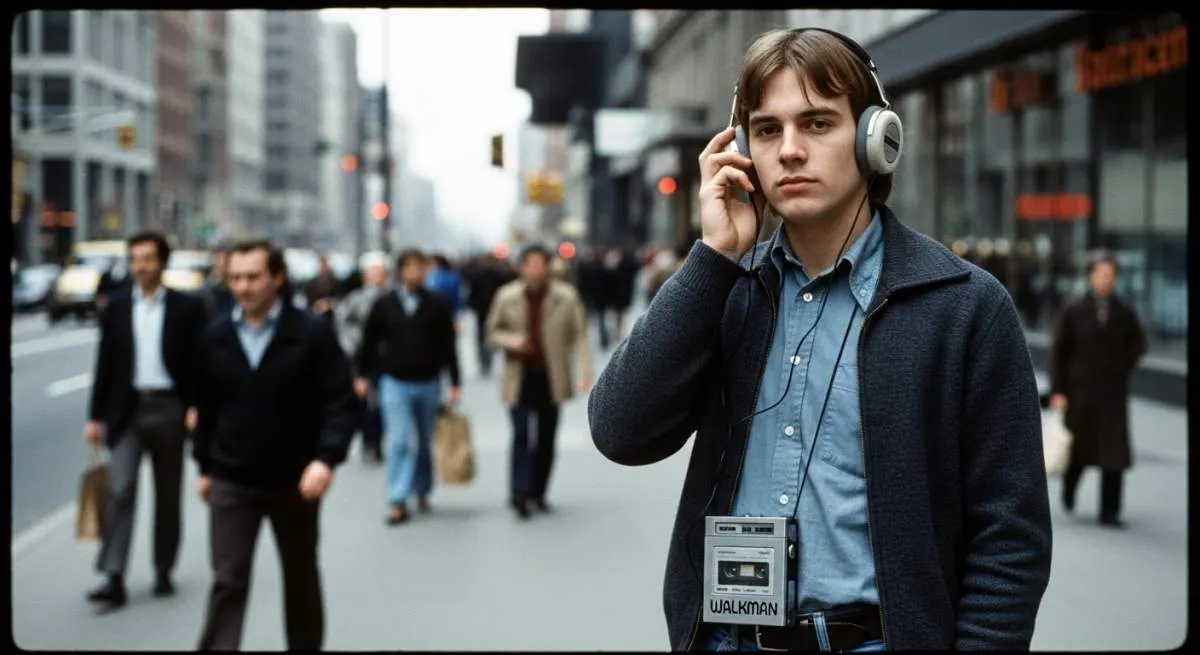
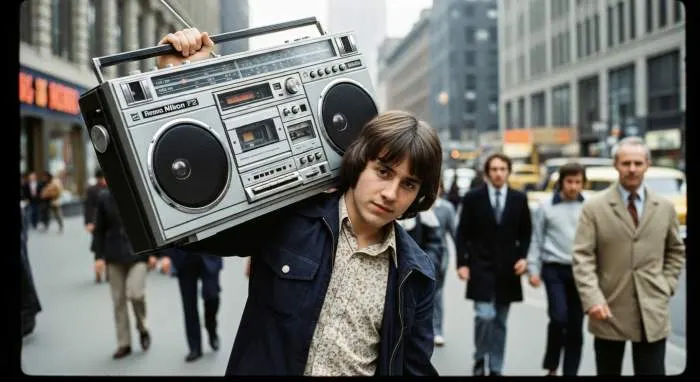
Let's rewind to a time before private soundtracks. In the late 1970s, music was fundamentally a shared affair. You listened to the radio with the family in the kitchen, or you endured whatever the local DJ decided to play in the car. If you wanted to take your tunes on the go, your only real option was the massive, imposing boombox.
The Birth of a Personal Revolution
On July 1, 1979, Sony launched the TPS-L2, and the world got quieter and louder all at once. This was the original Sony Walkman. It wasn't just a new gadget; it was an emancipation proclamation for your ears. Suddenly, you could walk down the street completely lost in your own curated world, your head bobbing to a private beat. The future had arrived, and it was powered by two AA batteries.
Morita was initially skeptical. Why make a tape player that couldn't record? But the experience of private, high-quality stereo sound won him over. The resulting TPS-L2 was a marvel of miniaturization, clad in cool blue and silver. It was the answer to the question:what was the first model of the Sony Walkman? This little box was the prototype of personal freedom.
The Name That Almost Wasn't
Sony's marketing team wasn't sold on the name 'Walkman.' They thought it sounded clunky, like something from a cartoon. For the American launch, they rebranded it the 'Soundabout.' In the UK, it became the 'Stowaway.' But the Japanese youth who instantly adopted the device loved the original name.
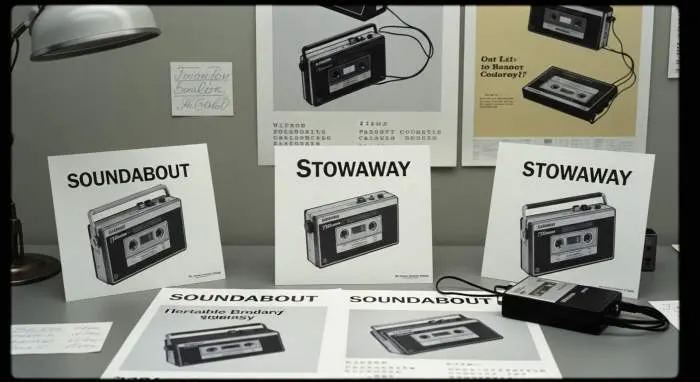
They understood it perfectly: a person who walks while listening. Akio Morita made a brilliant, instinctive call. He saw the organic connection people had with the name and ditched the corporate alternatives worldwide. So,why did Sony call it the Walkman? Because it was simple, descriptive, and it stuck with the people who mattered most.
The Price of a Private World
This new freedom wasn't cheap. If you're wondering what was the original price of the Sony Walkman in 1979, it was about 33,000 Yen, translating to roughly $150 to $200 U.S. dollars. For a cassette player that couldn't even record, this was a significant investment. Initial sales were slow, and Sony panicked after moving only 3,000 units in the first month.
Their solution was marketing genius. Instead of traditional ads, they sent young Sony employees into the streets of Tokyo with Walkmans. They handed them to passersby, letting them experience the crystal-clear stereo sound through the lightweight headphones. People's eyes lit up. Word-of-mouth exploded, and by the end of August, the entire initial stock of 30,000 units was gone. Lines formed overnight. They weren't selling a device; they were selling a revelation.
A Cultural Earthquake in Stereo
The Walkman's impact went far beyond headphones. It fundamentally altered how we interacted with public space and our own daily routines. You could be on a crowded subway yet be utterly alone with Blondie or Bruce Springsteen. This shift had profound, groovy consequences.
Your Life, Now With a Soundtrack
Before the Walkman, boredom meant dealing with ambient noise: traffic, chatter, or silence. Afterward, silence became optional. Every mundane task, waiting in line, walking to school, doing homework, was instantly elevated into a personal cinematic experience. You were the star, and your mix tape was the score.
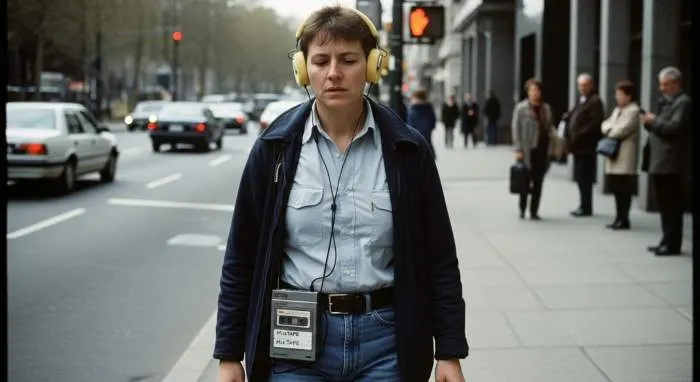
This fueled a massive boom in cassette sales and, more importantly, the high art of the mix tape. Curating a perfect 60- or 90-minute tape for a friend or a crush became a crucial social currency. It was the ultimate expression of "I know what you need to hear."
Fitness Found Its Beat
The late 70s fitness boom found its perfect partner in the Walkman. Jogging and aerobics were taking off, but running in silence was a drag. The Walkman was light, easy to operate, and provided the rhythmic energy to push through an extra mile. How did the Walkman change personal fitness and jogging? It made exercise fun. It transformed the solitary act of running into a private dance party, with the beat dictating your pace.
Sony made a quirky attempt to keep one foot in the communal world. The TPS-L2 famously had two headphone jacks for sharing. But it also had a bizarre feature: the 'Hotline' button. Since the device had no microphone, how could you talk to someone without removing your headphones? Pressing the orange Hotline button activated a small built-in mic and lowered the music volume, letting you hear the outside world. It was a charming, awkward bridge between your inner soundtrack and reality, a bridge most people preferred to keep closed.
The Tech That Made It Possible
The cultural magic was built on clever engineering. The Walkman was one of the first truly successful vintage audio devices that delivered genuine stereo fidelity from a pocket-sized package. This was only possible because of two key innovations: the compact cassette and a new kind of headphone.
The Walkman's timing was perfect. It arrived at the peak of the compact cassette's evolution. Invented by Philips in the 1960s, the cassette format was initially for dictation. In a radical move, Philips licensed it freely, making it a universal standard. By the late 70s, better tape and noise reduction like Dolby had made it a legitimate music format. The Walkman sealed the cassette's victory over the clunky 8-track, empowering the mix tape culture that defined a generation.
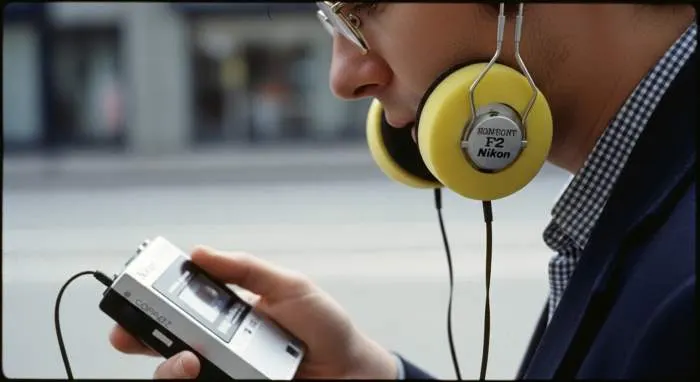
Before the Walkman, headphones were big, heavy studio gear. Sony had to invent new, lightweight, open-air headphones (the MDR-3L2) to complete the portable experience. These iconic foam-covered earpieces set the standard for personal listening for decades. The sound quality was a revelation compared to a tinny transistor radio, letting you hear new details in your favorite songs.
Headphones Get a Makeover
The Walkman was the ultimate accessory of self-expression for youth. It was a shield against parental noise, a private sanctuary, and a way to define your identity through your curated tapes. It gave teenagers unprecedented sonic autonomy. By the time Sony discontinued the cassette Walkman in 2010, over 200 million units had been sold.
The brand didn't die; it evolved. In 1984, Sony introduced the Discman, a portable CD player that brought digital clarity on the go. Later came the MiniDisc, a brilliant but doomed bridge between analog and digital. The true spiritual successor arrived in 2001 from Apple: the iPod. It took the Walkman's core idea, personalized, portable music as a lifestyle, and supercharged it for the digital age. The Walkman paved the road; the iPod drove a faster car down it.
The Walkman's Legacy and Family Tree
Today, the original Walkman is a cherished collectible. The nostalgia is powerful, but it's more than that. The cassette experience offers a ritual that streaming cannot replicate. The satisfying click of the door, the physical whir of the tape, the act of flipping it over, it forces you to slow down and commit to an album. It's tactile and imperfect, wrapped in the warm hiss of analog tape.
The Walkman gave us permission to be selfish with our joy. It gifted us the solitude of our own perfect soundtrack. Now, if you'll excuse me, I need to hunt down some AA batteries. Side B of my favorite tape isn't going to play itself.
Who invented the Walkman?
It was actually a team effort: Sony's Masaru Ibuka dreamed it up, but engineer Kozo Ohsone led the product development team. They had just five months to create it from scratch, working through nights to miniaturize the cassette deck into a portable player that felt like magic.