
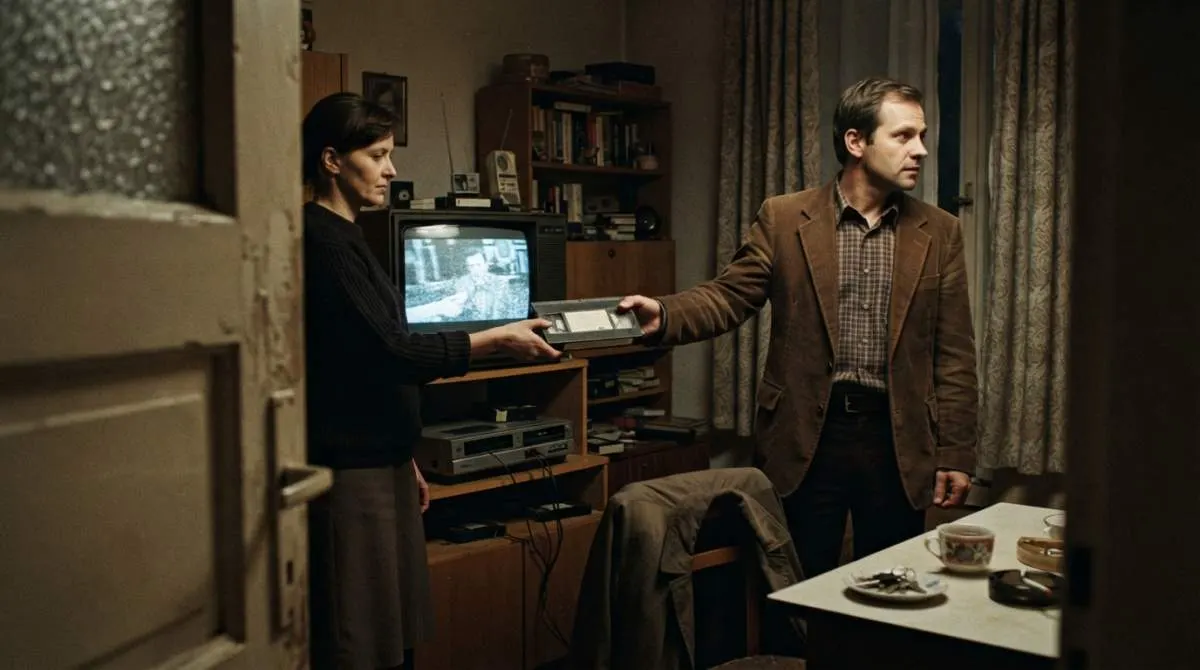
The tape whirred in the VCR, its tracking lines flickering like a nervous pulse. On the screen, a young man from the country arrived in Prague, drawn into a shadow world of whispered deals and foreign currency. This wasn't a Hollywood import smuggled from the West.
This was a homegrown crime drama, a mirror held up to a forbidden side of Czechoslovak life. And the person holding the remote likely paid five hundred crowns for it, cash-in-hand, in a transaction as illicit as the one unfolding on screen.
The film was Bony a klid, a 1987 crime drama directed by Vít Olmer. It starred Jan Potměšil as a naive young man seduced by the world of 'veksláci'-currency black marketeers who traded in Tuzex vouchers, or 'bony.' Its title referred to those vouchers and the 'klid' (peace and quiet) a trader needed to operate.
The regime, after seeing the finished product, deemed its unvarnished portrayal of criminality and the black-market economy unacceptable. They intended to ban it and lock the reels away in a vault, consigning it to oblivion.
The Leak That Started a Shadow Network
But the film had a life of its own before the censors could seal its fate. An unfinished copy, complete with only a temporary soundtrack, leaked from the editing room. According to the director, this raw cut didn't find its way to sympathetic intellectuals or dissident artists.
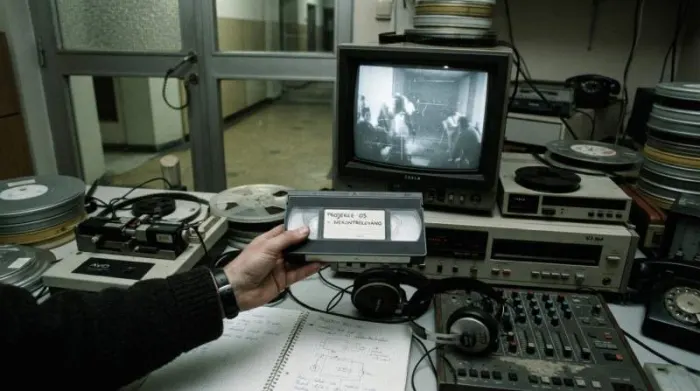
It was obtained by the veksláci themselves-the very subjects of the film.
These black marketeers, experts in circumventing the state's economic controls, saw an immediate opportunity. They became the film's unlikely distributors. Using VHS technology, they mass-produced copies and sold them directly to citizens for 500 Kčs a tape.
This created a pure, grassroots distribution system. The film about the black market was now a product on it, funded and spread by the same underground economy it depicted. The veksláci operated within a specific historical context: the Tuzex voucher system was established in 1957 as a state-run hard currency shop network, creating a parallel economy that, by the 1980s, fueled a vast black market estimated to handle billions of crowns annually.
This shadow economy was a direct response to the chronic shortages and poor quality of consumer goods in the official, centrally planned economy.
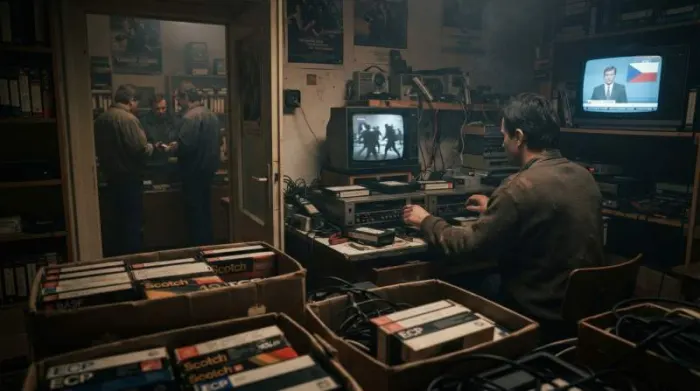
This was the peak of the black video market in Czechoslovakia. With limited access to Western media and strict state controls on culture, a thriving network for pirated tapes filled the void.Bony a klid became its crown jewel-a domestic production too hot for the state to handle, yet too compelling for the public to ignore [1].
The black video market itself was a sophisticated, if illegal, operation. It relied on individuals with access to VCRs and blank tapes, often smuggled from the West or obtained through diplomatic channels. Tapes were duplicated in "video salons"-apartments with multiple VCRs running day and night-and distributed through trusted networks, mimicking the very structures of the bony trade.
This underground cultural economy provided not just entertainment but a crucial window onto global film culture, from Hollywood blockbusters to European art cinema, all completely outside state control.
Mood Match
Four Moments, Four Tracks
Every moment has its own soundtrack, and here is the one I would pick for each.
Waiting for a deal to go through.
Never Gonna Give You Up by Rick Astley.
That relentless cheerfulness is exactly what you need when the phone refuses to ring and you are starting to wonder if you imagined the whole thing.
Walking home with cash in a pocket.
Sweet Child o' Mine by Guns N' Roses.
There is a swagger to that opening riff that matches the feeling of having something folded in your pocket and nowhere urgent to be.
Watching a forbidden tape after midnight.
I Wanna Dance with Somebody by Whitney Houston.
The volume has to stay low, but that joy still comes through, and it makes the whole illicit business feel like a celebration.
Hiding a tape from the authorities.
Livin' on a Prayer by Bon Jovi.
It is a song about holding on when the odds are against you, which is precisely the mood when someone is asking what is in your jacket.
Play them in order, and do not let anyone tell you the order is wrong.
Songs checked against en.wikipedia.org.
When Piracy Forced a Premiere
The circulation created a cultural paradox. The film was officially banned, yet thousands of people had seen it. It was a secret everyone knew.
Friends passed tapes to friends; the film became a topic of hushed conversation and shared experience entirely outside official channels. This underground circulation didn't just defy censorship-it mocked it, proving the state's control was porous. The phenomenon highlighted a key curiosity of late-socialist Czechoslovakia: the widespread existence of semi-legal or illegal practices (šedá ekonomika or "gray economy") that were tacitly tolerated because they fulfilled essential needs the state could not.
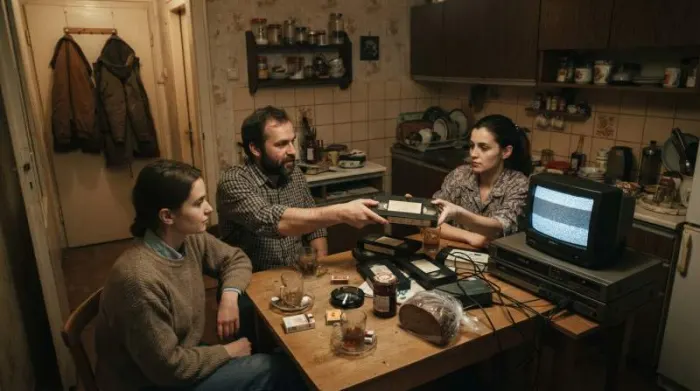
Watching a pirated tape was one such normalized act of minor dissent.
The pressure built from below. The authorities faced a dilemma: continue to ban a film that was already a public sensation, or grant it legitimacy and try to reclaim the narrative. The sheer scale of the piracy created a fact on the ground that the censors could no longer deny.
In a stunning reversal, the widespread, underground circulation of the pirated tapes pressured the regime to finally grant the film official approval. This was not an isolated incident but part of a broader pattern where the regime's cultural authority was eroding. Other films, like the 1984 comedy Slunce, seno, jahody(Sun, Hay, Strawberries), also gained massive popularity through the black video market before their official releases, demonstrating where real public taste lay.
Its journey from vault to cinema was a direct result of this public demand, channeled through illicit VHS copies. The film had its official premiere in July 1988, over a year after its completion.
The theatrical release felt almost like an afterthought-a rubber stamp on a victory the public had already won in their living rooms. The official version that premiered was slightly different from the pirated cut; the director was able to finalize the soundtrack and some edits, but the core narrative remained the same stark portrayal.
Its eventual broadcast on state television in 1990, after the Velvet Revolution, cemented its status as a cultural touchstone of the era's end.
- The banned 1987 film was pirated and sold by the black marketeers it depicted.
- A vast underground video network distributed the illicit VHS tapes to the public.
- Widespread public access via piracy forced the state to approve an official premiere in 1988.
The Echo of a Cultural Rebellion
Today, the film is a period piece, but its story is a potent case study in media resistance. It wasn't distributed via samizdat pamphlets or clandestine radio.
It spread through the consumer technology of the day, weaponized by a criminal underworld for profit, which inadvertently served a public hungry for unfiltered stories. The whole saga speaks to a deep-seated Cold War anxiety about truth and control. The film's cultural meaning extends beyond its plot; it became a symbol of the disconnect between official ideology and lived reality.
For viewers, it validated their own experiences with the bony system and the omnipresent shadow economy, offering a rare moment of recognition on screen.
You can still feel the reverberations of that underground network. The film is now available on legitimate streaming platforms, a clean digital file far removed from the wobbly, multi-generation VHS copies.
But to watch it is to see more than a crime drama. You're seeing the artifact that broke a system, a testament to how movie escapism can sometimes be a profoundly political act. The film's legacy is also preserved in Czech slang; the term "bony" remains in use, and the film is frequently referenced in discussions of the Normalization era's everyday corruption and moral compromises.
It reminds us that before digital leaks and viral trends, there were analog networks just as effective. The desire to see the forbidden story, to share in a collective secret, created a peer-to-peer system that ultimately changed the fate of the art itself.
The veksláci wanted a profit, the public wanted the film, and together, they wrote an ending the director never could. This story prefigures modern debates about piracy, intellectual property, and access to media, but within the unique pressure cooker of a collapsing socialist state. The saga of Bony a klid stands as a specific, powerful example of how popular culture can circumvent authority, creating shared narratives that undermine official control and reflect a society's true preoccupations.
Sources
- [1]Prague, Monoskop
Bracketed numbers in the text (e.g. [1]) refer to the sources listed here.
What was the origin story of the VHS tape that broke Czech censorship?
It all began in a tiny Prague apartment, where a reclusive engineer named Viktor Havelka spent two years perfecting a secret duplication method using salvaged parts from old Soviet electronics. His first successful copy, hidden inside a hollowed-out book, sparked a quiet revolution that spread from hand to hand across the country.